
Quality in remodeling is the blend of durable materials, disciplined methods, and accountable professionals. Whether you live in St Louis, Chesterfield, Ballwin, Clayton, Creve Coeur, Ladue, Olivette, Overland, St Charles, Maryland Heights, Wildwood, Valley Park, Sunset Hills, Webster Groves, Maplewood, or University City, the same fundamentals apply: insist on clear standards before work begins and measure progress against them.
A practical checklist for evaluating craftsmanship standards:
- Scope of work in writing: Require a detailed, line-by-line scope that lists products, model numbers, installation methods, and finish details. Vague scopes invite disputes and change orders.
- Jobsite protection plan: Ask how dust will be contained (zip walls, negative air), how floors and paths will be protected, and where materials and tools will be staged.
- Substrate and prep protocols: Quality shows before finishes go on. Look for specs on framing straightness (plumb/level/square), subfloor thickness and fastening schedule, underlayment type, and wall flatness tolerances—especially for tile and stone.
- Installation tolerances: Discuss expectations for reveals, grout joint widths, tile lippage limits (e.g., ANSI A108 guidance), cabinet alignment, caulk lines, and paint finish level (e.g., Level 4/5 for smooth walls).
- Code compliance and permits: Confirm which permits are required and who obtains them. Expect documented inspections for electrical, plumbing, mechanical, and structural work.
- On-site supervision: Identify the lead who will be on-site daily, their authority to make decisions, and the escalation process for issues.
- Quality control checkpoints: Agree on milestone walk-throughs—after rough-in, after drywall, before tile, before cabinetry, before final punch.
Local insight—historic and urban settings:
- In older homes common to Webster Groves, Maplewood, University City, and parts of Clayton and Ladue, insist on pre-construction assessments for lead paint (EPA RRP compliance), plaster stabilization, and wiring upgrades. Craftsmanship here means preserving original profiles and details (trim, doors, tile patterns) while discreetly upgrading systems to modern standards.
- In St. Louis city and inner-ring suburbs, narrow lots and shared alleys demand disciplined logistics and neighbor-friendly site management. Ask for a communication plan that respects noise, parking, and working hours.
Materials That Last: Top-Tier vs. Budget Options
Materials define longevity and performance. “Budget” is not a dirty word, but choices should be deliberate. The right remodeler will help you align selections with how you live, local conditions, and long-term value.
What “top-tier” typically means:
- Cabinetry: Plywood boxes (not particleboard), hardwood face frames, dovetail drawers, soft-close hardware, factory-cured finishes, and KCMA/TSCA compliance. Budget alternatives may use stapled particleboard boxes and thin veneers that struggle with humidity.
- Countertops: 3 cm quartz or natural stone installed without sub-tops; expert seam placement; proper support at spans. Budget options include laminate or 2 cm stone with more seams and support requirements.
- Flooring: For basements and high-moisture zones, porcelain tile or high-quality LVP with a 20 mil+ wear layer and rigid core. For main levels, engineered hardwood with a thick wear layer outperforms solid hardwood over marginal subfloors. Budget LVP with thin wear layers scratches more easily and telegraphs subfloor imperfections.
- Tile assemblies: Use waterproofing membranes (e.g., sheet or liquid-applied) on shower walls and pans, sloped mortar beds, and appropriate thinsets/grouts. Avoid mastic in wet areas. A well-built shower prevents leaks and mold; a cheap one invites both.
- Plumbing fixtures: Solid-brass or stainless valve bodies and ceramic cartridges from brands with readily available parts. Budget fixtures often rely on plastic internals and proprietary parts that are hard to service.
- Electrical and lighting: ETL/UL-listed fixtures, AFCI/GFCI protection, and sufficient lumens per task area. Avoid off-brand electronics without listings or warranties.
- Windows/doors: Low-E, insulated glazing with credible U-factors and DP ratings; correct flashing and air sealing. Budget units may save upfront but cost through drafts and condensation.
Local insight—basement moisture management:
- The St. Louis region’s clay soils and seasonal humidity create hydrostatic pressure against foundation walls. Before finishing a basement in St Charles, Maryland Heights, Wildwood, Valley Park, or Sunset Hills, confirm: exterior grading and guttering are correct, sump pumps and drain tiles function, and the slab is dry (calcium chloride or RH testing). Favor rigid foam against foundation walls, sealed seams, and an insulated framed wall—avoid fiberglass batts directly against concrete.
- Choose moisture-tolerant finishes: PVC or treated bottom plates, mold-resistant drywall, and non-wood baseboards in vulnerable areas. Plan for dehumidification and, where required, code-compliant egress windows for bedrooms.
How to compare materials side by side:
- Ask for data: spec sheets, warranties, test results (e.g., wear layer thickness, stone absorption rate, tile PEI rating).
- Review mockups: edge profiles, grout colors, lighting samples that match your home’s color temperature.
- Verify sourcing: reputable suppliers with consistent lead times reduce surprises and support warranty claims.
People and Process: Qualifications, Warranties, Estimates, and Timelines
Installer and contractor qualifications:
- Insurance: Request certificates for general liability and workers’ compensation, naming you as certificate holder.
- Licenses and permits: Missouri does not issue a statewide general contractor license, but local jurisdictions do regulate trades and permitting. Verify that electrical and plumbing contractors hold required local licenses and that your remodeler secures all permits in St. Louis City or County, as applicable.
- Safety and environmental: For pre-1978 homes common in older St. Louis neighborhoods, require EPA Lead-Safe (RRP) certification. Ask about silica dust control during concrete/tile work.
- Manufacturer certifications: Look for factory training (e.g., waterproofing systems, countertop fabrication) that keeps warranties intact.
- References and portfolio: Request recent local projects and, if possible, a visit to a current jobsite to observe cleanliness and coordination.
How to interpret warranties:
- Workmanship warranty: A written document (often 1–5 years) covering labor and installation defects. Clarify response times, what constitutes a defect, and who pays for diagnostic work.
- Manufacturer warranty: Coverage for products (e.g., cabinets, flooring, fixtures). Check length, what is excluded (e.g., water intrusion, UV fading), and required maintenance.
- Transferability: Important if you may sell within warranty period.
- Claim process: To avoid finger-pointing, confirm your remodeler will coordinate claims and service.
What a transparent estimate should include:
- Line items with quantities, unit costs, and brand/model specifics.
- Allowances for selections not finalized, with realistic ranges (e.g., “Tile allowance $8/sf material only”).
- Clear exclusions (e.g., structural changes, asbestos/lead abatement) and a written change-order process with pricing rules.
- Payment schedule tied to milestones, not just dates.
- Lead times and procurement plan for long-lead items (cabinets, special-order tile, custom glass).
- Permit fees, dumpster/haul-away, and final clean included or explicitly noted.
What a clear timeline should include:
- Preconstruction: design finalization, selections locked, ordering, permit submission.
- Field milestones: demo, rough-ins, inspections, drywall, tile, cabinetry, tops, finish trades, punch.
- Inspection dates: integrate city/county schedules to avoid delays.
- Communication cadence: weekly updates with photos and a two-week look-ahead.
- Contingency: a realistic buffer for discoveries typical in older homes (hidden plumbing, unlevel floors).
Red flags:
- Unusually low bids with vague scopes, heavy reliance on change orders, or requests for large upfront payments.
- No written warranty, no permits “to save time,” or unwillingness to list specific materials and methods.
Plan Before You Build: Complimentary 3D Design and Better Communication
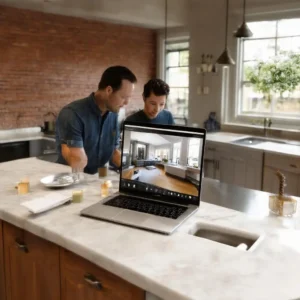
Complimentary 3D design previews are more than a courtesy; they are a risk reducer. When you and your remodeler can “walk through” your future kitchen, bath, basement, or home office before demolition, the result is clarity—and fewer costly mid-project changes.
How 3D planning improves outcomes:
- Visual clarity: See cabinet proportions, sightlines, and traffic patterns. Validate clearances against NKBA guidelines (e.g., appliance door swings, aisle widths, shower sizes).
- Early clash detection: Identify conflicts between structure, HVAC, plumbing, and cabinetry before orders are placed.
- Material coordination: Evaluate countertop veining, tile layout, grout lines, trim profiles, and lighting warmth in one cohesive model.
- Budget discipline: Test design options against allowances in real time—swap a tile or a fixture and understand the cost delta immediately.
- Stakeholder alignment: Share the model with household decision-makers so selections are approved once, not three times.
Best practices for design reviews:
- Come with priorities ranked: storage vs. seating, light vs. closed storage, premium surfaces vs. smart appliances.
- Ask for multiple camera views and a virtual walk-through to check heights, reach ranges, and views under real-world lighting.
- Request 2D plans with dimensions and annotated elevations so builders can execute precisely.
Local insight—preserving historic character:
- In traditional homes across Webster Groves, Maplewood, University City, and certain pockets of Clayton and Ladue, use 3D design to replicate original details: beadboard patterns, inset cabinetry, picture rails, and period-appropriate tile. Blend modern convenience (induction, ventilation, waterproofing) without erasing character.
- In mid-century homes prevalent in Creve Coeur and Olivette, model low-profile lighting, slab-front cabinetry, and warm wood tones to respect original design intent while upgrading performance.
Balance Style, Function, and Budget—with Confidence
A successful remodel balances aesthetics, daily usability, and cost. Define success in writing: what needs to improve, what must endure, and where you will compromise if needed.
A homeowner’s decision framework:
- Non-negotiables: moisture control in basements; safe electrical and plumbing; proper ventilation; durable waterproofing in wet areas.
- Value levers: Invest in “touch points” (hardware, faucets, counters) and foundational systems (subfloor, waterproofing). Save with smart substitutions—matte tiles that mimic stone, semi-custom cabinets with upgraded hardware, LVP that stands in for site-finished wood in basements.
- Phasing strategy: If budget is tight, phase by room or by finish tier, but never compromise on structure, waterproofing, or ventilation.
- Documentation: Keep a project folder with permits, inspection reports, product manuals, finish schedules, and warranty certificates.
Across St Louis, Chesterfield, Ballwin, Clayton, Creve Coeur, Ladue, Olivette, Overland, St Charles, Maryland Heights, Wildwood, Valley Park, Sunset Hills, Webster Groves, Maplewood, and University City, the hallmarks of a trustworthy remodeling partner are consistent: integrity in estimating, innovation in planning (including complimentary 3D design previews), skilled installation, and a clear warranty. With a rigorous checklist, transparent communication, and materials matched to your home and lifestyle, you can modernize with confidence—preserving what you love and improving what you use every day.