The top bathroom vanity styles for 2026 are warm natural wood fronts, fluted and reeded textures, floating wall-mounted silhouettes, furniture-style pieces, spa-inspired double vanities with layered lighting, integrated tech features, warm and mixed metals, and curved or rounded forms. Here is who each suits best:
- Warm wood fronts (white oak, walnut, warm greige): Best for primary baths, resale-focused renovations, and anyone who wants a look that ages gracefully rather than dating itself in three years.
- Fluted / reeded fronts: Best for adding sculptural depth to a mid-size or large bath without committing to heavy ornament.
- Floating / wall-mounted: Best for small baths where floor continuity makes the room read larger, and for modern or minimalist aesthetics.
- Furniture-style / vintage-inspired: Best for homeowners personalizing a primary bath for the long term, not staging for a quick sale.
- Spa-inspired with layered lighting: Best for shared primary baths and anyone building a daily wellness routine into the space.
- Integrated / invisible tech: Best for tech-forward households and new builds where electrical rough-in can be planned from the start.
- Warm and mixed metals: Best for anyone updating hardware and fixtures without a full gut renovation.
- Curved / rounded forms: Best for softening a bathroom that currently feels cold or boxy.
Table of Contents
- What designers and data say about 2026 vanity trends
- 1. Warm natural wood and wood-tone cabinetry
- 3. Floating vanities open up small bathrooms
- 4. Furniture-style vanities suit long-term personalization
- 5. Spa-inspired vanities center on layered lighting and layout
- 7. Hardware and finishes: warm metals are replacing matte black
- 8. Curved and rounded forms soften the modern bath
- How to choose the right vanity for your 2026 remodel
- What remodelers should know about durability, warranty, and construction standards
- Key Takeaways
- Trends are tools, not mandates
- Expressions Remodeling brings 2026 vanity design to St. Louis homes
- Sources and further reading
What designers and data say about 2026 vanity trends
The shift in bathroom vanity design is not subtle. According to the NKBA’s 2026 Bath Trends Report, 62% of industry experts now prefer wood-faced vanities over painted finishes, which came in at 53%. That gap has widened every year since 2022, and it reflects something bigger than aesthetics: homeowners are moving away from resale-neutral choices and toward bathrooms built around personal rituals. NKBA CEO Bill Darcy put it plainly in the report’s release, noting that 2026 bathroom design is shifting from resale-focused choices to highly personalized, ritual-based designs that support individual self-care routines.
The NKBA research methodology behind these numbers is worth understanding. The survey covers nearly 700 industry designers and rates 18 distinct trends by lifecycle stage (emerging, mainstream, or declining) and by appeal across generations. That structure makes it more useful than a simple popularity poll because it tells you which trends are still climbing and which have already peaked.
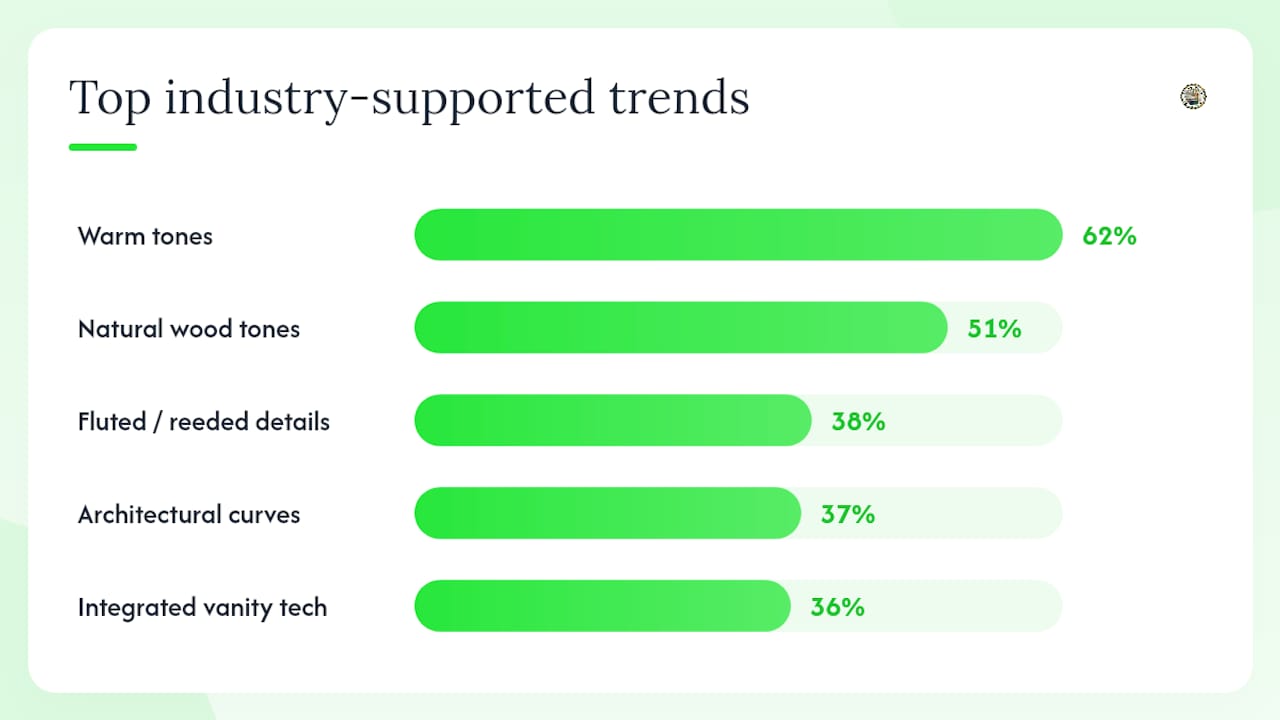
Fixr’s 2026 bathroom design report adds granularity with percentage breakdowns across trend categories. The Cittaneo market analysis frames the commercial side: wood finishes are overtaking white cabinetry across the market, and matte and brushed finishes are outpacing polished ones.
| Trend | Industry support | Stage |
|---|---|---|
| Natural wood tones | 51% of pros | Mainstream |
| Warm tones (greige, terracotta) | 62% | Mainstream |
| Fluted / reeded details | 38% | Rising |
| Architectural curves | 37% | Rising |
| Integrated vanity tech | 36% | Emerging |
| Floating vanities | 26% | Rising |
The underlying driver across all of these is biophilic design and the wellness movement. Bathrooms are no longer utility rooms that happen to have a vanity. For a growing share of homeowners, the morning routine at the mirror is the ritual, and the vanity is the centerpiece.
1. Warm natural wood and wood-tone cabinetry
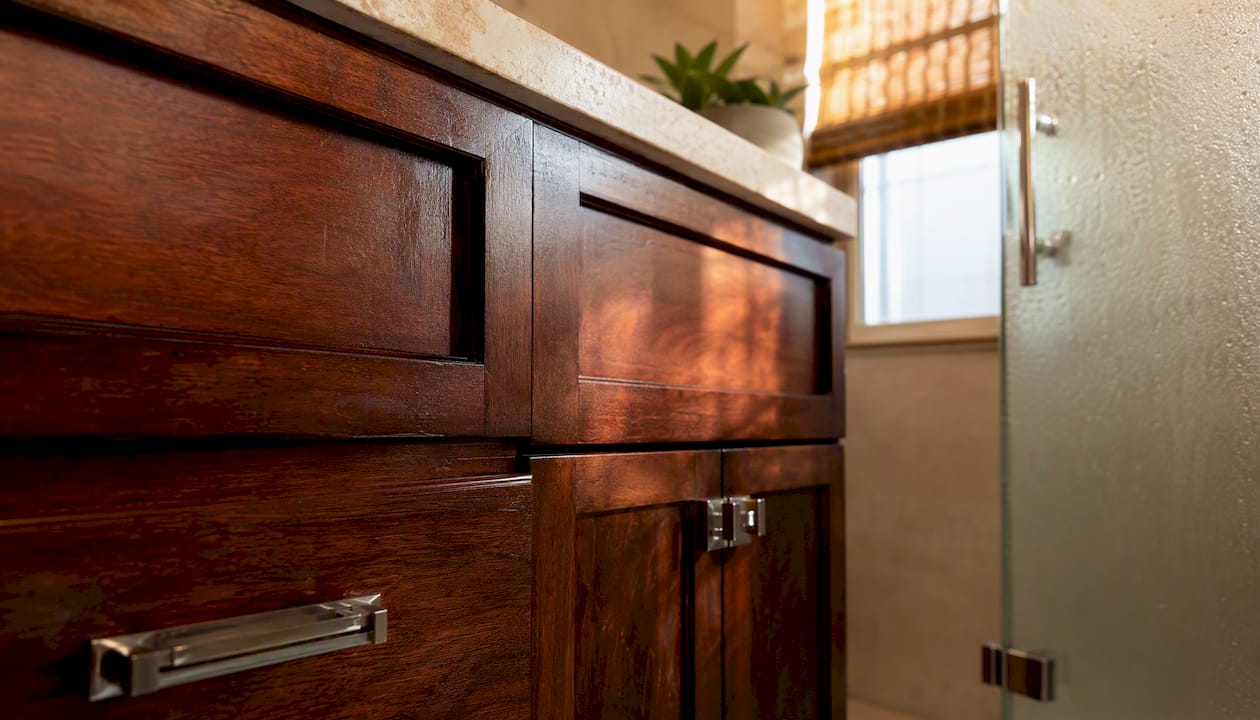
Wood-faced vanities lead the 2026 market for a straightforward reason: they look better over time than painted MDF. White painted cabinets chip, yellow, and show wear at edges. A white oak or walnut front develops a patina. That is not a design opinion; it is a maintenance reality that more homeowners are factoring into their decisions.
Material options and what they mean in practice:
- Solid wood: The most durable and refinishable option. Works best in well-ventilated baths. Prone to minor seasonal movement, so tight-tolerance frameless doors may need adjustment over time.
- Plywood with wood veneer: Dimensionally stable, moisture-resistant when properly sealed, and a strong choice for humid primary baths. Most quality semi-custom lines use this construction.
- MDF with wood-look veneer or thermofoil: Lower cost, but swells and delaminates when exposed to standing water or steam. Acceptable in powder rooms; risky in daily-use showers and baths.
For finish choices, white oak with a matte natural seal pairs cleanly with honed quartz or warm stone countertops. Walnut reads richer and suits brushed brass or champagne bronze hardware. Warm greige wood faces bridge the gap between the cool-gray era and the warmer palette now taking over.
Countertop and hardware pairings that work:
- White oak base + honed Calacatta quartz + brushed nickel or unlacquered brass
- Walnut base + leathered quartzite + champagne bronze
- Warm greige wood face + warm white quartz + matte black (if you want contrast) or polished nickel
Maintenance is simpler than most homeowners expect. A quality polyurethane or hardwax oil finish on solid wood needs a wipe-down with a damp cloth and an annual light recoat on high-wear areas. Avoid steam cleaners and standing water near the toe kick.
Pro Tip: When choosing between solid wood and veneered plywood, check the humidity level in your specific bathroom first. A bath with a separate shower enclosure and good exhaust ventilation can handle solid wood. A bath where the vanity sits directly in the steam path of an open shower is better served by moisture-rated plywood with a sealed veneer.
3. Floating vanities open up small bathrooms
Floating, or wall-mounted, vanities have been gaining ground steadily. Industry data shows 15–20% year-over-year growth in this category, driven by their ability to make a small bathroom feel larger by exposing the floor plane. The visual effect is real: an unbroken floor surface reads as more square footage than a floor interrupted by a vanity base.
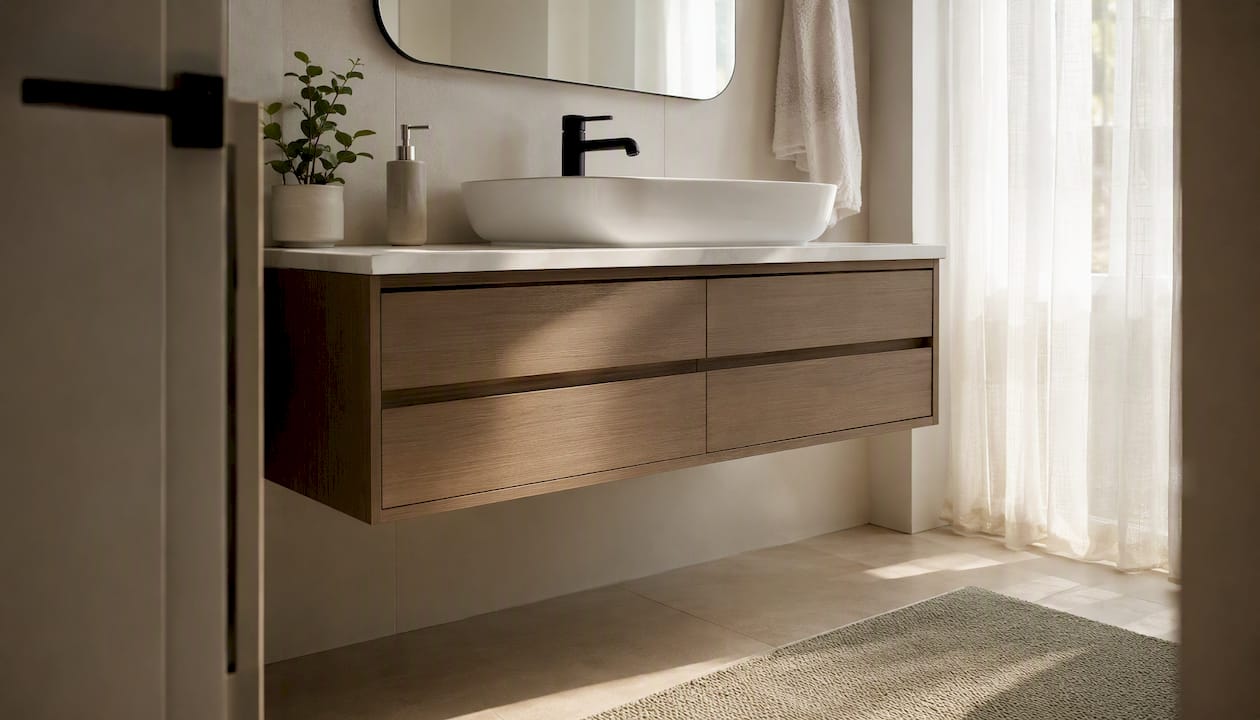
The appeal is not only spatial. Floating vanities clean up the silhouette of a modern bath, eliminate the toe-kick shadow line that can make a room feel dated, and make floor cleaning easier. For small-space planning, space-saving fittings and floating configurations are among the most effective tools available.
Installation checklist before you commit:
- Structural anchoring: Floating vanities require direct anchoring into studs or dedicated blocking behind the wall. Drywall anchors alone will not carry the load, especially for solid wood units.
- Clearance: Allow 1–2 inches of clearance on each side for scribe trim and a clean caulk joint against the wall.
Pro Tip: The gap between the bottom of a floating vanity and the floor is a design decision, not just a structural one. A lower hang (12–14 inches off the floor) reads more grounded and furniture-like. A higher hang (16–18 inches) maximizes the open-floor visual effect. Coordinate the height with your mirror and lighting placement before finalizing.
4. Furniture-style vanities suit long-term personalization
Furniture-style vanities look like they were pulled from a well-appointed bedroom rather than specified from a cabinet catalog. Legs, visible silhouettes, antique or unlacquered brass hardware, and carved or fluted details are the visual cues. The construction is different from built-in casework, and that difference matters for longevity.
A true furniture-style vanity uses furniture-grade joinery: mortise-and-tenon or dovetail drawer boxes, solid wood face frames, and legs that are structural rather than decorative. Built-in casework, by contrast, is typically a box with applied trim. The furniture approach means the piece can be moved, refinished, or repurposed, which is part of its appeal for homeowners who want a bathroom that feels collected rather than installed.
Styling notes for the furniture look:
- Pair with an unlacquered or antiqued mirror rather than a frameless rectangle.
- Use sconce lighting on either side of the mirror rather than a bar light above it.
- Choose a vessel or undermount sink with a simple profile; an ornate sink competes with the vanity’s own detail.
- Warm stone or honed marble countertops reinforce the organic, non-manufactured feel.
Moisture resistance is the critical construction check. Furniture-style pieces often use solid wood legs that sit on or near the floor. Confirm that the legs are sealed on all faces, including the bottom, and that the finish is rated for bathroom humidity. Unsealed end grain on legs is the most common failure point.
Pro Tip: Semi-custom furniture-style vanities often come in standard widths but allow you to specify the sink cutout location and plumbing knockout position. Confirm these dimensions against your existing rough-in before ordering. Moving a drain even four inches can add $300–$500 to the plumbing cost.
5. Spa-inspired vanities center on layered lighting and layout
A spa-inspired vanity is not a single style so much as a set of decisions that work together: warm wood or stone materials, soft curves, layered lighting, and a layout that supports a real morning and evening routine. Houzz research on homeowner preferences consistently shows that lighting and mirror quality rank among the top priorities for bathroom satisfaction, ahead of tile and fixture choices.
The lighting framework that actually works in a spa-inspired bath has three layers:
- Task lighting: Sconces at eye level on either side of the mirror, or a lighted mirror with high CRI (90+) LEDs. Color temperature of 2700K–3000K gives the most flattering, warm light for grooming.
- Ambient lighting: A ceiling fixture or recessed lights on a dimmer, separate from the task circuit, so you can lower the room light while keeping the mirror bright.
- Accent lighting: Under-vanity LED strips or toe-kick lighting that create a warm glow at floor level. This detail does more for the spa feel than almost anything else at its price point.
Double vanity planning for shared primary baths:
- Standard double vanity widths run 60–72 inches. Confirm you have at least 30 inches of clear floor space in front of each sink.
- Two separate drain lines are cleaner than a shared trap; budget for the additional plumbing rough-in.
- Mirror placement matters: two separate mirrors or a single wide mirror with a center dividing element both work, but a single frameless rectangle often reads as an afterthought in a furniture-forward bath.
For a spa-level bathroom experience, the vanity lighting plan is as important as the fixture selection itself.
Pro Tip: Anti-fog mirrors with integrated dimmable LED lighting solve two problems at once. Look for models with a separate dimmer for the ambient LED strip and the task light so you can set a low-light morning routine without fogging the mirror during a hot shower.
7. Hardware and finishes: warm metals are replacing matte black
Matte black hardware had a long run. In 2026, warm metals are clearly taking over. Brushed brass, champagne bronze, and polished nickel are the finishes showing up most consistently in new installations, and the Cittaneo market analysis confirms that matte and brushed finishes are outpacing polished ones across the category. For modern bathroom accessories in 2026, warm metal tones are the dominant direction.
Mixing metals without a disjointed result:
The rule that you must match every metal in a bathroom is outdated. The current approach is to choose one dominant finish (usually the faucet and drain) and one accent finish (towel bars, cabinet pulls, mirror frame). Two metals work; three is where it gets complicated. Keep the undertone consistent: warm metals (brass, bronze, gold) mix well together; cool metals (chrome, nickel, stainless) mix well together. Crossing the warm/cool line requires intention and usually a strong design rationale.
Countertop pairings for 2026:
- Warm wood base + honed white quartz with warm veining + brushed brass: the most requested combination in current primary bath remodels.
- Painted base (sage, warm white, navy) + marble-look quartz + polished nickel: cleaner and more transitional.
- Two-tone approach: a wood lower cabinet with a painted upper section or a contrasting island in a large bath. This works best when the two tones share an undertone (both warm or both cool).
Pro Tip: Order a sample of your chosen hardware finish and hold it against your faucet, towel bar, and mirror frame before committing. Photography and screen rendering both distort metal tones. A champagne bronze pull can look nearly identical to brushed brass on a screen and noticeably different in person under bathroom lighting.
8. Curved and rounded forms soften the modern bath
Straight lines and 90-degree corners defined bathroom design for most of the 2010s. The correction is well underway. Fixr’s data shows 37% of design professionals identifying architectural curves as a top trend, and the shift shows up in vanity silhouettes, mirror shapes, and countertop edge profiles.
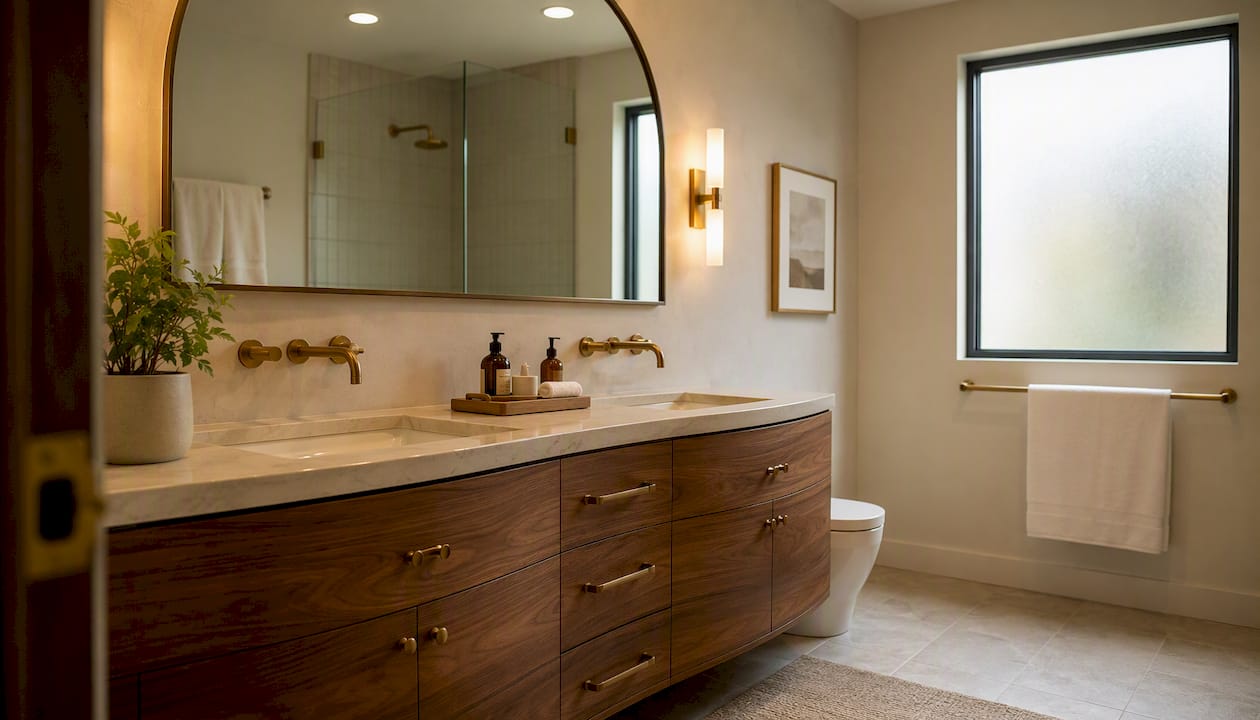
Curved vanities work particularly well in bathrooms that feel cold or clinical. A rounded front corner on a 48-inch vanity softens the entire room without requiring any other changes. Oval and arched mirrors amplify the effect. The combination of a curved vanity base, a warm wood finish, and an arched mirror is one of the most cohesive looks in current residential bath design.
For smaller bathrooms, a curved front edge also has a practical benefit: it reduces the sharp-corner injury risk in a tight space, which matters in family baths. The trade-off is that curved fronts are harder to source in stock sizes and typically require semi-custom or custom fabrication, which adds cost and lead time.
How to choose the right vanity for your 2026 remodel
Getting the style right matters less than getting the fit right. A beautiful vanity that is two inches too wide for your rough-in, or one that requires plumbing relocation you did not budget for, is a problem no amount of good design solves.
Clearance and sizing reference
| Dimension | Recommended minimum | Notes |
|---|---|---|
| Side clearance (each side) | 1–2 inches | For scribe trim and caulk joint |
| Front clearance (to toilet or wall) | 15–18 inches | 15" minimum; 18" preferred |
| Vanity height (standard) | — | 36" is the current “comfort height” preference |
| Double vanity width | 60–72 inches | Allows 30" per person at the sink |
| Floating vanity height off floor | 12–18 inches | Lower = furniture feel; higher = open-floor effect |
Materials and construction checklist
- Specify moisture-rated substrates (plywood or solid wood) for any vanity in a bath with an open shower or high steam exposure.
- Confirm soft-close drawer slides and hinges; these are standard on quality builds and a red flag when absent.
- Check finish durability: a catalyzed lacquer or hardwax oil finish will outlast a standard water-based paint on wood fronts.
- Ask for the drawer box construction: dovetail or dowel-and-glue solid wood is the quality benchmark; stapled particleboard is not.
Cost and timeline guidance
A straightforward vanity swap (same footprint, no plumbing relocation) typically runs $1,500–$4,000 installed for a stock or semi-custom unit, including demo, basic plumbing reconnection, and installation labor. A midrange semi-custom vanity with a stone top and upgraded hardware lands in the $4,000–$8,000 range. High-end furniture-style or fully custom builds with integrated tech and stone countertops can reach $10,000–$20,000+ depending on material selection and electrical work.
Lead times matter: stock vanities ship in 1–2 weeks; semi-custom runs 4–8 weeks; fully custom can take 10–16 weeks. Add 1–2 weeks for plumbing and electrical rough-in if relocation is involved.
Questions to ask your contractor before signing:
- Will you install blocking for a floating vanity before the tile goes up?
- Is plumbing relocation included in the bid, or is it a separate allowance?
- What is the warranty on finish, hardware, and any electrical integrations?
- How do you handle wall irregularities and out-of-plumb conditions?
Red flags: a bid with no line item for demo and disposal, no mention of permit requirements for electrical work, or a price that is 40%+ below other bids without a clear explanation.
Pro Tip: For a high-impact bathroom upgrade that also adds resale value, a vanity replacement with a new countertop and updated lighting is one of the best dollar-for-dollar investments in a primary bath. It changes the entire feel of the room for a fraction of a full gut renovation.
What remodelers should know about durability, warranty, and construction standards
The NKBA’s research methodology surveys nearly 700 industry professionals and rates trends by lifecycle, which means its findings reflect what experienced designers are actually specifying, not just what looks good in a photo. That distinction matters when you are making a $5,000–$15,000 purchase decision.
Construction best practices that separate quality from cost-cutting:
- Wood-faced cabinets outperform painted MDF in humid environments because the substrate and finish system are more moisture-tolerant. Specify plywood or solid wood for any vanity in a bath with daily shower use.
- Moisture-rated finishes (catalyzed lacquer, conversion varnish, or hardwax oil) are not optional in a bathroom; they are the difference between a vanity that looks good at year one and one that still looks good at year ten.
- Drawer hardware should be rated for at least 75 lbs. per pair and carry a lifetime mechanical warranty from the manufacturer. Blum and Häfele are the industry benchmarks.
Warranty terms to request in your contract:
- Finish warranty: minimum 1 year on painted surfaces, 2 years on wood finishes.
- Hardware warranty: lifetime on hinges and drawer slides.
- Electrical integrations: ask for the manufacturer’s warranty on any built-in LED or charging component, and confirm the contractor’s labor warranty for the installation.
Pro Tip: Request a written specification sheet for every cabinet component before signing a contract. A reputable contractor can tell you the substrate, finish system, drawer slide brand, and hinge brand for every piece they propose. If they cannot, that is a signal about the quality of the build.
Key Takeaways
The single most important decision in a 2026 vanity remodel is material selection: moisture-rated construction with a quality finish system determines whether your investment looks good in ten years, not just ten days.
| Point | Details |
|---|---|
| Wood fronts lead the market | 62% of industry experts prefer wood-faced vanities; specify moisture-rated plywood or solid wood for daily-use baths. |
| Measure before you order | Allow 1–2 inches of clearance on each side and confirm plumbing rough-in alignment before purchasing any vanity. |
| Plan tech in the rough-in phase | USB-C drawers, anti-fog mirrors, and refrigerated units all require dedicated circuits; retrofit electrical is the most expensive surprise in a vanity project. |
| Warm metals are the 2026 finish | Brushed brass, champagne bronze, and polished nickel are replacing matte black; mix two finishes maximum and keep undertones consistent. |
| Expressions Remodeling | Handles measurement, moisture-rated construction, electrical coordination, and 3D design for St. Louis homeowners planning a 2026 vanity remodel. |
Trends are tools, not mandates
The conversation around 2026 bathroom design tends to flatten into a checklist: add fluting, use warm wood, float the vanity, done. What gets lost is the question of whether those choices actually serve the person using the bathroom every day.
Fluted fronts are genuinely beautiful, but they also trap moisture and are harder to refinish than flat doors. Floating vanities open up a small bath visually, but they require structural blocking that most homeowners do not think about until the tile is already on the wall. Integrated tech features look compelling in a showroom and become a liability when the charging drawer’s USB board fails and the custom cabinet has to be partially disassembled to replace it.
The trends worth following in 2026 are the ones that align with how a specific bathroom is used. A warm white oak vanity in a well-ventilated primary bath with good exhaust is a sound, long-lasting choice. The same vanity in a steam-heavy bath with inadequate ventilation is a warranty claim waiting to happen. Material honesty, as designers call it, is not about choosing the most expensive option. It is about choosing the right substrate for the actual conditions of the space.
The clients who end up happiest with their vanity remodels are the ones who spent as much time on the measurement checklist and the construction spec as they did on the finish samples. The style is what you see. The construction is what you live with.
Expressions Remodeling brings 2026 vanity design to St. Louis homes
Getting a 2026 vanity right from the first measurement to the final hardware installation requires more coordination than most homeowners expect: structural blocking, plumbing rough-in alignment, electrical planning for tech features, moisture-rated material selection, and finish choices that hold up in a real bathroom rather than just a showroom. Expressions Remodeling handles all of it for St. Louis homeowners, with complimentary 3D design visualization so you can see your vanity in context before a single cabinet is ordered.
The team works across St. Louis and surrounding communities, managing everything from demo and blocking to plumbing coordination and post-install support. Every project includes a written specification for materials and hardware, so you know exactly what is going into your bathroom. If you are planning a high-impact bathroom upgrade for 2026, contact Expressions Remodeling to schedule a consultation and get a 3D plan for your space.
Sources and further reading
- NKBA | KBIS Releases Annual 2026 Bath Trends Report — NKBA
- Bathroom Design Trends Report 2026 | Fixr
- Top 10 Bathroom Vanity Trends 2026: What’s In & Out
- BATHROOM VANITIES MARKET SURGES TO $85.6 BILLION AS WELLNESS DESIGN DRIVES PREMIUM RENOVATIONS — CITTANEO
- These are the bathroom styles and features homeowners want now | Houzz
- Small bathroom vanity buying guide – AshDeco
Recommended
- Top Bathroom Remodeling Trends for 2024: Sustainable Luxury and Smart Solutions – Expressions Remodeling
- Smart Bathroom Remodeling Ideas for Clayton Homeowners: Style, Function, and Long-Term Value – Expressions Remodeling
- Transform Your Bathroom into a Spa-Like Sanctuary: A Guide to Serenity and Style – Expressions Remodeling
- Bathroom Remodeling Ideas for Clayton Homeowners: Comfort, Style, and Lasting Value – Expressions Remodeling