Quality craftsmanship means the hidden work, structure, systems, and substrate prep, was done right, and the finishes were installed with the same care. Homeowner success looks like durable, code-compliant results backed by documentation and a written warranty, not just a paint job that looks good on move-in day. Industry benchmarks like the NAHB Residential Construction Performance Guidelines exist precisely because finishes lie, and contractors who work to that standard, the way Expressions Remodeling does across St. Louis renovations, leave a paper trail to prove it.
TL;DR:
- Visible finish details like flush baseboards, consistent grout lines, and properly aligned reveal gaps indicate craftsmanship but do not guarantee long-term durability.
- Underlying issues such as substrate leveling, waterproofing, and structural framing quality are invisible but critical to prevent future failures and costly repairs.
- Contractors who document permit records, rough-in photos, and provide detailed warranties demonstrate a higher standard of craftsmanship, reducing risks of hidden problems.
- Spending on high-end finishes is less impactful than prioritizing substrate preparation, materials, and installation methods that ensure longevity and resistance to moisture and movement.
- Verifying a contractor’s process through documentation and licensing is more reliable than relying on confidence or appearance alone for a durable, code-compliant renovation.
Table of Contents
- Signs of Quality Craftsmanship You Can Actually See
- The Hidden Workmanship That Actually Determines Longevity
- How to Evaluate a Contractor Before You Sign Anything
- Materials and Methods That Actually Extend a Renovation’s Life
- Where the Idea of Quality Craftsmanship Came From
- Why Quality Craftsmanship Protects Your Home’s Value
- Quality Craftsmanship vs. Standard Workmanship: What’s Actually Different
- Skilled Labor Training and Certification Behind the Work
- How Expressions Remodeling Builds Craftsmanship Into Every Project
- Where to Verify These Standards Yourself
- Renovation Standards Are a Choice, Not an Accident
- Sources
- FAQ
Signs of Quality Craftsmanship You Can Actually See
Most homeowners judge a renovation by what’s in front of them, and that’s not wrong, it’s just incomplete. Visible finish quality is necessary but not sufficient. Combining a visual scan with a few hands-on tests catches problems that a glance never will, according to inspection guidance on assessing construction quality.
Start with trim and transitions. Baseboards should sit flush against the wall with no visible gaps at outside corners, and grout lines in tile should run at a consistent width from one end of a wall to the other. A wandering grout line usually means someone rushed the layout.
Here’s what to check during any walkthrough:
- Doors and drawers: open and close every one. Doors should swing freely without dragging, and drawers should glide without wobble or binding.
- Reveal gaps: the space between a cabinet door and its frame should be even top to bottom, not wider at one corner.
- Paint and finish: look for consistent sheen, no roller marks, and clean cut lines where wall paint meets trim.
- Flooring: tap or lightly drag a coin across tile. A hollow, drum-like sound usually signals a void under the tile where adhesive didn’t make full contact.
- Electrical: confirm GFCI outlets are installed near water sources, outlet covers sit flush, and the panel has labeled circuits.
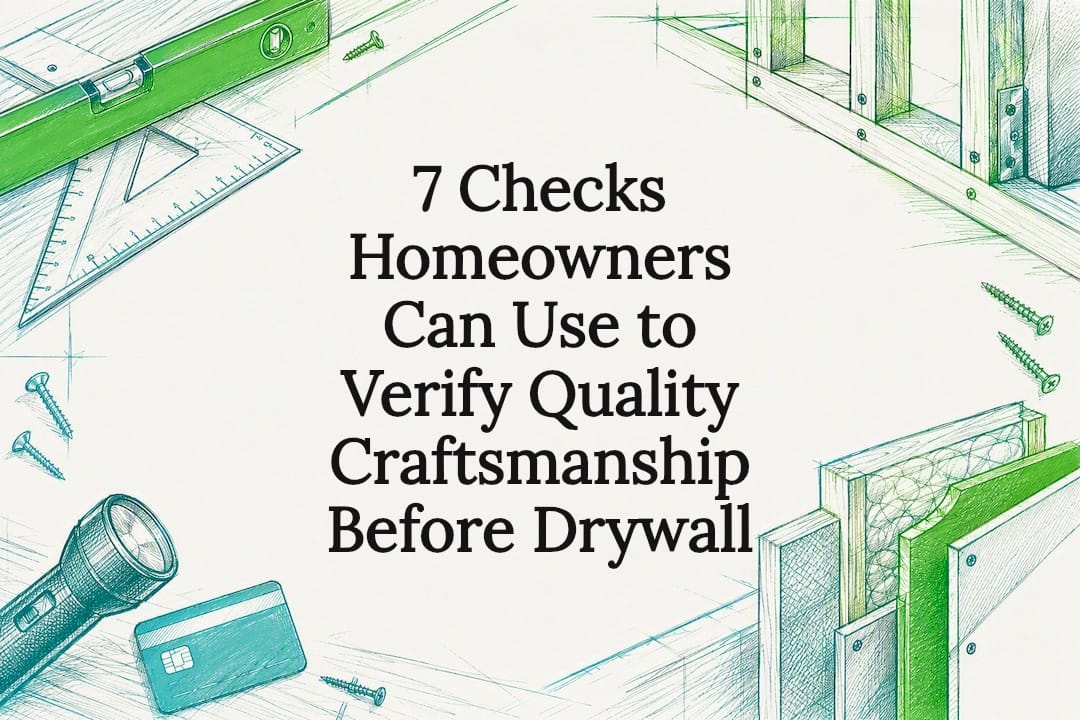
Two DIY tests catch what a casual glance misses. Slide a credit card into the gap where baseboard meets floor, if it slips in more than a sliver, the trim wasn’t scribed to the floor properly. And for drywall, shine a flashlight sideways across the surface at a low angle; side-lighting throws shadows across any bump, ridge, or sanding mark that flat overhead light hides completely, a trick pulled from the same construction quality assessment methods inspectors rely on.
Pro Tip: Bring a flashlight and a credit card to every walkthrough. Between the two, you’ll catch more finish problems than most general contractors flag on their own punch lists.
The Hidden Workmanship That Actually Determines Longevity
Finish quality is often misleading. Long-term failures almost always trace back to something nobody could see on move-in day, poor substrate preparation, inadequate waterproofing, or a fastener driven into the wrong spot. Craftsmanship starts behind the walls, with level framing, properly routed mechanical systems, and structural connections that were never meant to be seen again once drywall goes up.
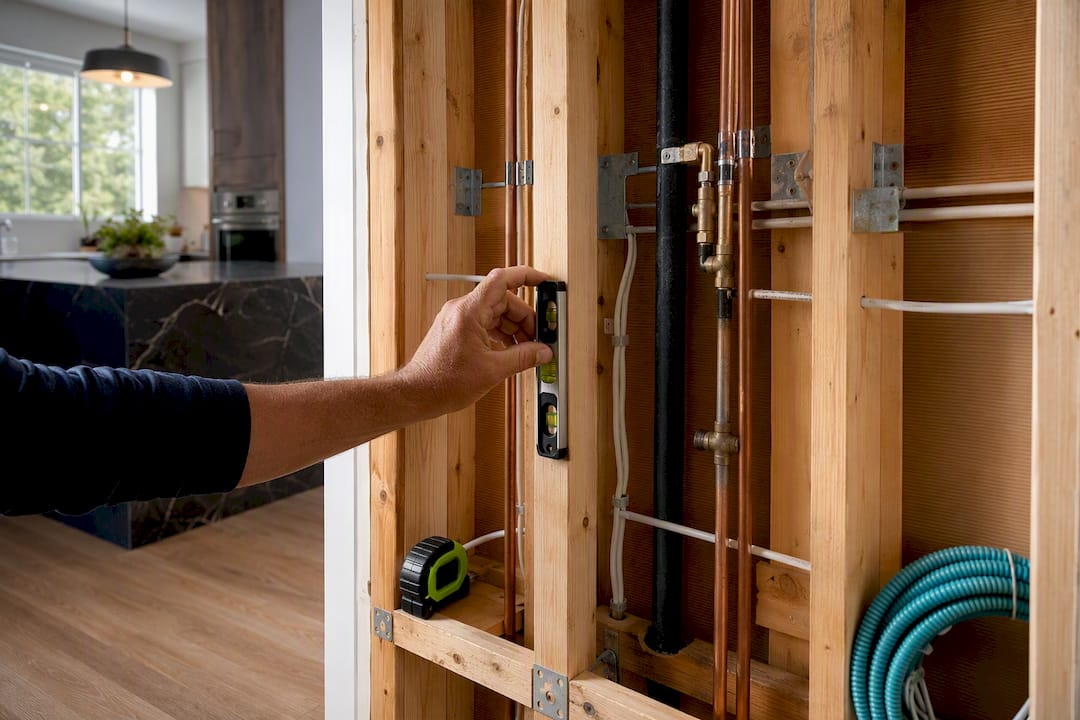
Substrate prep is the clearest example. Tile installed over a substrate that wasn’t leveled or waterproofed correctly might look flawless for a year, then crack or let moisture into the subfloor. Framing tells a similar story: joists that were notched too deep for a plumbing run, or studs that are out of plumb, create problems that show up as cracked drywall or sticking doors months later.
A few things worth checking or asking about before drywall closes everything in:
- Ask whether plumbing and electrical routing avoided over-notching structural members.
- Look for insulation installed without gaps or compression, since compressed insulation loses much of its R-value and creates thermal bridging at the studs.
- Request dated rough-in photos before walls close, this is standard practice among contractors who document permit and inspection steps properly.
- Confirm a third-party or municipal inspector signed off on rough plumbing and electrical, not just the contractor’s own crew.
If a contractor can’t produce rough-in photos or permit records when asked, that’s not a paperwork gap. It’s a sign nobody was checking the work while it still could have been fixed cheaply.
How to Evaluate a Contractor Before You Sign Anything
- Verify license and insurance. Ask for the license number and call to confirm it’s active, then request a certificate of insurance naming you or your project.
- Confirm who pulls the permit. A contractor who avoids permits, or suggests skipping them to save money, is telling you they don’t want inspections catching their mistakes.
- Get an itemized bid. Vague lump-sum quotes hide corner-cutting. Getting at least three itemized bids lets you compare labor and material line by line.
- Check the payment schedule. Payments tied to project milestones, not a large upfront deposit, protect you if work stalls or quality slips.
- Ask for references from similar projects, then actually call them and ask what went wrong, because something always does.
- Watch how they discuss unknowns. A contractor who names risks like hidden water damage or outdated wiring, rather than promising a smooth project, is thinking like a craftsperson rather than reciting a script, a distinction NAHB’s own guidance on high-performance builds highlights repeatedly.
- Get the warranty in writing. Written warranties tied to documented performance standards give you leverage if something fails after closeout.
Red flags worth walking away from: cash-only payment demands, evasiveness about permits, no references, or a refusal to put a warranty in writing. Our guide to contractor interview questions walks through the exact questions to ask before you sign.
At final walkthrough, insist on a documented punch list, a written record of every unfinished or defective item with a completion date attached. Photographing rough-in stages and tying a punch list to contract closeout protects you if disputes surface after the crew has already left.
Pro Tip: Never make your final payment until every item on the punch list is checked off and photographed. A contractor confident in their work won’t push back on this.
Materials and Methods That Actually Extend a Renovation’s Life
Spending more on premium tile or high-end cabinet fronts feels like the obvious way to buy quality. It’s usually the wrong place to spend first. Substrate, waterproofing membranes, and installation method determine whether a beautiful finish lasts five years or twenty-five. Our piece on the long-term value of quality craftsmanship covers this trade-off in more depth.
A few things worth prioritizing before you ever pick a finish color:
- Full-bed mortar coverage under tile, rather than dots or ridges of adhesive, so the tile doesn’t flex and crack under foot traffic.
- Manufacturer-specified fastening patterns for flooring and siding, since deviating from them often voids the product warranty entirely.
- A proper waterproofing membrane behind any tile in a wet area, not just a moisture-resistant backer board.
- Asking suppliers directly whether an installation method matches the manufacturer’s written instructions, because a contractor’s habit isn’t the same as a manufacturer’s requirement.
Interior doors are a good visible proxy for this whole idea: a comparison of door price versus quality shows that core construction and hinge hardware matter more to longevity than the veneer you see. The same logic applies to exterior systems; regular metal roof inspection and maintenance catches fastener and seam issues long before a leak reaches the drywall.
The NAHB Residential Construction Performance Guidelines set performance tolerances that go beyond minimum building code, and contractors who build to that standard, rather than to code minimums alone, spend more time on substrate and less on marketing photos. That trade-off costs more upfront and saves you a full renovation later.
Where the Idea of Quality Craftsmanship Came From
Craftsmanship as a formal concept predates modern construction by centuries. Medieval guild systems required tradespeople to complete apprenticeships lasting years before earning the title of master craftsman, a structure built on the idea that skill takes time and supervision to develop properly. That guild model shaped how trades like carpentry, masonry, and metalwork trained workers well into the industrial era.
Mass production in the twentieth century changed the incentive structure. Speed and cost became the dominant metrics, and a lot of construction shifted toward assembly-line thinking, standardized parts, minimal customization, and labor optimized for throughput rather than precision. That shift didn’t eliminate craftsmanship, but it did make it optional rather than default.
What’s changed more recently is documentation. Homeowners today can request rough-in photos, permit records, and written warranties in ways that simply weren’t standard practice a generation ago. The tools of craftsmanship, sharp tools, patient hands, attention to alignment, haven’t changed much. What’s changed is the ability to verify that craftsmanship actually happened, rather than taking a contractor’s word for it. That shift toward documentation is arguably the biggest quality upgrade the renovation industry has seen in decades.
Why Quality Craftsmanship Protects Your Home’s Value
A renovation’s resale value depends on more than square footage or a trendy kitchen backsplash. Appraisers and buyers’ inspectors both look past finishes when they can, checking for water stains, uneven floors, or doors that don’t close square, all symptoms of workmanship that cut corners somewhere behind the wall.
Durability compounds this effect over time. A bathroom with a properly waterproofed shower pan and full-bed tile can outlast the mortgage on the house. One built with shortcuts, thin-set applied inconsistently, no membrane behind the tile, tends to need a second remodel within a decade, sometimes sooner if moisture gets into the subfloor. That second remodel costs more than doing it right the first time, and it usually means tearing out finishes that looked perfectly fine until the substrate underneath failed.
Real estate agents in competitive markets know this instinctively. A home with documented permits, warranty paperwork, and evidence of quality workmanship sells with less friction during inspection negotiations, because the buyer’s inspector finds fewer surprises. Homes with a history of DIY shortcuts or unpermitted work tend to trigger repair requests or price reductions once an inspector starts poking around. The renovation that costs more upfront because it was done with care is frequently the one that protects, rather than erodes, your equity.
Quality Craftsmanship vs. Standard Workmanship: What’s Actually Different
Standard workmanship meets code. Quality craftsmanship exceeds it, on purpose, with margin built in for how a house actually behaves over twenty years rather than how it looks at final inspection. Code is a floor, the minimum a jurisdiction will legally allow, not a target to aim for.
The practical differences show up in details that rarely get photographed. A standard installation might use the minimum number of fasteners code requires; a craftsperson often follows the manufacturer’s full fastening schedule, even where code allows fewer. Standard drywall work might skip a second skim coat because the wall looks fine under normal lighting; quality work accounts for how that wall will look under raking light from a window, which is exactly the side-lighting test mentioned earlier in this guide.
Time is the other variable. Standard workmanship optimizes for finishing the job. Quality craftsmanship optimizes for how the job performs after the crew leaves, which is a different set of decisions entirely, from how tightly a miter joint is cut to whether a shower pan gets a slope test before tile goes down. Neither approach is invisible to a trained inspector, but only one of them holds up when you’re not looking.
Skilled Labor Training and Certification Behind the Work
Craftsmanship doesn’t happen by accident, it comes from training pipelines that take years to complete. Apprenticeship programs in trades like electrical, plumbing, and carpentry typically combine paid on-the-job hours with classroom instruction, often running three to five years before a worker earns journeyman status. That structure exists because trade skill genuinely takes repetition to build, the same joint or connection made correctly hundreds of times before it becomes second nature.

Certifications matter too, though not all of them carry equal weight. A licensed electrician or plumber has passed a state-administered exam tied to code knowledge, which is different from a manufacturer certification that simply confirms someone attended a product training session. Homeowners evaluating a contractor’s crew should ask which trades are performed by licensed subcontractors versus general labor, since framing and finish carpentry often don’t require a state license the way electrical and plumbing work does.
The gap between a licensed, apprenticeship-trained tradesperson and an unlicensed crew member isn’t always visible in the finished product, at least not immediately. It shows up later, in whether a GFCI trips correctly, whether a water line holds pressure for years instead of months, and whether the work would pass inspection if someone looked closely. Training is the mechanism that turns craftsmanship from a personality trait into a repeatable standard.
How Expressions Remodeling Builds Craftsmanship Into Every Project
Some remodeling companies approach kitchen, bathroom, and basement renovations with an emphasis on durable materials and documented process, not just finish selection. Projects typically move through 3D design planning before construction starts, giving homeowners a clear picture of the finished space before a single wall opens up. Behind the scenes, good planning extends to photo documentation of rough-in stages and quality checklists at key milestones, practices recommended to ask any contractor about. Warranty terms and project communication are typically handled directly with clients throughout the process. Homeowners exploring a bathroom, kitchen, or basement project can review current pricing and services or browse the full range of remodeling options to start a conversation.
Where to Verify These Standards Yourself
The NAHB Residential Construction Performance Guidelines set the performance tolerances referenced throughout this guide. For hands-on inspection methods, see the construction quality assessment guide and contractor evaluation checklist. St. Louis homeowners can also review Expressions Remodeling’s bathroom remodeling services for project-specific guidance.
Renovation Standards Are a Choice, Not an Accident
Here’s what most homeowners get backward: they assume quality craftsmanship is something you can spot by walking through a finished space with a good eye. It isn’t. The best-looking renovation I could point to might be hiding a shower pan that was never slope-tested, and the plainest-looking one might have a contractor who photographed every stud before it disappeared behind drywall.
The uncomfortable truth is that verifying craftsmanship requires more effort than most homeowners want to put in during a stressful renovation. It’s easier to trust a friendly contractor and pick tile samples than it is to ask for rough-in photos or read a permit record. But that extra effort, the credit-card test on baseboards, the phone call to confirm a license number, the insistence on a written warranty, is the entire difference between a renovation that holds up and one that needs redoing in five years.
If there’s one habit worth adopting from everything in this guide, it’s this: stop evaluating a contractor by how confident they sound and start evaluating them by what they’re willing to document. Confidence is free. Photographs of a rough-in stage, a written warranty, and a permit record cost the contractor nothing extra either, if the work was actually done right the first time. The ones who hesitate to provide that paperwork are telling you something, whether they mean to or not.
— Kierin
Sources
- NAHB – Deliver high-performance homes (NAHB blog, Sept 2023)
- Assessing Construction Quality: Key Indicators & Methods
- 15 Signs You’ve Found a Great General Contractor – HouzzWire
FAQ
Is a Contractor Claiming “Quality Craftsmanship” Trustworthy?
The phrase alone means nothing, since any contractor can put it on a business card. Verify it through documented behavior instead, licenses, pulled permits, itemized bids, references from similar projects, and a written warranty, rather than taking the marketing claim at face value.
What’s Another Word for High-Quality Craftsmanship?
Common terms include “fine workmanship,” “skilled tradework,” and “master craftsmanship,” all of which point to the same idea: work built with precision and durability beyond the minimum required. In construction specifically, the more useful phrase is “documented workmanship,” since it implies proof rather than just a reputation.
Who Is the Best Home Improvement Company?
There’s no single objectively “best” company, since quality depends on licensing, documentation, and process rather than brand recognition alone. Homeowners get better results evaluating contractors against a specific checklist, permits, references, warranties, and rough-in documentation, than by chasing a general reputation.
What Skills Do Skilled Craftspeople Actually Have?
Skilled tradespeople combine technical training, often through multi-year apprenticeships, with the judgment to identify project unknowns before they become expensive problems. That includes precise measurement and installation skill, but also the communication to explain trade-offs clearly, a trait industry guidance on high-performance building specifically calls out as a marker of real expertise.