


Remodeling contractor interview questions are the single most reliable tool homeowners have to verify qualifications, catch red flags, and confirm project compatibility before signing anything. The industry standard for a thorough contractor interview is 45–60 minutes, covering licensing, insurance, experience, project management, and contract terms. Interviews under 30 minutes routinely miss critical details that surface later as cost overruns or disputes. This guide gives you the exact questions to ask, explains why each one matters, and tells you what answers to watch out for.
What are the best remodeling contractor interview questions to start with?
Licensing and insurance questions belong at the top of every contractor interview. They are not formalities. They determine whether you, as the homeowner, carry legal and financial risk if something goes wrong on your property.
Ask every contractor these questions upfront:
- “Can you show me your current contractor’s license and confirm it covers work in my city or county?”
- “Do you carry general liability insurance, and what is the coverage limit?”
- “Do you carry workers’ compensation insurance for every worker on my property?”
- “Does your policy include property damage coverage?”
Standard insurance documents for a professional contractor include general liability coverage of at least $1 million, workers’ compensation, and property damage coverage. That coverage limit matters because it defines how much protection you actually have if a worker is injured or your property is damaged. A contractor who hesitates to share these documents is a contractor you should not hire.
Licensing requirements vary by state and municipality, so confirm that the license is valid in your specific location. Missouri, for example, requires contractors to meet local licensing standards that differ by city. Ask the contractor to name the issuing authority so you can verify the license independently.

Pro Tip: Call the insurance provider directly to confirm the policy is active. Contractors occasionally present expired certificates.
How do you evaluate contractor experience through questions and references?
Experience questions reveal whether a contractor can actually handle your specific project, not just projects in general. A contractor with 20 years in commercial construction may be the wrong fit for a residential kitchen remodel.
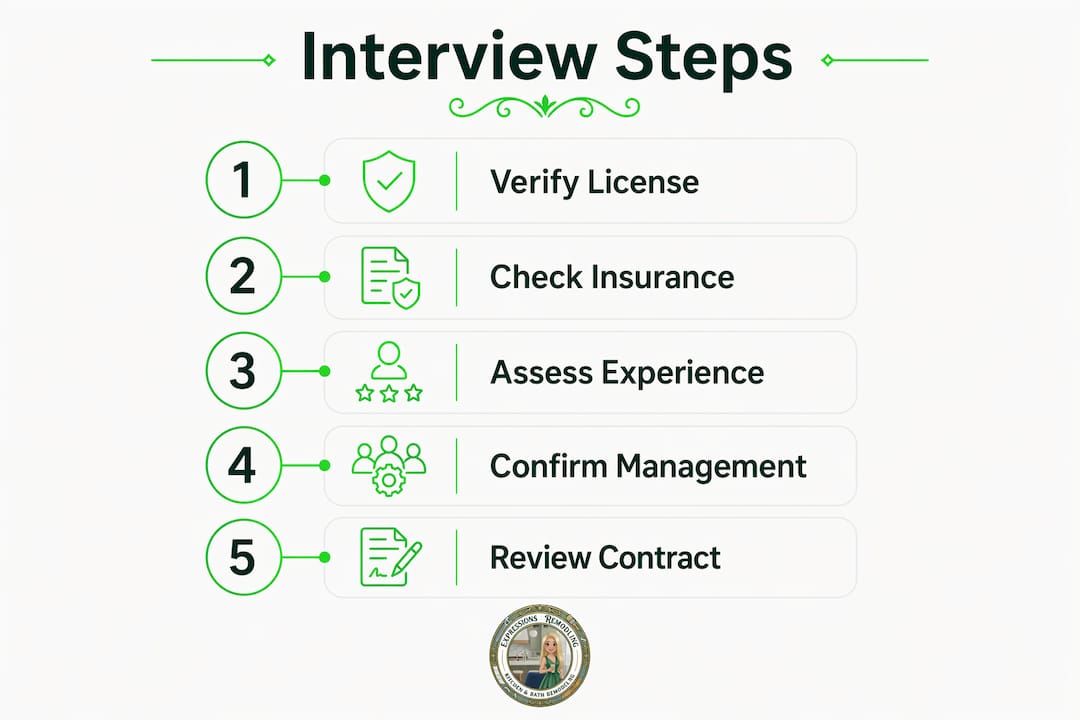
Ask about the types of projects completed in the last two years, and request references from work that closely matches your scope. Professional contractors typically provide references from 3–5 recent projects upon request. “Recent” matters here. A reference from five years ago tells you little about how the contractor operates today.
When you contact references, ask these specific questions:
- “Did the project finish on time and within the original budget?”
- “How did the contractor communicate with you during the project?”
- “Were there any unexpected problems, and how were they handled?”
- “Would you hire this contractor again?”
The last question is the most revealing. A satisfied client almost always says yes without hesitation. Vague or qualified answers are worth noting.
Pro Tip: Visit a completed project in person if the reference agrees. Photos on a contractor’s website are curated. A real finished space tells you far more about quality craftsmanship and attention to detail.
Understanding the contractor’s background also means knowing their project delivery model. Contractors who use a design-build model manage both design and construction under one contract, which simplifies permit handling and accountability. Contractors who separate design from construction may assign design responsibility to you, which changes your workload and risk exposure significantly.
How do project management questions reveal a contractor’s reliability?
Project management is where most remodels succeed or fail. A contractor may have excellent skills but poor oversight habits, and that combination produces delays, miscommunication, and budget creep.
Ask these questions in order:
- “Who will manage my project on a daily basis, and will that person be on site?”
- “Who is my main point of contact for questions and updates?”
- “Do you use subcontractors, and if so, how do you select and supervise them?”
- “How often will you provide progress updates, and through what channel?”
- “How do you handle change orders, and what is your process for getting my approval before proceeding?”
- “What happens if we hit an unexpected structural problem or code issue?”
- “What permits does this project require, and who is responsible for pulling them?”
Defining who manages the site daily and who handles administrative communication is the single most effective way to prevent mid-project breakdowns. When two people think someone else is responsible for a decision, that decision gets made badly or not at all.
The subcontractor question deserves extra attention. Many general contractors rely on subcontractors for electrical, plumbing, or tile work. That is normal. What matters is whether the contractor has established relationships with those subcontractors and takes responsibility for their work. A contractor who shrugs off accountability for a subcontractor’s mistakes is telling you something important.
Asking about lessons learned from past projects is one of the most underused questions in contractor interviews. A contractor who can describe a specific problem they encountered and explain exactly how they resolved it demonstrates both experience and honesty. A contractor who claims past projects were always smooth is either inexperienced or not being straight with you.
Understanding renovation project management before your interview helps you ask sharper follow-up questions and recognize weak answers when you hear them.
What contract, payment, and timeline questions protect your interests?
Contract and payment questions are where homeowners most often leave themselves exposed. Verbal agreements, vague estimates, and informal payment arrangements are the leading causes of remodeling disputes.
Ask every contractor these questions before you sign anything:
| Question | What you are checking for |
|---|---|
| “What will the written contract include?” | Scope, materials, timeline, payment schedule, and change order process |
| “What deposit do you require upfront?” | Legitimate contractors rarely ask for more than 10–30% upfront |
| “What is the payment schedule tied to?” | Payments should be tied to project milestones, not calendar dates |
| “How do you handle delays, and what is the timeline guarantee?” | Look for specific language, not vague reassurances |
| “Will you provide a lien waiver before final payment?” | Confirms all subcontractors and suppliers have been paid |
Reliable contractors insist on a site visit before providing any estimate. A “ballpark number” given without seeing your space almost always grows once work begins. That growth comes through change orders, which are written amendments to the original contract scope. A contractor who cannot clearly explain their change order process is a contractor who will surprise you with costs later.
Requesting a lien waiver before final payment protects you from legal claims filed by unpaid subcontractors or material suppliers. Without a lien waiver, a subcontractor who was not paid by your general contractor can place a mechanic’s lien on your home. That is a legal encumbrance that can complicate a future sale.
Pro Tip: Never pay the final installment until you have a signed lien waiver and a completed punch list. Both protect you legally and financially.
Vague cost estimates, unwillingness to provide written documentation, or unclear change order processes are the clearest red flags in any contractor interview. Contractors who welcome detailed questions and answer them specifically are the ones worth hiring.
Key Takeaways
Asking the right remodeling contractor interview questions, covering licensing, experience, project management, and contract terms, is the most reliable way to hire a qualified contractor and avoid costly mistakes.
| Point | Details |
|---|---|
| Verify licensing and insurance first | Confirm a valid license and at least $1 million in general liability coverage before any other discussion. |
| Request recent, comparable references | Ask for 3–5 references from projects completed within the last 12–18 months that match your scope. |
| Clarify daily site management | Identify who manages your project on site and who is your main communication contact. |
| Tie payments to milestones | Never agree to a payment schedule based on calendar dates; link every payment to a completed project phase. |
| Require a lien waiver at close | Get a signed lien waiver before releasing final payment to avoid legal claims from unpaid subcontractors. |
The questions that actually separate good contractors from great ones
Most homeowners walk into a contractor interview focused on price. That is the wrong priority. Price is easy to compare. Character, reliability, and communication style are not, and those three things determine whether your remodel goes smoothly.
The question I find most revealing is simple: “Tell me about a project that did not go as planned and what you did about it.” Every experienced contractor has a story. The ones worth hiring tell it clearly, take responsibility for their part, and explain the fix. The ones to avoid either claim nothing ever went wrong or blame the client, the supplier, or the weather.
Homeowners also underestimate the value of gut instinct during an interview. If a contractor is evasive about insurance, dismissive of your questions, or visibly impatient with the process, that behavior does not improve once work begins. The interview is the best version of the relationship you will ever see.
Preparation matters as much as the questions themselves. Homeowners who arrive with a written list of questions, a clear project scope, and a budget range get better answers. Contractors take structured interviews seriously. They recognize a prepared homeowner as someone who will hold them accountable, and the best contractors welcome that.
Knowing the types of contractors available for your project before the interview also sharpens your questions. A design-build firm answers differently than a general contractor who subcontracts everything, and you should know which model you are evaluating.
— Kierin
Expressions Remodeling makes the interview process easier
Expressions Remodeling works with St. Louis homeowners through a transparent process that starts before a single wall is touched. Every project begins with a detailed consultation where you can ask the same questions outlined in this guide and get direct, documented answers. Expressions Remodeling also offers complimentary 3D design previews so you can see your finished space before construction begins, eliminating guesswork about scope and materials. Whether you are planning a kitchen upgrade, a bathroom refresh, or a full basement finish, Expressions Remodeling brings the communication standards and written documentation that protect you from day one.
FAQ
What questions should I ask a remodeling contractor first?
Start with licensing and insurance. Ask for proof of a valid contractor’s license and confirm the contractor carries general liability insurance of at least $1 million and workers’ compensation coverage.
How long should a contractor interview take?
A thorough contractor interview takes 45–60 minutes. Interviews under 30 minutes consistently miss critical details about project management, change orders, and dispute resolution.
What is a lien waiver and why does it matter?
A lien waiver is a signed document confirming that a contractor has paid all subcontractors and suppliers. Requesting one before final payment protects you from legal claims filed against your property by unpaid parties.
What are the biggest red flags in a contractor interview?
The clearest red flags are vague estimates given without a site visit, refusal to provide written contracts or documentation, and evasive answers about insurance or change order processes.
Should I contact contractor references before hiring?
Always contact references from projects completed within the last 12–18 months that are similar in scope to yours. Ask specifically about timeline, budget accuracy, and whether they would hire the contractor again.