

TL;DR:
- Effective renovation requires clear subcontractor agreements, detailed scheduling, and daily communication.
- A well-organized process minimizes delays caused by coordination failures, which account for over 35 percent of project setbacks.
The fastest way to coordinate your renovation workflow
Getting a renovation done on time comes down to one thing: knowing exactly who does what, and when. Here are the moves that actually work.
- Write detailed subcontractor agreements covering scope, payment milestones, and schedule before anyone picks up a tool. Written agreements prevent the scope creep and payment disputes that cause 61% of contractor conflicts.
- Use the 48-hour mobilization rule. Confirm every subcontractor’s arrival two days before they’re due on site, not the morning of. This single habit cuts no-show rates by over 60%.
- Build a project sequencing map that shows every trade in order, with clear trigger points. Plumbing rough-in cannot start until demolition is complete; drywall cannot start until rough-in inspections pass. Make those dependencies visible to everyone.
- Document subcontractor work daily. Record crew size, hours worked, tasks completed, and any issues. Daily work reports prevent disputes and give you a paper trail if quality problems surface later.
- Notify downstream trades the same day an upstream trade falls behind. A plumber running two days late is manageable. A drywaller who shows up to an unfinished rough-in and bills you for a wasted mobilization trip is expensive.
Table of Contents
- 1. Why subcontractors matter and where coordination breaks down
- 2. How to set clear expectations and communicate with subcontractors
- 3. How to build a realistic schedule that handles trade overlaps
- 4. Quality control checkpoints that keep subcontractors accountable
- 5. Which digital tools actually help you manage subcontractors
- 6. What renovation experts say about preventing delays and cost overruns
- 7. How to handle unexpected delays without losing the whole schedule
- 8. How to coordinate materials and resources across multiple trades
- 9. What your subcontractor contracts actually need to cover
- 10. Safety protocols and compliance every homeowner should know
- Expressions Remodeling handles the coordination so you don’t have to
- Key Takeaways
1. Why subcontractors matter and where coordination breaks down
Subcontractors are the specialists who make a renovation actually happen. Your general contractor (GC) manages the project, but the plumber, electrician, HVAC technician, tile setter, and finish carpenter each bring trade-specific expertise that no single person can replicate. According to the Home Builders Institute, builders typically involve many subcontractors on a single-family home build, with subcontracted work accounting for the majority of total construction costs. Even on a smaller kitchen or bathroom remodel, you’re typically coordinating four to eight trades simultaneously.
That dependency is where things go wrong. Coordination failures cause 35% of all construction project delays, more than weather events, material shortages, or owner-driven changes combined. The most common culprits are scheduling conflicts between trades, scope misunderstandings about who is responsible for what, and spatial clashes in congested spaces above ceilings and behind walls.
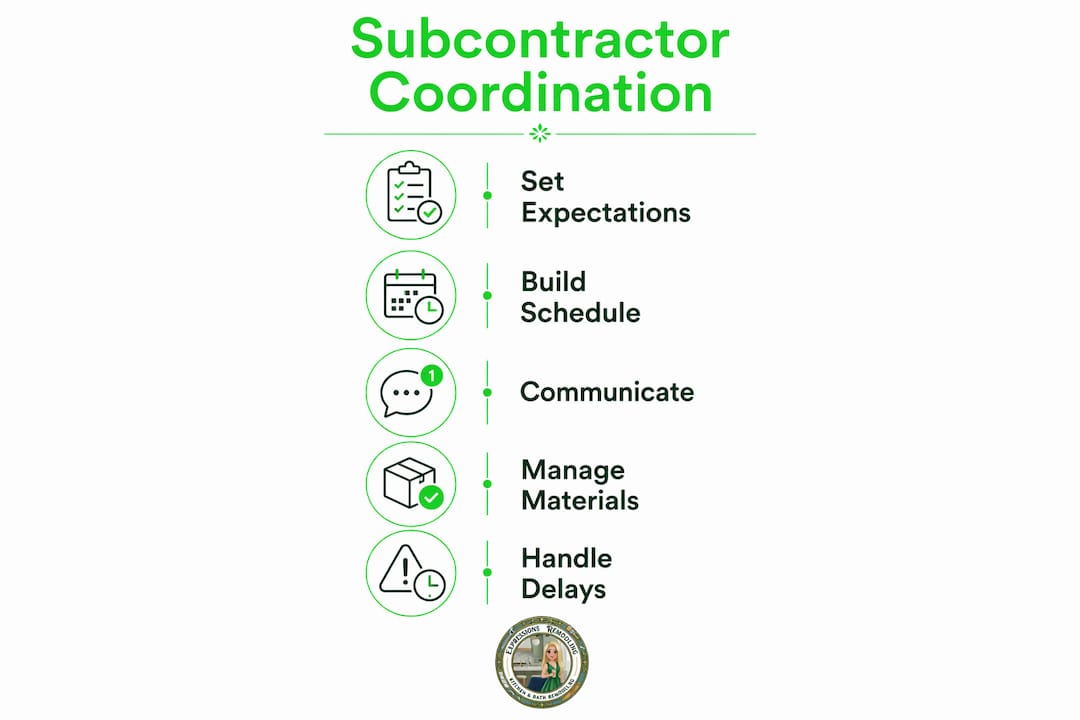
The standard residential build order runs: demolition, structural work, rough-in trades (plumbing, electrical, HVAC), inspections, insulation, drywall, then finish work. Deviating from that sequence, even slightly, creates costly mistakes. A drywaller who closes walls before electrical inspection passes means tearing out finished work. Pre-qualifying your subcontractors before the project starts, rather than scrambling to find someone mid-job, is the single best way to avoid those situations.

2. How to set clear expectations and communicate with subcontractors
The most effective communication structure on any renovation is simple: the homeowner talks to the GC, the GC talks to the subs, and the subs do not field change requests directly from the homeowner. Once that chain breaks, you’re managing a three-way argument about money instead of a project.
- Establish a single point of contact for all change requests. Every scope change goes through the GC in writing before any work proceeds.
- Hold pre-install meetings before each trade begins work. These trade-specific conversations clarify scope boundaries, confirm access and staging, and surface conflicts before they become field problems. Pre-install meetings are used on fewer than 40% of projects, yet they’re among the most effective tools for reducing rework.
- Set mobilization details during the 48-hour confirmation call. Confirm arrival time, access, what materials need to be on site, and who the on-site contact is.
- Document every decision the same day it’s made. After any on-site conversation that involves a change, send a brief text or email summarizing what was agreed. Thirty seconds of documentation prevents a surprising change order two weeks later.
Understanding the types of renovation contractors involved in your project helps you set the right expectations with each trade from the start.
3. How to build a realistic schedule that handles trade overlaps
A schedule that looks good on paper but ignores how trades actually work is worse than no schedule at all. The method that works in practice is the three-week lookahead: a rolling short-interval schedule updated every week with input from each subcontractor. It bridges the gap between your master project timeline and the daily reality on the ground.
- Sequence trades logically following the standard build order. Demolition, structural, rough-ins, inspections, insulation, drywall, finishes. Each phase is a trigger for the next.
- Use a sequencing map to show trade dependencies visually. When the electrician sees that drywall starts the Monday after their rough-in inspection, they understand the stakes of running late.
- Notify downstream trades immediately when an upstream trade slips. A framing sub two weeks behind pushes MEP rough-in, drywall, and ultimately the move-in date. Early notification gives everyone a chance to adjust rather than absorb a wasted trip.
- Update the lookahead weekly with each sub’s input. Short-interval scheduling works because it asks trade foremen to commit only to tasks they can realistically accomplish, which improves schedule adherence across the board.
Pro Tip: Re-confirm every subcontractor’s mobilization 48 hours before their scheduled start, every single time, even for trades you’ve worked with before. Familiarity does not equal reliability, and a quick confirmation call costs nothing compared to a wasted mobilization trip.
For a detailed look at how renovation timelines are structured from start to finish, that resource breaks down realistic phase durations for common residential projects.
4. Quality control checkpoints that keep subcontractors accountable
Quality problems caught early cost a fraction of what they cost after walls are closed. The way to catch them early is to build inspection checkpoints into the schedule as hard stops, not suggestions.
- Establish five inspection phases: pre-work (confirm site conditions and scope), rough-in (before walls close), pre-drywall (after insulation, before board), pre-finishing (after drywall, before paint and trim), and final walkthrough.
- Require subcontractor sign-offs at each checkpoint. A written sign-off confirms the trade’s work is complete, code-compliant, and ready for the next phase. It also creates accountability if issues surface later.
- Complete daily work logs recording crew details, hours, tasks completed, and any issues. Daily documentation is your best protection against disputes and your clearest record of performance.
- Address defects in writing, immediately. A written notice with a specific correction deadline tied to the workflow prevents a small punch list item from cascading into a schedule delay.
- Tie payment milestones to completed phases, not calendar dates. Releasing payment when a phase is verified complete, rather than on a fixed schedule, gives you real leverage and gives the subcontractor a clear incentive to finish cleanly before moving on.
5. Which digital tools actually help you manage subcontractors
Technology does not fix a broken process, but it makes a working one much easier to maintain. The tools worth using fall into a few clear categories.
Shared digital plan platforms eliminate the problem of outdated drawings circulating on a job site. When every trade is working from the same current set of plans, with real-time markups visible to everyone, the number of “I didn’t know that changed” conversations drops sharply.
Project management software that tracks bid comparisons, schedule updates, requests for information (RFIs), and payment applications keeps everything in one place instead of scattered across text chains and email threads. Centralized communication means every decision is on record, which matters when a dispute arises six weeks into a project.
For projects with congested above-ceiling spaces where plumbing, electrical, and HVAC all compete for the same real estate, AI-powered drawing analysis tools can detect spatial conflicts before rough-in begins. Catching a clash on screen costs nothing. Catching it after the ceiling is framed costs a day of rework and a schedule slip that ripples downstream.
The right tool depends on project scale. A full project management platform makes sense for a whole-home renovation. For a single-room remodel, a shared folder with current drawings, a group chat with a clear naming convention, and a simple spreadsheet schedule often covers the need.
6. What renovation experts say about preventing delays and cost overruns
The data on residential renovation delays is clear. Subcontractor coordination failures account for 35% of all construction project delays, according to FMI and Autodesk’s 2023 research, making it the single largest cause, ahead of weather, materials, and owner changes combined.
35% of all construction project delays trace back to subcontractor coordination failures, not weather or material shortages. FMI/Autodesk, 2023.
The expert-backed tactics that consistently prevent those delays:
- Pre-install meetings resolve trade conflicts before work starts. They’re used on fewer than 40% of projects despite being one of the most effective coordination tools available.
- Bid leveling normalizes subcontractor quotes to the same scope basis so you’re comparing actual costs, not headline numbers. A lower bid that excludes three line items is often more expensive once you fill the gaps. Bid leveling is the foundation of any fair subcontractor selection process.
- The three-week lookahead balances detailed planning with the flexibility real job sites require. It works because it asks each trade to commit only to what’s actually achievable in the near term.
- The 48-hour confirmation rule reduces no-shows by over 60%. Confirm mobilization two days out, every time.
- Elevation zones and coordination drawings for trades sharing congested ceiling spaces prevent the expensive rework that comes from discovering a conflict after framing is complete.
Pro Tip: Take photos of every rough-in phase before walls close and keep them organized by date and location. If a leak or wiring issue surfaces years later, those photos tell you exactly what’s behind the wall without tearing it open to find out.
Knowing the right interview questions for remodeling contractors before you hire helps you identify which subcontractors actually have the systems in place to execute on these standards.
7. How to handle unexpected delays without losing the whole schedule
Every renovation hits at least one delay. The question is whether that delay stays contained or cascades through the rest of the schedule.
The key is building float into your timeline from the start. Float is buffer time between phases, not padding for inefficiency. A realistic kitchen remodel schedule accounts for the fact that inspection scheduling in most North American municipalities takes two to five business days, and that a failed inspection means rescheduling. If your schedule has no room for that, one failed inspection blows your drywall start date.
When a delay hits, the first call goes to the downstream trades, not the homeowner. Notify them the same day, give them a revised start date, and confirm they can adjust. Most subcontractors are managing multiple jobs; early notice lets them fill the gap with other work rather than sitting idle and billing you for it.
Material delays are the other common disruption. Long-lead items like custom cabinetry, specialty tile, or certain plumbing fixtures can take six to twelve weeks. Order those items before demolition starts, not after. Sequencing your procurement around lead times rather than around when you think you’ll need the materials is one of the most practical ways to protect your schedule.
8. How to coordinate materials and resources across multiple trades
Material procurement and subcontractor scheduling are more connected than most homeowners realize. A tile setter who shows up to a job site where the tile hasn’t arrived yet bills for a wasted trip. An electrician who needs a specific panel that’s backordered for three weeks holds up every trade that follows.

The practical approach is a master materials list tied directly to the project schedule. For each phase, identify every material that trade needs, its lead time, and who is responsible for ordering it. Long-lead items go on order first, before any work begins. Standard materials get ordered to arrive a few days before the relevant phase starts, not the morning of.
Resource allocation across trades also means thinking about physical space. Two trades working in the same area simultaneously create safety risks and slow both of them down. A sequencing map that shows not just when each trade works but where they work prevents those collisions. The role of plumbers in renovations is a good example of a trade whose sequencing affects nearly every other phase of a project.
9. What your subcontractor contracts actually need to cover
Your GC’s contract with you does not legally bind the subcontractors. You need a separate written agreement for every sub, on every project, without exception. That agreement is what protects you when scope disputes or payment disagreements arise, and 61% of contractor conflicts come down to exactly those two issues.
A solid subcontractor agreement covers:
- Defined scope of work with specific plan references and acceptance criteria
- Payment schedule tied to milestones, not calendar dates
- Insurance and licensing requirements, verified before work starts
- Warranty obligations and cure periods for defective work
- Change order procedures requiring written approval before any additional work proceeds
- A communication chain clause stating the sub defers all owner communication to the GC
Retainage, typically 10% held back until project completion, protects you against incomplete or deficient work. Release it promptly once the work is verified. Holding it longer than necessary damages your relationship with good subcontractors and affects your reputation in the local trade market. For a full breakdown of what residential remodeling contracts should include, that guide covers every clause worth knowing.
10. Safety protocols and compliance every homeowner should know
Safety compliance on a renovation site is not just the GC’s responsibility. As the homeowner, you have a direct interest in making sure every subcontractor on your property is licensed, insured, and following applicable safety standards.
Before any trade starts work, verify their general liability insurance and workers’ compensation coverage. A subcontractor who gets injured on your property without workers’ comp coverage can create significant legal and financial exposure for you. Ask for certificates of insurance naming you as an additional insured, and confirm the coverage is current.
Permit compliance is equally non-negotiable. In North America, most structural, electrical, plumbing, and HVAC work requires a permit and a passing inspection before walls close. Work done without permits creates problems when you sell the home and can void your homeowner’s insurance coverage for related claims. Confirm who pulls the permits before work starts, and never let a contractor talk you out of pulling them to save time or money.
For trades working in confined spaces, at heights, or with hazardous materials like lead paint or asbestos in older homes, federal OSHA standards and state-level regulations apply. A reputable subcontractor knows these requirements. If a trade is unfamiliar with the applicable standards for your project, that’s a vetting failure worth addressing before work begins.
Expressions Remodeling handles the coordination so you don’t have to
Managing four to eight subcontractors across overlapping phases, tracking permits, confirming mobilizations, and documenting daily progress is a real job. For most homeowners, it’s a second job on top of everything else.

Expressions Remodeling takes that entire coordination burden off your plate. Their St. Louis team manages the full subcontractor workflow, from pre-qualified trade selection and written agreements to daily oversight and quality checkpoints, so your project moves on schedule without you spending six hours a week on the phone. Whether you’re planning a kitchen upgrade or a bathroom remodel, every phase is sequenced, documented, and delivered with the craftsmanship their St. Louis clients rely on. Contact Expressions Remodeling today to get a quote and see exactly what your project timeline looks like.
Key Takeaways
Effective renovation coordination requires written agreements, a realistic sequencing plan, and daily oversight, not just a good relationship with your contractor.
| Point | Details |
|---|---|
| Coordination failures are the top delay cause | 35% of construction delays come from subcontractor coordination failures, more than weather or materials. |
| The 48-hour rule cuts no-shows | Confirming subcontractor mobilization 48 hours in advance reduces no-show rates by over 60%. |
| Written contracts prevent most disputes | Scope creep and payment issues cause 61% of contractor conflicts; signed agreements with clear milestones prevent both. |
| Pre-install meetings are underused but effective | Fewer than 40% of projects use them, yet they’re one of the most reliable ways to prevent rework. |
| Expressions Remodeling manages the full workflow | Their St. Louis team handles subcontractor selection, scheduling, and quality oversight from start to finish. |