
REMODELING TIPS

A change order is a written amendment to your remodeling contract that changes the scope of work, the price, the schedule, or all three. It only counts once you and the contractor have both signed it, and it should be signed before the changed work starts. Done well, change orders keep a project honest. Done badly, they are where remodeling budgets and friendships go to die.
This guide explains what a change order is, why they happen, what one must say, and how to judge whether the one in your hand is fair. We build kitchens, bathrooms and basements in St. Louis, so the examples come from the kind of work local homeowners actually do.
The Associated General Contractors of America describes a change order as an official change in the original scope of work or terms of a construction contract, agreed to by the owner and the contractor (and the designer, where there is one). Procore’s construction library puts it as a document that alters the original agreement, detailing the changes in scope, cost and schedule.
Three things to notice:
If you want the bigger picture of how the pieces fit, our guide to how remodeling contracts work covers the original agreement that every change order attaches to.
Most fall into two families: changes you ask for, and conditions nobody could see.
These are the ones you control. You see the tile in the showroom and love a different one. You decide to move the sink, add recessed lights, or turn a basement closet into a wet bar. Design revisions after the contract is signed are the most common owner-driven change, and they are the easiest to avoid with decisions made up front.
Cabinets are a classic example. A wrong dimension, a missed filler panel or an appliance that does not fit the opening can force a reorder and a schedule slip. The NKBA-based checklist on cabinet ordering mistakes is a useful read before you sign off on a kitchen layout.
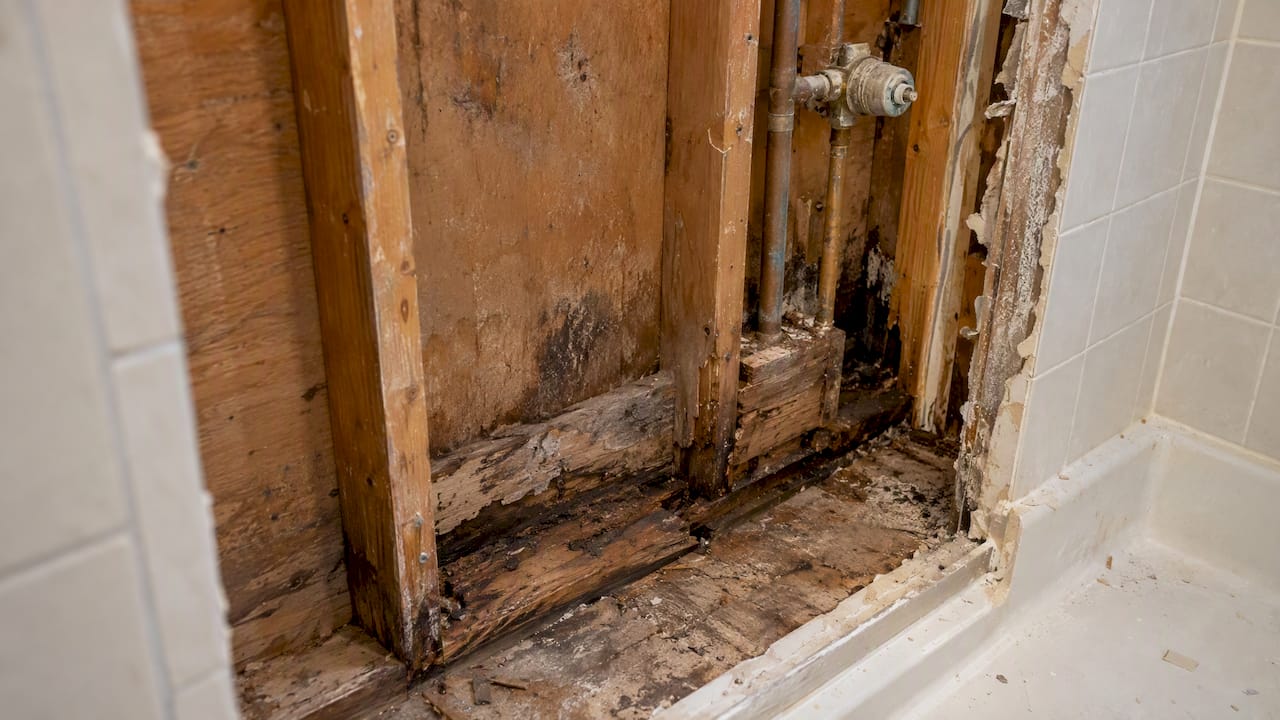
Once walls, floors or ceilings open up, a contractor may find things no estimate could price: water damage behind a shower, old wiring that does not meet current code, rotted subfloor, or a plumbing run in the wrong place. In older St. Louis houses these are real possibilities. Basements bring their own questions about moisture, which is why we suggest testing moisture and radon before planning an unfinished basement.
Sometimes an inspector or the building code requires something the plans did not show. In St. Louis County, for example, the county’s residential guide for kitchen and bath remodels explains that licensed, bonded and insured electrical, mechanical and plumbing contractors can sign onto a residential permit application as long as each trade’s new work appears in the drawings. Work that is not in the drawings is a conversation to have before it happens, not after.
The homeowner who understands this category can tell a legitimate change from a made-up one. If a change is required by code or safety, the work may genuinely not be able to proceed without it. You can still insist on seeing it in writing, with a price.
Procore lists the core contents of a professional change order. Translated into homeowner terms, check for each of these:
| Item | What to look for |
|---|---|
| Project and contact details | Your address, both parties’ names, and a reference to the original contract and its date |
| Date of request | When the change was raised, and by whom |
| Description of the work | Specific enough to picture: product, size, location, and the reason (site condition, design revision, code) |
| Schedule impact | Added or removed days, or a plain statement of “no change” |
| Cost adjustment | An exact dollar amount, positive or negative, ideally itemized into labor and materials |
| Updated contract total | The original price plus all prior change orders plus this one |
| Signatures | Both parties, dated, before the work begins |
If the document says “extra work as needed” or leaves the amount blank, it is not a change order yet. It is a promise to send you a bill.
Here is an invented but realistic scenario, to show the math. It is an illustration, not a real client project.
A homeowner signs a contract for a bathroom remodel. During demolition, the crew finds soft subfloor around the old tub. The contractor stops, shows the homeowner photos, and writes a change order: replace 24 square feet of subfloor, with a stated amount for labor and materials, and one added day to the schedule. The homeowner reads it, asks one question about the plywood grade, signs, and work resumes.
While the crew is there, the homeowner decides to swap the planned vanity for a larger one. That is a second, separate change order, with its own price and its own signature. The contract total on the second form includes the first change. At the end, there is a clean paper trail of two documents and no arguments.
Now the bad version: the contractor says “we found some rot, we’ll take care of it,” and the homeowner nods. Three weeks later the final invoice is $1,800 higher. Nothing was agreed in writing, so nobody can prove what was said.
Working on a handshake is the single most common source of payment disputes on remodeling jobs, even when the contractor promises to document it later. Get the new scope, the exact price and the schedule impact on paper before the first nail goes in for that specific change.
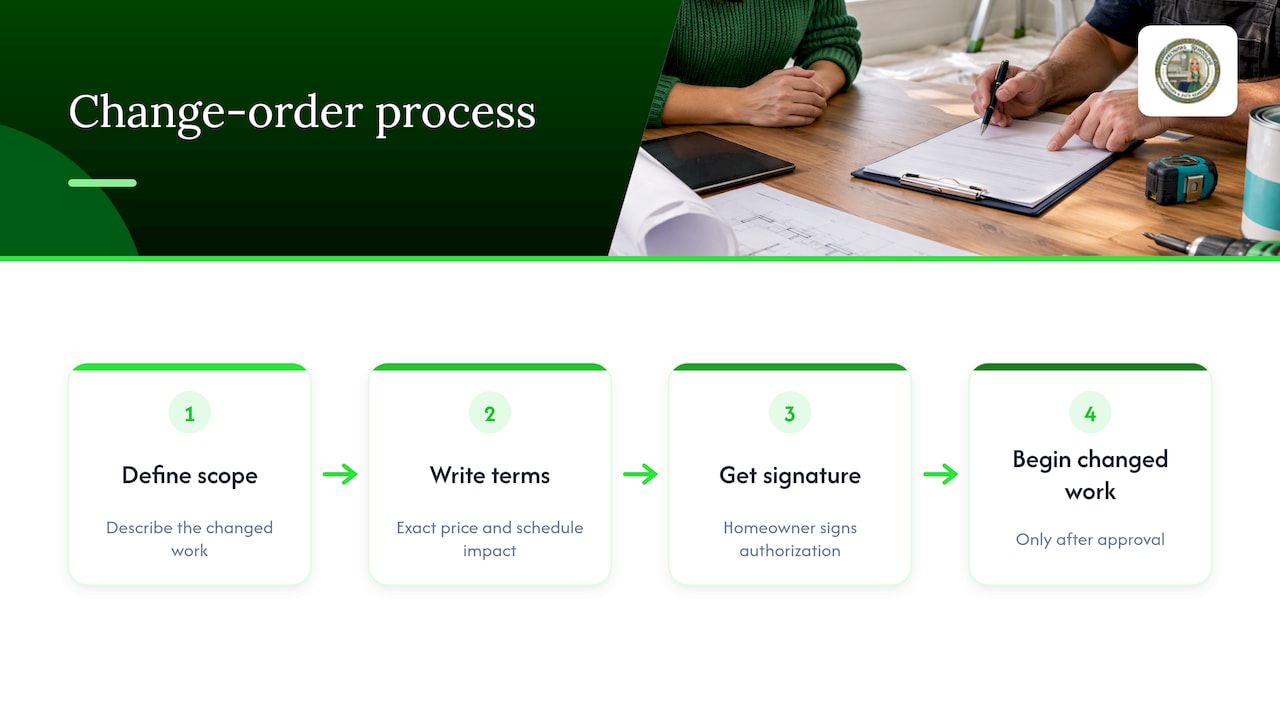
This is also practical law. Written contracts and change processes are recommended in St. Louis so that they hold up under the Missouri Merchandising Practices Act, and a local contractor guide advises defining in your first contract that written authorization and signature are required before any changed work proceeds. The same guide notes that without a written change order clause, disputes over verbal modifications become difficult to resolve.
A Missouri example shows why this matters beyond paperwork. The Attorney General obtained a judgment against a St. Louis County contractor who the State said took upfront payments for basement renovation work, in violation of the Missouri Merchandising Practices Act. That case is about upfront payments rather than change orders, but it is the same lesson: money and scope should always be tied to something in writing.
The Missouri Attorney General’s office also receives consumer complaints about change orders. A local legal segment on what to do if you feel cheated by a contractor reports that the office hears frequently about change orders on finished or partly finished work, usually when a contractor claims materials cost more than first estimated. If you are in that spot, the Attorney General’s consumer protection line is the official place to start, and an attorney is the right person to see if real money is at stake.
Don’t sign at the kitchen counter while the crew waits. Take a day if the schedule allows it, and run through these questions.
You are on firm ground when the change was already in the original scope, when the amount is vague or has no breakdown, when work has already been done without your signature and you are now asked to approve it after the fact, or when the contractor adds a charge for something that was clearly part of your estimate. Pushing back politely and in writing is normal. A good contractor expects it.
You will not eliminate them, but you can shrink them.
We think a change order should feel boring. The homeowner should already know it is coming, understand the reason, see the price, and sign it without a knot in their stomach.
In our work on kitchens, bathrooms and basements across St. Louis, the changes that hurt are rarely the big discoveries. They are the small ones that nobody wrote down: a moved outlet, a bigger niche, an upgraded faucet. Each one feels like nothing, and together they become a number nobody expected. So we encourage clients to treat every change, however small, with the same process: describe it, price it, sign it.
We also like the 3D design visualization step for this reason. Seeing the space before construction starts surfaces many “can we move this?” questions while moving them still costs nothing. Changes made on a screen are the cheapest ones in remodeling.
And please ask about credits. If you simplify the plan or choose a less expensive material, the contract total should go down, and it should go down on paper.
— Kierin
Budget conversations go better when the starting numbers are public. Our pricing page lists bathroom remodeling starting from $9,999 (5×7 full bathroom package $16,999), kitchen remodeling starting from $17,999, full basement remodeling from $40 per square foot, and vinyl flooring labor starting from $3.49 per square foot. Those figures are the published starting points for scoping a project, and your own scope sets the final contract.
If you are planning a project and want a scope written clearly enough that changes stay rare, start with our basement remodeling or bathroom remodeling pages, or reach us from the Expressions Remodeling home page.
Yes, when the change adds work or materials, the contractor will price it, and that price belongs in the change order. Change orders can also reduce the contract price if you remove work or choose cheaper materials. Either way, the adjustment should be an exact figure, agreed in writing before the work happens.
Yes. Contractors typically request one when they find hidden conditions, when a code or inspection requirement changes the plan, or when a material is unavailable. You are entitled to see the reason, the price and the schedule effect before you sign. You can ask for photos of any concealed damage.
It should include project and contact details, the date, a specific description of the changed work and why, the schedule impact, the exact cost adjustment, and the updated contract total. Both you and the contractor should sign it before the work begins.
That depends on your contract and the facts, and it is a question for an attorney or the Missouri Attorney General’s consumer protection office. In general, a written clause requiring signed change orders makes unapproved charges much harder to enforce. This is why we recommend never letting changed work begin without one.
No. An estimate is a price proposal before you sign. A change order amends the signed contract afterward. If a number changes after the contract is signed, it should show up as a change order, not as a surprise on the final invoice.
YOUR NEXT PROJECT
Tell us about your project and get a free, no-pressure estimate.