

A remodeling contract is a legally binding agreement that defines the exact scope of work, payment terms, timeline, and responsibilities for both the homeowner and the contractor. Understanding how remodeling contracts work before you sign protects your budget, your home, and your legal rights. Most disputes in residential renovation trace back to a vague or one-sided contract, not to poor craftsmanship. The Contractors State License Board and construction industry standards both treat a written, detailed contract as the minimum baseline for any legitimate remodeling project.
What key components should a remodeling contract include?
A complete home renovation agreement covers six core areas. Missing any one of them creates a gap that contractors can exploit and courts struggle to resolve.
- Scope of work. The contract must name specific materials, brands, finishes, and methods. “Install new cabinets” is not a scope of work. “Install 42-inch Shaker-style maple cabinets in Sherwin-Williams Alabaster, supplied by [named supplier]” is.
- Payment schedule. Terms must state the deposit amount, milestone payment triggers, and the final payment release condition. Never accept a payment schedule tied only to calendar dates.
- Timeline. The contract needs a firm start date, defined milestones, and a substantial completion date. “Substantial completion” is a legal term meaning the space is safe and usable, not necessarily finished to the last detail.
- Change order policy. All scope or price changes require a written, signed change order before any new work begins. Verbal agreements are the single most common cause of remodeling disputes.
- Insurance and permits. Contractors should carry at least $1 million general liability insurance per occurrence plus state-mandated workers’ compensation. The contract must also state who pulls permits and who pays for them.
- Warranties. Labor workmanship warranties typically run one year, and manufacturer warranties should transfer to the homeowner and be registered in their name.
Pro Tip: Ask for a copy of the contractor’s certificate of insurance before signing. If they hesitate, treat it as a red flag.
Every item on this list belongs in the contract before you sign. A contractor who resists adding any of these terms is telling you something important about how they operate.

How do remodeling contracts address payment terms and protect homeowners financially?
Payment terms are where most homeowners lose leverage. The structure of how and when you pay determines how much control you keep throughout the project.
- Cap your deposit. State laws set clear limits. California restricts deposits to 10% or $1,000, whichever is less. Massachusetts allows up to one-third of the contract price. Any demand for more than one-third upfront is a warning sign regardless of your state.
- Tie payments to milestones. Milestone-based payment schedules are the most secure structure available. Each payment releases only after a verifiable stage of work is complete, such as framing inspection passed or tile installation finished.
- Require lien waivers. A lien waiver is a written statement from the contractor or subcontractor confirming they have been paid and waiving their right to file a lien against your property. Get one with every payment.
- Include retainage. Withhold 5–10% of the total contract price until the punch list is complete. This gives the contractor a financial reason to finish every last detail.
- Fix your allowances. Vague allowances shift cost risk directly to you. If the contract says “$500 allowance for tile,” and you pick a tile that costs $800, you pay the difference. Negotiate itemized, capped allowances with specific product names or models written in.
Pro Tip: Never pay ahead of work. If a contractor says they need next month’s payment to buy materials today, that is a cash flow problem on their end, not yours.
The financial structure of your contract is not a formality. It is the mechanism that keeps the project moving and keeps you protected if it stalls.
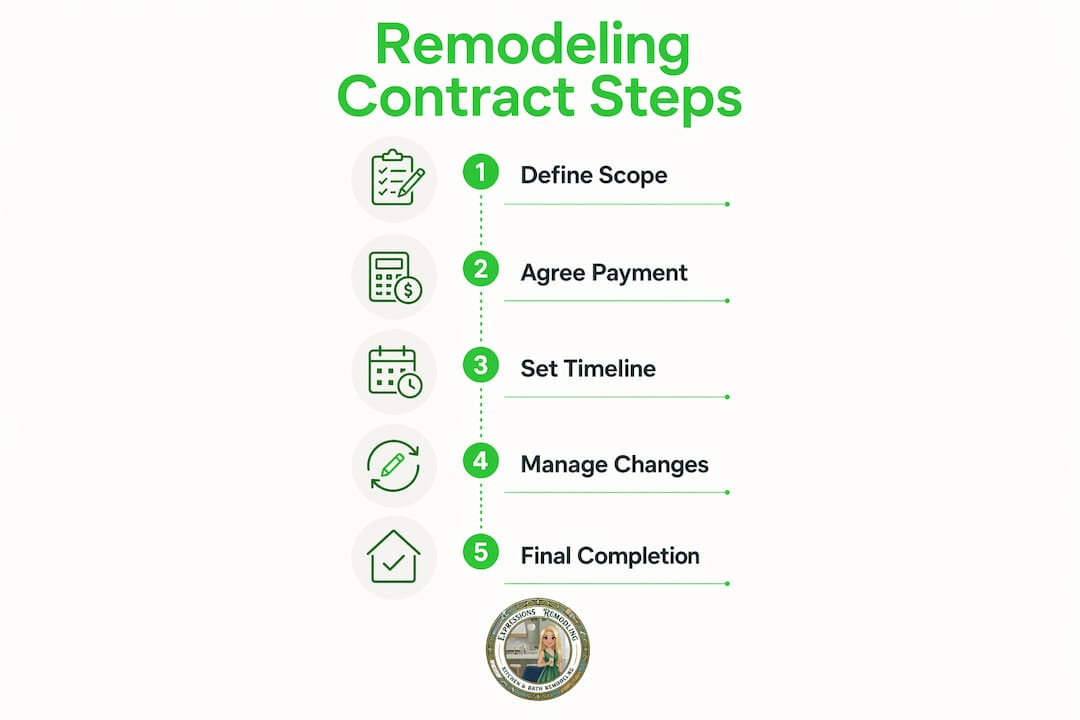
What are common contractual pitfalls and how can homeowners negotiate better terms?
Contracts drafted by contractors are written to protect contractors. That is not cynical. It is simply how the legal process works, and homeowners must understand it before they sit down to sign.
- Vague scope language. Phrases like “as needed,” “standard grade,” or “per plan” without an attached plan are open invitations for disputes. Every material, method, and finish must be named specifically.
- Blank spaces. Never sign a contract with blank fields. A contractor can fill them in later, and you will have no legal recourse.
- Large upfront payments. A demand for more than one-third of the project cost before work begins is outside industry norms and leaves you with little leverage if the contractor underperforms or disappears.
- Missing right-to-cancel clause. Many states mandate a 3-day right to cancel on contracts signed in your home. If this clause is absent, the contractor is likely prioritizing their own interests over yours.
- No dispute resolution clause. Without a defined process, disagreements go straight to litigation. Negotiate for mediation or arbitration as the first step, which is faster and cheaper for both parties.
For projects exceeding $25,000, spending $150–$400 on an attorney review is one of the most cost-effective decisions you can make. Most contracts are drafted by legal teams working for the contractor. An independent attorney who knows construction law will spot unfavorable clauses in under an hour.
Homeowners who treat a contract as a negotiable document, rather than a take-it-or-leave-it form, consistently get better outcomes. You have the right to add clauses, remove language, and request revisions before you sign.
How does the timeline and change order process work in remodeling contracts?
The timeline section of a remodeling contract does more than set expectations. It creates legal accountability for both parties.
Scheduled dates and what they mean
The contract should name a firm start date and a substantial completion date. Under the AIA A201 standard, substantial completion means the project is usable for its intended purpose, even if minor punch list items remain. This distinction matters because it triggers the release of most of the contract balance. Retainage of 5–10% stays withheld until the full punch list is signed off.
The change order process
Written, signed change orders before any new work begins are the industry standard for managing scope changes. A change order must state the new work, the revised cost, and the impact on the project timeline. Verbal agreements about changes are the primary driver of budget overruns and contractor disputes.
| Document | Purpose | When required |
|---|---|---|
| Original contract | Defines scope, cost, and timeline | Before work begins |
| Change order | Amends scope, price, or schedule | Before any change is executed |
| Lien waiver | Confirms payment and releases lien rights | With each payment |
| Punch list | Lists remaining items at substantial completion | At project closeout |
| Final release | Confirms all work is done and paid | Before final payment |
Keep every signed document in a dedicated project folder, physical or digital. If a dispute arises, your paper trail is your strongest asset. Contractors who resist putting changes in writing are creating conditions for a dispute, whether intentionally or not.
Key Takeaways
A remodeling contract protects homeowners through specific scope language, milestone-based payments, written change orders, and clear completion standards.
| Point | Details |
|---|---|
| Define scope precisely | Name every material, brand, and method to prevent disputes over what was agreed. |
| Cap deposits by state law | Deposits above one-third of the contract price fall outside industry norms and reduce your leverage. |
| Use milestone payments | Tie each payment to a completed, verifiable stage of work rather than a calendar date. |
| Require written change orders | Any scope or price change must be signed before new work begins to avoid budget overruns. |
| Get legal review for large projects | An attorney review for projects over $25,000 costs $150–$400 and identifies unfavorable clauses. |
What I’ve learned from watching homeowners sign contracts too fast
Most homeowners I’ve seen get burned by remodeling contracts made the same mistake: they were so excited about the project that they treated the contract as a formality. They skimmed it, signed it, and handed over a large deposit the same day. That sequence is exactly backwards.
The contract is the single most important document in the entire renovation process. It is more important than the design, the material selections, and the contractor’s reputation. A great contractor with a vague contract will still create problems. A good contract with a decent contractor will almost always produce a successful project.
The detail that surprises most homeowners is that contracts often protect contractors by default. The language is written by people who do this every day. You are signing it once. That asymmetry is real, and the only way to close it is to read every line, ask questions about anything unclear, and negotiate the terms that matter most to you.
My strongest advice: never sign on the day you receive the contract. Take it home, read it overnight, and come back with questions. A contractor who pressures you to sign immediately is telling you that the contract benefits them more than it benefits you. A contractor who welcomes your questions and revisions is showing you how they will behave throughout the entire project.
Clear contracts do not just prevent disputes. They build the kind of working relationship where both sides feel respected and accountable. That is the foundation of a renovation that actually finishes on time and on budget.
— Kierin
Expressions Remodeling makes contract clarity part of the process
Signing a remodeling contract should feel like the start of something exciting, not a leap of faith. Expressions Remodeling builds transparency into every agreement from day one, with detailed scope documents, milestone-based payment schedules, and written change order policies that protect St. Louis homeowners throughout the project.

Before construction begins, Expressions Remodeling offers a complimentary 3D design preview so you can see exactly what you are agreeing to, down to the finishes and layout. That visual clarity translates directly into a tighter, more specific contract with fewer surprises. Whether you are planning a kitchen upgrade, a bathroom renovation, or a basement finish, Expressions Remodeling gives you the documentation and communication to move forward with confidence. Reach out to start a conversation about your project.
FAQ
What is a remodeling contract?
A remodeling contract is a legally binding agreement between a homeowner and a contractor that defines the scope of work, payment terms, project timeline, and responsibilities of each party.
How much deposit is standard for a remodeling contract?
Industry norms and state laws set deposit limits between 10% and one-third of the total contract price, depending on your state. California caps deposits at 10% or $1,000, whichever is less.
What is a change order in a remodeling contract?
A change order is a written, signed amendment to the original contract that documents any change in scope, cost, or timeline. No changes should begin without a signed change order in place.
What does “substantial completion” mean in a remodeling contract?
Substantial completion means the project is safe and usable for its intended purpose, even if minor items remain on the punch list. Retainage of 5–10% is typically withheld until all punch list items are finished.
Do I need an attorney to review my remodeling contract?
For projects over $25,000, an independent attorney review costs $150–$400 and is considered standard protection. Most contracts are drafted to favor the contractor, and a construction-savvy attorney will identify unfavorable terms quickly.