
Staging and remodeling work together as two distinct but complementary strategies: remodeling permanently upgrades your home’s structure, systems, and finishes, while staging translates those improvements into the visual and emotional cues buyers use to decide what a home is worth. According to NAR data cited by Realty Executives, staged homes spend 73% less time on the market, and 82% of buyers’ agents say staging helps buyers visualize a property as their future home.
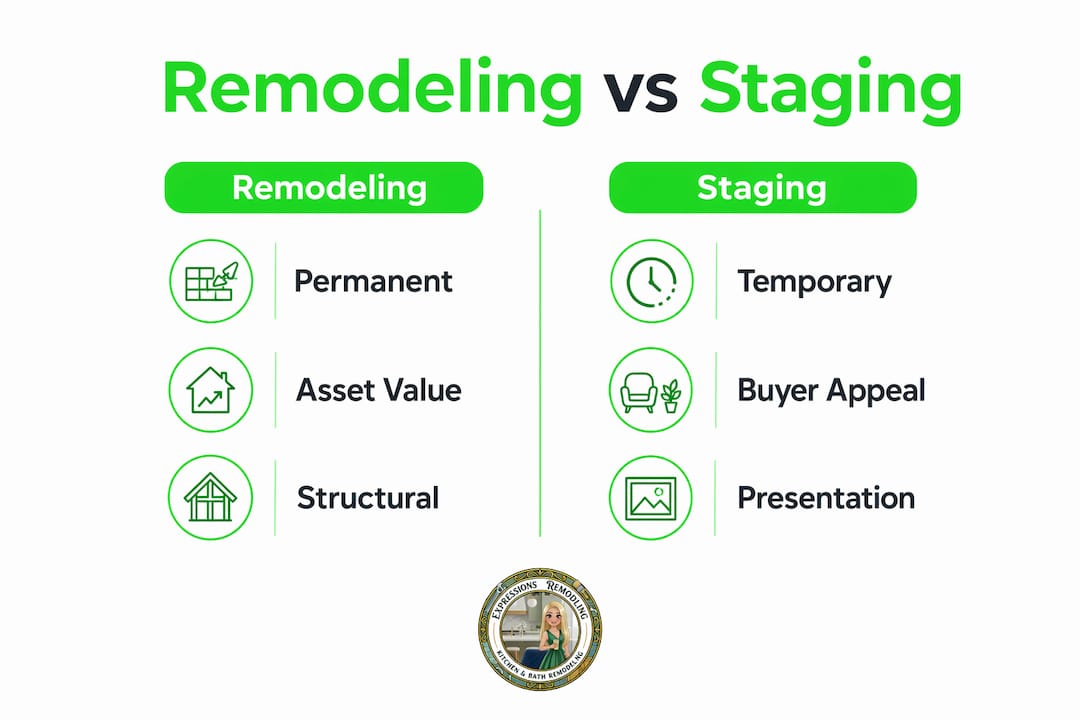
- Remodeling = asset enhancement (permanent changes to layout, systems, finishes)
- Staging = marketing presentation (reversible furnishings, lighting, and flow that make improvements readable)
- Combined = the strongest outcome for sellers, and the clearest path to perceived value for long-term owners
If you’re planning a high-quality remodel, staging should be in your timeline and budget from day one, unless you’re staying put with no near-term sale in mind.
Table of Contents
- How does remodeling differ from staging in purpose?
- When should you stage, remodel, or do both?
- What’s the right sequence: stage before, during, or after remodeling?
- What do staging and remodeling actually cost, and what’s the ROI?
- How do you integrate staging into a remodeling project?
- What a combined remodel and staging project looks like in practice
- Key Takeaways
- The case for planning staging before you break ground
How does remodeling differ from staging in purpose?
Remodeling is a permanent investment in the home’s reality: new cabinetry, updated plumbing, reconfigured layouts, replaced flooring. It changes what the home actually is. Staging, by contrast, is a reversible presentation layer. It shapes how buyers perceive and emotionally respond to what’s already there, using furniture placement, lighting, and neutral decor to define scale, flow, and purpose.
The two roles rarely overlap, but they reinforce each other. A kitchen refresh with new countertops and cabinet hardware is a remodeling decision. Staging that kitchen with a clean layout, pendant lighting, and a simple table setting is what makes buyers understand the scale and imagine cooking there. Neither alone tells the full story.

| Dimension | Remodeling | Staging |
|---|---|---|
| Purpose | Permanent asset improvement | Perception and emotional appeal |
| Changes | Structural, functional, finish-level | Furnishings, lighting, decor |
| Reversible? | No | Yes |
| Timeline | Weeks to months | 1–7 days |
| Best for | Fixing liabilities, upgrading utility | Maximizing perceived value at sale |
Staging fixes presentation problems that block buyer imagination. Remodeling fixes visible liabilities that buyers discount in their offers. Both matter, but they solve different problems.
Pro Tip: Staging cannot hide structural decay. If your home has deal-breaker defects, like water damage, failing HVAC, or rotted subfloors, remodel those first. No amount of furniture arrangement rescues a home that fails inspection.
When should you stage, remodel, or do both?
Your property’s condition, your timeline, and your goal drive this decision more than any rule of thumb.
| Condition | Timeline | Goal | Best Path |
|---|---|---|---|
| Good condition, dated decor | Fast (under 60 days) | Sell | Stage only |
| Cosmetic wear, sound structure | Flexible | Sell | Light targeted remodel + stage |
| Visible liabilities (systems, finishes) | Flexible | Sell | Selective remodel first, then stage |
| Any condition | Long-term | Stay | Remodel for utility; stage optional |
| Vacant home | Fast | Sell | Full vacant staging, minimal remodel |
For sellers with tight timelines, staging frequently offers faster, more predictable ROI than remodeling. A staging project installs in days and requires no permits. A minor kitchen remodel can run 3–6 weeks even when everything goes smoothly.
Budget context matters too. The NAR’s 2024 Profile of Home Staging puts professional staging typically costs a few hundred to a few thousand dollars, with staged homes selling for 5–13% more than non-staged homes. A minor kitchen remodel can cost thousands of dollars and generally recoups a high percentage of that cost at resale. The math favors staging for most sellers unless visible defects are actively suppressing offers.
- Assess your comp set. Walk comparable listings in your neighborhood. If they all have updated kitchens and yours doesn’t, a targeted refresh matters. If they’re similar, staging is your edge.
- Identify deal-breakers. Anything a buyer’s inspector will flag, address first. Deferred maintenance kills deals that staging can’t save.
- Set your timeline. Under 60 days to list? Staging is almost always the right first move. More time? Selective remodeling becomes viable.
- Match scope to price tier. Midmarket homes usually see the best returns from cosmetic updates plus staging. Luxury properties may justify larger remodel budgets to meet buyer expectations.
A useful resource for this decision is Expressions Remodeling’s guide on pre-listing renovation options, which walks through when targeted remodeling makes sense before a sale.
What’s the right sequence: stage before, during, or after remodeling?
Sequence is where most homeowners make costly mistakes. The right order depends on your goal.
Remodel first, then stage is the strongest approach when visible liabilities exist. Selective remodeling removes deal-breakers; staging then defines the space and scale of those improvements for buyers. This sequence takes longer but produces the most complete result.
Stage only works when the home is structurally sound and the only problem is presentation. It’s the fastest path to market and carries the least risk.
Staged during remodel applies to partial-occupancy situations, where one area is complete and photo-ready while work continues elsewhere. This is uncommon but useful for phased projects.
| Sequence | Timeline | Best For | Risk |
|---|---|---|---|
| Stage only | 1–7 days | Sound home, fast sale | Low |
| Remodel then stage | 3–6 weeks | Visible liabilities | Moderate (construction delays) |
| Stage during remodel | Varies | Phased projects | Higher coordination demand |
Construction carries real risk: permits, material lead times, and contractor scheduling can all push your listing date. Staging installs in days and is fully reversible. If your remodel timeline slips, virtual staging for marketing photos is a practical contingency. Expressions Remodeling’s complimentary 3D design service lets you preview finishes and layouts before construction begins, which reduces the risk of costly mid-project changes.
What do staging and remodeling actually cost, and what’s the ROI?
Staging costs vary by scope and occupancy. Light occupied styling consultations and full vacant staging costs vary widely depending on home size and rental duration. Professional photography is often bundled in at the higher end.
Remodeling costs span a wider range. A kitchen refresh at midrange runs roughly $27,000. Bathroom cosmetics and flooring updates are lower, and targeted refreshes often yield stronger percentage returns than full overhauls when matched to neighborhood comps. The key is avoiding over-improvement: spending $60,000 on a kitchen in a neighborhood where buyers won’t pay for it is a reliable way to lose money.
Factors that shift the ROI calculation:
- Local comp set: If nearby listings have updated finishes, remodeling closes the gap. If they don’t, staging is your differentiator.
- Property tier: Luxury homes often justify higher remodel budgets. Midmarket homes usually don’t.
- Visible condition: Worn flooring, dated hardware, and poor lighting suppress offers more than buyers admit. Small fixes, like paint, lighting swaps, and new hardware, can produce major uplifts in photos and showings when combined with staging.
- Buyer expectations in your market: St. Louis buyers in Clayton or Ladue expect move-in-ready presentation. Meeting that expectation with staging is often cheaper than remodeling to meet it structurally.
For guidance on avoiding costly scope creep, Expressions Remodeling’s article on over-improvement in remodeling is worth reading before you set a budget.
How do you integrate staging into a remodeling project?
A practical checklist keeps contractors, designers, and stagers from working against each other.
- Get a pre-remodel inspection. Identify structural and mechanical deal-breakers before committing to cosmetic work.
- Prioritize visible liabilities. Fix anything a buyer’s inspector will flag. Everything else is optional.
- Set your budget and timeline with your contractor in writing. Build in a contingency of at least 10–15% for delays.
- Choose finishes that align with your comp set. Neutral selections photograph better and appeal to more buyers. Avoid personal taste choices that narrow your buyer pool.
- Schedule your stager before construction ends. Good stagers book out weeks in advance. Lock in your date early.
- Decide which rooms to stage physically vs. virtually. Living room, kitchen, and primary bedroom have the highest impact. Secondary bedrooms and basements are candidates for virtual staging if budget is tight.
- Book professional photography for the day after staging is complete. Never photograph before staging is finished.
- Ask your stager about rental duration. Most vacant staging rentals run 30–90 days. Know your expected days on market before committing to a rental term.
Pro Tip: When selecting finishes for a remodel you plan to sell after, run your choices past your stager before ordering. A stager can tell you whether a tile or cabinet color will photograph well and appeal to buyers in your price range, saving you from a costly swap.
For quick cosmetic wins that pair well with staging, a house makeover guide covering door and hardware refreshes is a practical starting point.
What a combined remodel and staging project looks like in practice
Expressions Remodeling recently worked with a St. Louis homeowner preparing a 1990s-era home for sale. The home was structurally sound but had a dated kitchen, worn bathroom tile, and a basement used for storage. The goal was a faster sale at a stronger price without over-improving for the neighborhood.
What was remodeled:
- Kitchen: cabinet repainting, new hardware, quartz countertop replacement, updated lighting
- Primary bathroom: new tile surround, vanity swap, fixture updates
- Basement: basic finishing to convert storage into a functional bonus room
What was staged:
- Kitchen and living room: neutral furniture, layered lighting, minimal decor
- Primary bedroom: bed, nightstands, and soft textiles to define scale
- Basement: simple seating and a desk to suggest a home office use
Visualization first: Before any construction began, Expressions Remodeling used its complimentary 3D design service to walk the homeowner through finish selections and layout options. That step eliminated two potential finish choices that would have looked dated in photos, saving the cost of a mid-project change.
Pairing selective remodeling with professional staging let this home present as move-in ready without the cost or timeline of a full renovation. The kitchen and bath updates addressed the visible liabilities; staging made those updates feel like a lifestyle, not just a repair.
The result: a photo-ready listing completed on schedule, with the basement bonus room adding a use-case that buyers in the comp set hadn’t seen in comparable listings.
Key Takeaways
Staging is the presentation layer for remodeling’s structural gains; combining both, in the right sequence, consistently outperforms either approach used alone.
| Point | Details |
|---|---|
| Remodeling vs. staging roles | Remodeling fixes the home’s reality; staging makes those improvements readable and emotionally persuasive to buyers. |
| Sequence rule | Fix visible liabilities through selective remodeling first, then stage to define space, scale, and buyer flow. |
| Staging ROI | Staged homes spend 73% less time on the market and sell for 5–13% more, at a median staging cost in the lower thousands. |
| Avoid over-improvement | Match remodel scope to your comp set; targeted refreshes outperform lavish overhauls in most midmarket neighborhoods. |
| Virtual staging and 3D design | When timelines are tight, virtual staging and complimentary 3D visualization reduce risk without delaying your listing. |
The case for planning staging before you break ground
Most homeowners treat staging as an afterthought, something to arrange in the final week before listing. That’s the wrong frame. The decisions you make during a remodel, finish colors, lighting placement, cabinet styles, directly affect how well a stager can work with the space afterward. A remodel planned with staging in mind produces better photos, a faster sale, and fewer last-minute fixes.
What Expressions Remodeling does differently is build that conversation into the project from the start. The complimentary 3D design process isn’t just about helping you visualize the finished space before construction. It’s also a practical tool for testing whether your finish selections will photograph well and appeal to buyers in your price range. That kind of forward planning is what separates a remodel that sells a home from one that simply updates it.
Craftsmanship matters, but so does sequencing. A beautifully executed kitchen remodel that’s staged with the wrong furniture scale, or photographed before the stager arrives, will underperform a simpler project that was planned end-to-end. The homeowners who get the strongest results are the ones who treat remodeling and staging as a single coordinated strategy, not two separate line items.
If you’re planning a remodel in the St. Louis area and want to talk through how to sequence your project for the best outcome, schedule a complimentary design session with Expressions Remodeling. The conversation starts with your goals, not a sales pitch.
Recommended
- What Is Home Remodeling? A Homeowner’s Guide
- Smart Home Remodeling Planning Tips for St. Louis Homeowners – Expressions Remodeling
- Stress-Free Home Remodeling in St. Louis: How Smart Planning, 3D Design, and Quality Craftsmanship Lead to Better Results – Expressions Remodeling
- Renovation vs Remodeling Explained for Homeowners