
TL;DR:
- Over-improvement occurs when renovation costs or quality exceed what the local market supports at resale, creating a value gap. Homeowners often over-invest due to emotional attachment and market misjudgments, risking extended selling times and appraisal shortfalls. Researching comparable sales and applying the 30% rule help prevent costly over-improvements and ensure upgrades align with market value.
Over-improvement in remodeling happens when renovation costs or upgrade quality exceed what your local housing market will support at resale. Appraisers call this functional obsolescence, and it creates a painful gap between what you spent and what buyers will actually pay. Think of a $60,000 chef’s kitchen installed in a neighborhood where homes top out at $220,000. The kitchen is beautiful. The market simply doesn’t care.
Here’s what over-improvement looks like in practice:
- Renovation cost exceeds market support: Your upgrades push the home’s implied value above what comparable nearby sales can justify.
- Functional obsolescence: Appraisers flag features that cost more than they contribute to market value, a condition known as superadequacy.
- Neighborhood mismatch: The home becomes the most expensive property on the block, which buyers treat as a red flag rather than a premium.
- ROI gap: You spend $40,000 on a bathroom overhaul, but the market only rewards $18,000 of that at resale.
The key appraisal concept here is the principle of contribution: an improvement adds value only equal to what buyers in that specific market are willing to pay for it, not what it cost to build.
Why homeowners tend to over-improve
Emotional investment drives most over-improvement decisions. You live in the space, you love it, and you want it to reflect your taste at its best. That’s understandable. The problem is that buyers don’t share your attachment, and the market prices homes on what comparable properties have sold for, not on what you poured into the renovation.

A few patterns show up repeatedly. Homeowners often benchmark their plans against higher-end neighborhoods rather than their own street. They see a magazine kitchen or a spa bathroom and assume the upgrade will translate directly into sale price. It usually doesn’t. Renovation trends also pull people toward finishes and features that feel current but may not match what buyers in a given zip code actually want.
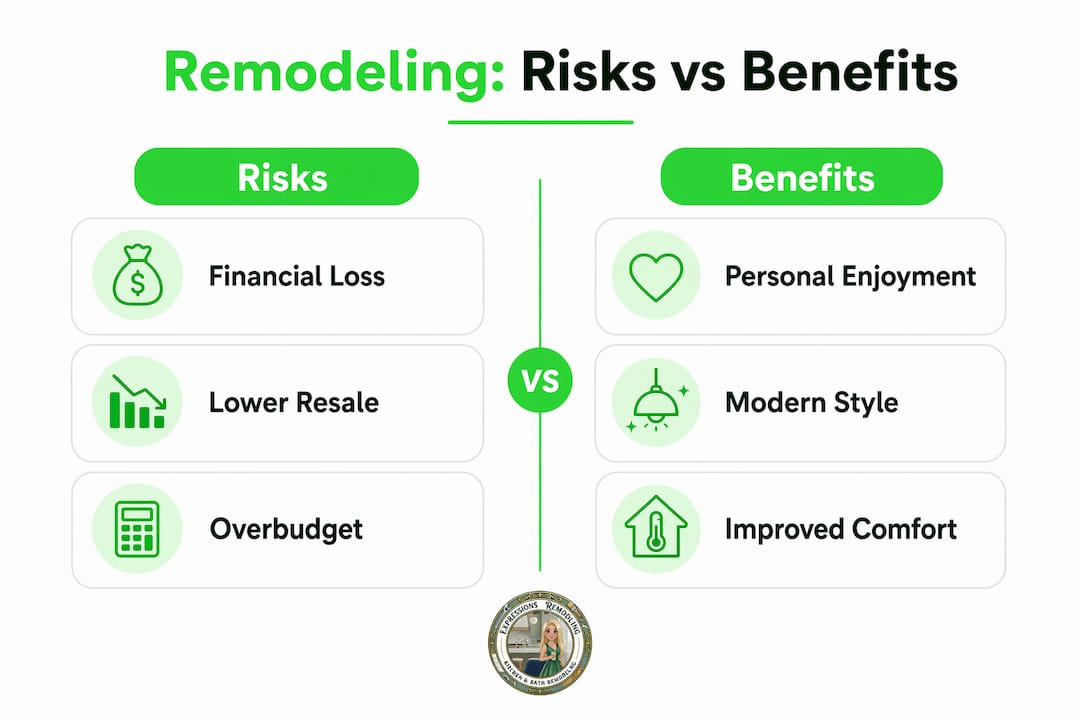
There’s also a tendency to underestimate the gap between personal preference and broad market appeal. Highly personalized upgrades, bold design choices, or niche features like a home theater or wine cellar can shrink the buyer pool considerably. Fewer interested buyers means slower sales and more negotiating leverage for the ones who do show up.
The financial risks of over-improving your home
The financial damage from excessive remodeling shows up in two ways: appraisal shortfalls and extended time on market. Appraisers rely on sales comparison data, not renovation receipts. Granite countertops, high-end appliances, and custom cabinetry only affect the appraised value if local sales data supports an adjustment. Without comparable homes that sold with similar features, the appraiser simply can’t justify adding the cost to the value.
Statistic to know: Homes priced more than 10% above the neighborhood median take two to three times longer to sell. Over-improvement that inflates your asking price into that range doesn’t just cost you money on the renovation. It costs you time, carrying costs, and often a price reduction anyway.
Highly personalized over-improvements can also alienate buyers outright, forcing price cuts regardless of what the renovation actually cost. A pool installed in a neighborhood where no comparable homes have pools is a classic example. The appraiser needs market data to justify the value adjustment. If that data doesn’t exist locally, the pool adds little to the appraised value and may actually deter buyers who don’t want the maintenance.
Common over-improvements that rarely pay off at resale include:
- Full luxury kitchen gut-remodels in mid-range neighborhoods
- High-end master suite additions
- Sunrooms and room additions that push square footage above neighborhood norms
- Custom pools in areas where pools aren’t standard
- Elaborate home theaters or wine cellars
Understanding resale value remodeling before you commit to a project is the clearest way to avoid this trap.
How to avoid over-improving during your remodel
The most reliable guardrail is research done before you hire a contractor. Pull recent comparable sales within half a mile of your home and find the highest sale price for a property similar to yours. Your post-renovation estimated value should not significantly exceed that number. If it does, you’ve identified an over-improvement risk before spending a dollar.
The 30% rule is the most widely used budgeting heuristic in remodeling. It states that total renovation spending should not exceed 30% of your home’s current market value, covering hard costs, labor, permits, and soft costs like design fees. Homeowners often use the 30% rule to estimate a spending ceiling proportional to their home’s market value. The rule isn’t a law or a lending standard. It’s a financial guardrail designed to keep you from funding renovations the market won’t reimburse.
A few practical steps that actually work:
- Check neighborhood price ceilings first. Research the highest recent sale price for a comparable home nearby. That number is your ceiling, not your renovation budget.
- Prioritize high-ROI updates. Fresh neutral paint, updated fixtures, and minor kitchen refreshes consistently outperform major gut-remodels on a cost-per-dollar-returned basis.
- Separate your budget line items. Track hard costs (materials, finishes), labor (typically 35–50% of hard costs), permits, and soft costs individually so nothing gets buried.
- Build in a contingency. Add 10–20% to your project estimate for surprises. Unexpected costs are the fastest way to blow past the 30% threshold without realizing it.
- Consult a local real estate professional or appraiser before major upgrades. They can tell you what the market in your specific neighborhood will actually support.
Pro Tip: Before committing to any upgrade over $10,000, ask a local appraiser whether comparable sales in your area support that feature. If they can’t point to data, the market probably won’t reward it.
For homeowners planning a kitchen project, affordable kitchen upgrades that refresh the space without a full gut-remodel often deliver better resale returns than a complete overhaul. Similarly, high-ROI home renovations focused on function and broad appeal consistently outperform luxury personalization at resale.
What appraisers actually look at, and why it matters
Appraisers don’t value your home based on what you spent. They value it based on what buyers have paid for similar homes nearby. The principle of contribution holds that an improvement adds value only to the extent the market accepts it. A $30,000 upgrade that buyers in your neighborhood won’t pay a premium for contributes far less than $30,000 to your appraised value.
When a home’s improvements exceed local market standards, appraisers classify them as superadequacies. The construction cost may be high, but the contributory value is limited because buyers in that market simply won’t pay for it. This is why appraisers require objective evidence of market demand. Without comparable sales showing that buyers paid more for a specific feature, expensive improvements often fail to move the appraised value at all.
That said, a home isn’t automatically over-improved just because it’s the largest or most upgraded on the street. If market data shows that comparable high-end homes in the area have sold at prices that justify the investment, the upgrades may be fully supported. The distinction is always local. A luxury kitchen that would be an over-improvement in a $200,000 neighborhood could be exactly right in a $700,000 one. The market sets the ceiling, and the ceiling varies by location.
Key Takeaways
Over-improvement in remodeling costs homeowners money and time when renovation spending exceeds what the local market will return at resale.
| Point | Details |
|---|---|
| Market sets the ceiling | Resale value is capped by comparable nearby sales, not by renovation cost or quality. |
| Appraisers need data | Features only add appraised value when local sales data supports an adjustment for them. |
| The 30% rule is a guardrail | Total renovation spending should not exceed 30% of your home’s current market value. |
| Overpriced homes sit longer | Homes priced more than 10% above the neighborhood median take two to three times longer to sell. |
| High-ROI updates beat luxury | Cosmetic refreshes and functional updates consistently outperform major gut-remodels on resale return. |
Remodel with confidence, not regret
Expressions Remodeling works with St. Louis homeowners to plan projects that reflect personal style without sacrificing resale value. Every project starts with understanding your goals, your neighborhood’s market, and where the smart money goes in your specific home. Whether you’re refreshing a kitchen, updating a bathroom, or finishing a basement, the team at Expressions Remodeling keeps your investment aligned with what the market will actually reward.
Ready to remodel without the risk of over-improving? Get a project consultation and find out exactly where your renovation dollars will work hardest.