
A value-add renovation is a targeted improvement that increases a property’s market value and net operating income beyond what the renovation itself costs. The term comes from commercial real estate, where value-add properties are those with identifiable, fixable underperformance: below-market rents, deferred maintenance, high vacancy, or poor management. Fix those problems, and you force the value up. That’s the whole idea.
Not every renovation qualifies. Repainting a bedroom is maintenance. Replacing a leaky roof is repair. A true value-add improvement does something more specific: it either raises income, reduces operating costs, or repositions the property to attract higher-paying buyers or tenants. The distinction matters because it changes how you budget, prioritize, and measure success.
Key traits that define a value-add renovation:
- Increases net operating income (NOI) or comparable sale price above renovation cost
- Targets a clear gap between current performance and market potential
- Produces measurable results: higher rent, lower vacancy, or stronger appraisal
- Stays within the neighborhood’s ceiling value to avoid diminishing returns
- Can be physical (kitchens, baths, flooring), operational (management, leasing), or strategic (re-tenanting, repositioning)
What renovation strategies actually add value to a property?
The most effective value-add home improvements fall into three categories: physical upgrades, operational improvements, and strategic repositioning. Most property owners focus only on the first category and leave the other two on the table.
Physical upgrades are what most people picture. Kitchen and bathroom renovations consistently rank at the top because tenants and buyers pay a visible premium for updated finishes. Flooring replacements, particularly luxury vinyl plank, deliver strong returns relative to cost. Exterior improvements, including fresh paint, landscaping, and updated signage on multifamily properties, create immediate curb appeal that affects first impressions and perceived value. Adding amenities like in-unit laundry, central air conditioning, or a dedicated parking spot can justify rent premiums that pay back the capital cost within a few years.

Operational improvements require no construction at all. Switching to professional property management, auditing vendor contracts for overpriced services, implementing utility billback programs, and tightening leasing processes all reduce expenses or increase effective income. These changes improve NOI just as reliably as a kitchen gut, often faster.
Strategic repositioning means changing who lives or works in the property. Re-tenanting below-market or problem tenants, reducing vacancy from above-market levels, and upgrading the tenant mix can shift a property’s income profile without a single hammer swing.
Common value-add strategies at a glance:
- Kitchen updates: countertops, cabinets, fixtures, appliances
- Bathroom refreshes: vanities, tile, lighting, hardware
- Flooring replacement with LVP or tile
- Exterior paint, landscaping, and curb appeal improvements
- In-unit laundry installation
- Common area upgrades in multifamily properties
- Professional property management transition
- Utility expense audits and billback programs
- Vacancy reduction through improved leasing and marketing
- Energy-efficient HVAC or lighting upgrades
One hard limit applies across all categories: neighborhood ceiling values cap what any improvement can return. Luxury finishes in a Class C neighborhood will not command Class A rents. Spending beyond what the local market supports produces diminishing returns, no matter how beautiful the renovation.
Pro Tip: Before committing to any upgrade, pull rent comps for the top 10–15% of comparable properties in your immediate area. That ceiling is your maximum achievable rent, and your renovation budget should work backward from it, not forward from your wish list.
Which renovations generate the highest ROI?
Kitchen and bathroom updates deliver the strongest returns for most residential and multifamily properties. Minor kitchen remodels recoup around 72% of costs for resale, and bathroom remodels come in around 67%, according to the Cost vs. Value Report from NAR and NARI. For rental properties, the math shifts: what matters is rent increase per dollar spent, not resale percentage.

The multifamily example below illustrates how rent premiums translate into property value at scale.
| Renovation Type | Typical Cost per Unit | Monthly Rent Premium | Capital Recoup Period |
|---|---|---|---|
| Full kitchen update | — | $100 | 3–5 years |
| Bathroom refresh | $6,000 | $150 | roughly three years |
| Flooring (LVP/tile) | $6,000 | $50–$100 | 3–5 years |
| In-unit laundry | — | $50–$100 | 2–3 years |
| Exterior/curb appeal | — | Portfolio-wide lift | Varies |
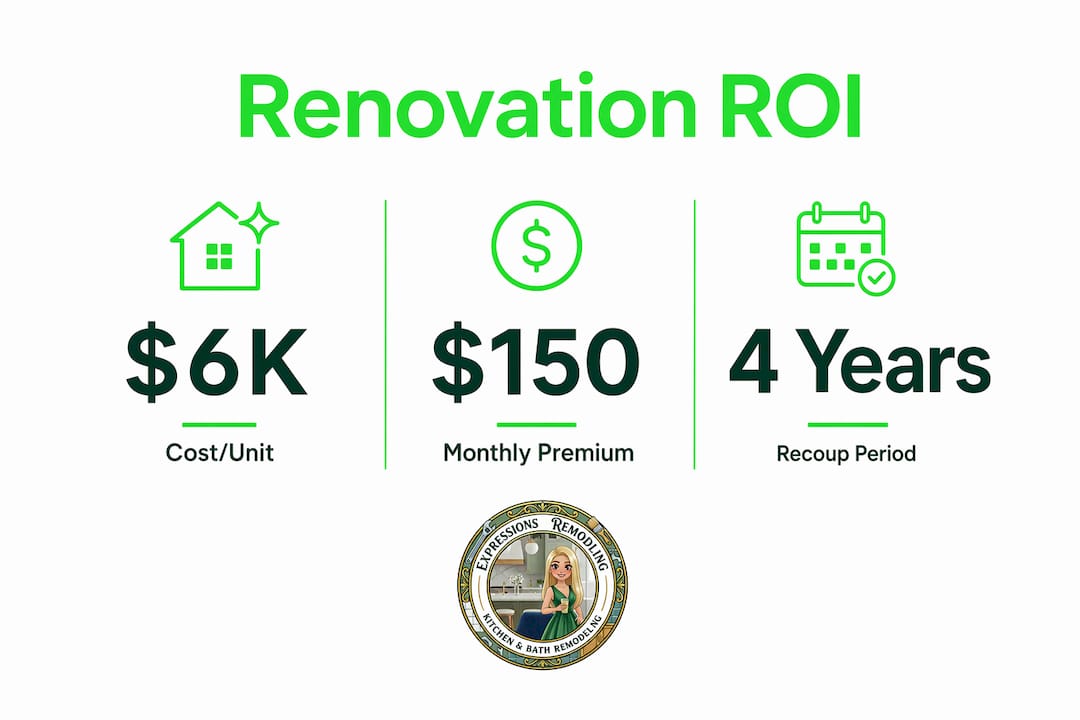
A practical example: multifamily renovations averaging $6,000 per door, targeting a $150 monthly rent premium, typically recoup that capital in roughly three years and create lasting NOI growth. At a 6% cap rate, a $6,000 annual NOI increase translates to $100,000 in added property value. That math is why investors focus so intently on NOI rather than cosmetic appeal alone.
The net value-add calculation is straightforward: renovation premium minus renovation cost, minus contingencies and carrying costs. When that number goes negative, you have a lifestyle renovation, not an investment. Including contingency and carry costs in every ROI projection is the difference between realistic underwriting and wishful thinking.
Pro Tip: Run this formula before any project: (monthly rent increase × 12) ÷ renovation cost = simple annual ROI. Target at least $2 in value or rent return for every $1 spent over your hold period. If the numbers don’t clear that bar, reconsider the scope.
For a deeper look at which specific projects pay off most reliably, Expressions Remodeling’s guide to high-ROI home renovations breaks down the numbers by project type.
How do you plan and execute a value-add renovation without costly surprises?
The biggest mistakes in value-add execution happen before construction starts. Incomplete budgets, optimistic timelines, and vague contractor agreements create the conditions for cost overruns that can erase projected profits entirely.
A complete renovation budget covers more than materials and labor. Labor typically runs 35–50% of hard costs, permits and inspections add another 0.5–3% of construction value, and soft costs like design and architectural fees typically add 5–10%. Financing fees run 1–3% on top of that. Investors who budget only for materials routinely discover their actual costs are 40–60% higher than expected.
The 30% rule offers a useful guardrail for homeowners: keep total renovation spending below 30% of the property’s current market value. For a $400,000 home, that means staying under $120,000 across all projects. Income properties can justify exceeding that threshold when projected rent increases support the math, but the rule prevents the most common mistake: over-improving relative to the neighborhood.
Planning tips that protect your ROI:
- Get at least three contractor bids during due diligence, before you close or commit
- Build a contingency of roughly one-sixth to one-fifth into every budget, not as an afterthought but as a line item
- Phase renovations unit-by-unit in multifamily properties to minimize vacancy during construction
- Communicate timelines clearly with existing tenants to reduce turnover friction
- Prioritize high-visibility upgrades (kitchens, baths, entry areas) over hidden infrastructure unless safety or code requires otherwise
- Track actual costs against budget weekly, not monthly
Common pitfalls that destroy value-add returns include underestimating timelines, ignoring holding costs during vacancy, and over-improving beyond the market tier. A renovation that runs three months longer than planned adds three months of mortgage payments, insurance, and property taxes to your cost basis. That 10–20% cost overrun can eliminate projected profits on a deal that looked solid on paper.
For a detailed look at why budgets slip and how to prevent it, Expressions Remodeling’s guide on renovation cost overruns covers the most common failure points.
Pro Tip: Lock your renovation scope in writing before work begins. Scope creep, adding “just one more thing” mid-project, is the single most reliable way to blow a budget. Every change order should require your written approval and a revised cost estimate.
Forced appreciation vs. market appreciation: why the distinction changes your strategy
Most property value increases happen passively. The market rises, your neighborhood improves, and your property is worth more without you doing anything. That’s market appreciation, and you have no control over it.
Forced appreciation works differently. You create it through renovations, rent increases, expense reduction, and operational improvements. The value goes up because you made it go up. That distinction is what makes value-add investing attractive to active investors: the return is not dependent on market timing.
The mechanics are direct. In commercial real estate, property value is a function of NOI divided by the cap rate. Raise NOI by $10,000 annually at a 6% cap rate, and you add roughly $167,000 in property value. That relationship is why investors underwrite rent premiums so carefully: a small monthly increase compounds into a large valuation lift at exit.
Execution risk is where forced appreciation strategies fail. Cost overruns, inaccurate rent projections, and extended vacancy during renovations increase holding costs and erode profits. Conservative underwriting, with a 15–20% budget contingency and rent projections based on current comparable rents rather than hoped-for future rents, is the standard practice that separates successful value-add investors from those who break even or worse.
Expressions Remodeling brings this discipline to residential projects in St. Louis, combining detailed pre-construction planning with quality execution to protect the financial outcomes homeowners and investors are counting on. The team’s experience across kitchen, bathroom, and basement remodeling means clients get accurate scopes, realistic timelines, and craftsmanship that holds up at appraisal.
Ready to put a value-add strategy to work in your St. Louis home? Expressions Remodeling specializes in the renovations that move the needle: kitchens, bathrooms, and finished basements that increase both livability and market value. Explore kitchen upgrade options or contact the team directly to discuss your project scope and budget.
Key Takeaways
Value-add renovations generate real financial returns only when the improvement cost is lower than the resulting increase in property value or net operating income.
| Point | Details |
|---|---|
| Definition of value-add | Improvements that raise NOI or market value beyond their cost, targeting identifiable underperformance. |
| Highest-ROI upgrades | Kitchen updates recoup around 72% of costs and bathroom remodels about 67% for resale; for rentals, focus on rent premium per dollar spent. |
| Budget discipline | Include labor (35–50% of hard costs), permits, soft costs (5–10%), financing fees (1–3%), and a 15–20% contingency. |
| The 30% rule | Keep total renovation spending below 30% of the property’s current market value to avoid over-improving relative to the neighborhood. |
| Forced appreciation | Raising NOI through renovations directly increases property value independent of market conditions, giving investors active control over returns. |