
Most kitchens need one of four fixes: refacing, new doors only, full replacement with stock or semi-custom boxes, or ready-to-assemble cabinets you install yourself. Budget roughly $2,000 to $28,000 depending on which route you pick and how big the kitchen is. The quick rule: if fixing what you have would cost more than half of new cabinets, replace instead of repair. Start by measuring your kitchen and inspecting the boxes for damage, then get two or three quotes before deciding anything.
TL;DR:
- Replacing only doors or refacing is cost-effective for quick updates, but full replacement is necessary for structural issues or layout changes.
- Cabinets should have solid plywood boxes, with drawers featuring dovetail joinery and full-extension slides rated for daily use.
- Full cabinet replacement can take from one to three weeks, depending on material customization and size, with permits potentially extending the timeline.
- Cabinet costs range from $2,000 to $28,000, with semi-custom and custom options pushing prices higher, especially for larger or complex kitchens.
- DIY work is limited to hardware, painting, or simple replacements, while layout changes and plumbing or electrical rerouting require professional contractors.
Table of Contents
- Refacing, New Doors, Full Replacement, or RTA: Which Fits Your Kitchen
- When Should You Replace Instead of Repair or Reface?
- What Should You Require From Cabinet Materials and Construction?
- How Long Does Cabinet Replacement Actually Take?
- What Drives Cabinet Replacement Costs?
- Should You DIY or Hire a Pro?
- How Do You Vet a Cabinet Contractor Before Hiring?
- Author Perspective: When Replacement Beats Refacing
- How Expressions Remodeling Can Help With Your Cabinet Project
- Sources
- FAQ
Refacing, New Doors, Full Replacement, or RTA: Which Fits Your Kitchen
Each option solves a different problem, and picking the wrong one wastes money either way.
Refacing keeps your existing cabinet boxes and swaps the doors, drawer fronts, and exterior surfaces for a new look. It only works if the boxes are structurally sound, and it typically costs 30 to 50 percent less than full replacement while taking a few days instead of weeks.
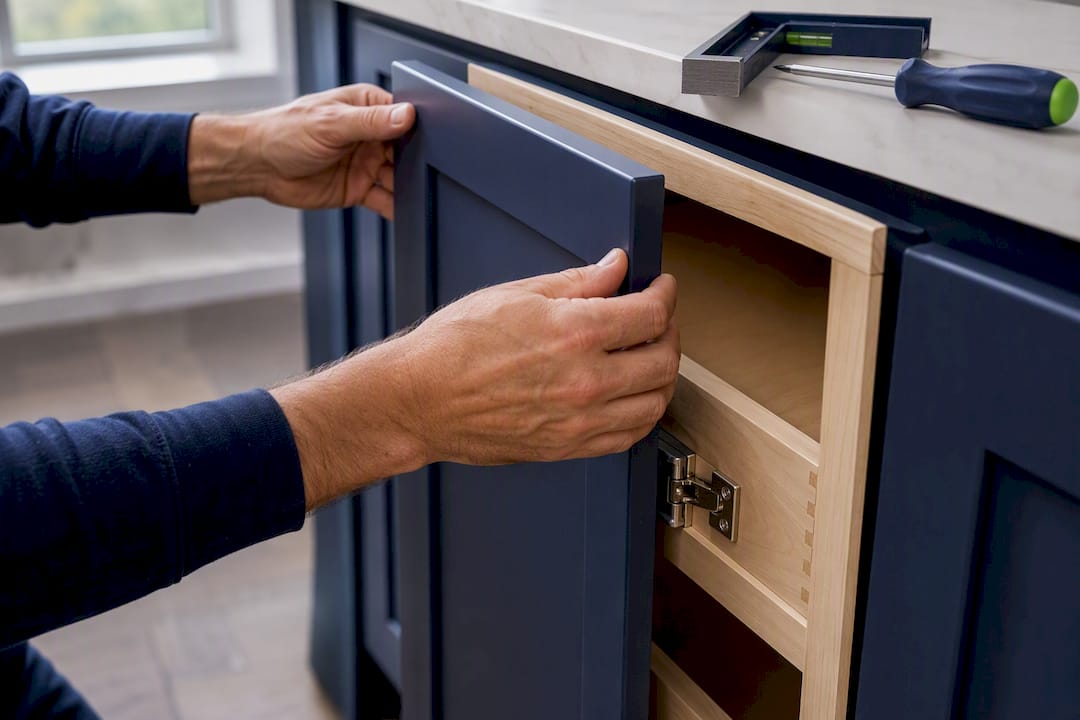
Replacing just the doors and drawer fronts is refacing’s cheaper cousin. Skip the veneer work entirely and hang new doors on hinges you already have. Good for a quick style refresh, not for fixing worn interiors or bad layouts.
Full replacement means new boxes, doors, and hardware throughout, in stock, semi-custom, or custom lines. It’s the only option that lets you change the kitchen’s footprint, and it costs the most but lasts the longest.
RTA (ready-to-assemble) cabinets ship flat and get bolted together on-site, often cutting material costs by 30 to 50 percent compared to pre-assembled units, in exchange for your time or a paid assembly service.
- Small kitchen: refacing in days, full replacement in one to two weeks
- Medium kitchen: full replacement often runs two to three weeks with lead times
- Large kitchen: custom cabinet orders can push installation past three weeks
When Should You Replace Instead of Repair or Reface?
Some damage makes the decision for you. Others come down to math and how long you’re staying put.
- Structural damage, water damage, mold, or rot in the boxes always means replace, since refacing over compromised wood just hides a growing problem.
- A layout change (moving a sink, adding an island, widening a doorway) requires full replacement. Refacing can’t touch the footprint.
- Repair costs exceeding roughly half the price of new cabinets signal it’s time to stop patching. If a contractor quotes $4,000 in structural repairs on cabinets that would cost $8,000 to replace, replacement usually wins on long-term value.
- Your timeline in the home matters. Selling in a year or two often favors a lower-cost reface; staying put for a decade tips the scale toward full replacement.
Pro Tip: Before calling anyone, open every cabinet and drawer and push on the box sides. Flex or soft spots almost always mean water damage you can’t see from the front.
What Should You Require From Cabinet Materials and Construction?
Cheap construction fails fast in a kitchen that gets used daily, and the difference often isn’t visible until year three or four.
Solid plywood boxes hold screws and weight far better than particleboard, which crumbles under repeated moisture exposure near sinks and dishwashers. MDF is fine for door panels and painted finishes, where its smooth surface actually outperforms wood grain, but it shouldn’t be the main box material.
For drawers, insist on:
- Dovetail joinery with solid wood sides, not stapled particleboard
- Plywood drawer bottoms, not thin hardboard that sags under weight
- Full-extension drawer glides rated for repeated daily use
Consumer Reports’ cabinet buying guide flags stapled particleboard drawers as the clearest sign of a corner-cutting manufacturer. Any composite wood component in your new cabinets, whether plywood, MDF, or particleboard, must meet EPA TSCA Title VI formaldehyde emission standards. Ask any supplier for compliance labeling before you sign anything, and review construction and door style trade-offs before committing to a finish.
How Long Does Cabinet Replacement Actually Take?
The clock starts the day you commit to a plan, not the day work begins.
- Measure and finalize design. A day or two for a straightforward layout, longer if you’re reworking the footprint.
- Order cabinets. In-stock or RTA units can arrive within a week or two. Semi-custom typically runs 4 to 8 weeks. Custom orders can take 8 to 12 weeks or more.
- Demolition. Usually one to two days for a standard kitchen.
- Installation. Refacing wraps up in 3 to 5 days; full replacement generally takes 1 to 3 weeks once cabinets are on-site.
- Finish work. Countertops, backsplash, and final trim can add several more days, especially if plumbing or electrical lines need to move.
Permits for structural or electrical changes can add weeks to the front end of the schedule, so factor that in before you set a target move-in date.
What Drives Cabinet Replacement Costs?
Cabinetry alone typically eats up 30 to 40 percent of a kitchen remodel’s total budget, with total project costs ranging from about $2,000 to $28,000 depending on size and material grade.
- Stock cabinets run the lowest per-linear-foot cost, best for standard layouts with no custom sizing needed
- Semi-custom cabinets cost more but allow size and finish adjustments for awkward spaces
- Custom cabinets command the highest prices, built to exact dimensions and specs
- Refacing runs roughly $150 to $450 per linear foot in many markets, though local labor rates swing that range significantly
Hidden costs sneak in through countertop removal and reinstallation, plumbing disconnection, old-cabinet disposal fees, and end panels needed to match new cabinets to existing walls. When comparing quotes, insist on line items for materials, labor, lead time, and warranty coverage so you’re comparing apples to apples, not just bottom-line totals. Small kitchens might land near the $10,000 mark; larger or custom jobs can climb well past $20,000. For lower-cost refreshes, see these affordable kitchen upgrade ideas.
Should You DIY or Hire a Pro?
Some cabinet work is genuinely beginner-friendly. Painting existing doors, swapping hardware, and installing pre-made replacement doors on existing hinges are all reasonable weekend projects with basic tools.
Full cabinet replacement, layout changes, and anything touching plumbing or electrical lines belong with a licensed contractor. Misaligned boxes, uneven countertops, and code violations are the most common DIY pitfalls, and fixing them after the fact often costs more than hiring a pro from the start.
- DIY-friendly: hardware swaps, door painting, simple door replacement
- Pro-only: box installation, layout changes, plumbing or electrical rerouting
Pro Tip: If your project requires moving a sink or gas line, get a licensed plumber’s quote before you finalize your cabinet order. Rerouting costs can change your entire budget.
How Do You Vet a Cabinet Contractor Before Hiring?
Some kitchen remodeling contractors focus on matching cabinet construction and layout decisions to how each homeowner actually uses their kitchen. That kind of hands-on project management is exactly what separates a smooth cabinet replacement from a stressful one.
Before hiring any contractor for cabinet work, confirm:
- Current license and liability insurance, in writing
- At least two or three references from recent kitchen projects
- A written scope of work covering materials, labor, and change-order policy
- A stated warranty on both materials and installation
- A realistic timeline with milestones, not just a start and end date
Author Perspective: When Replacement Beats Refacing
The decision rule is simpler than most homeowners expect: refacing preserves a layout you already like, replacement fixes one you don’t. Cheaper always feels better in the moment, but a reface over a bad floor plan just delays the renovation you actually wanted, at extra cost down the line.
— Kierin
How Expressions Remodeling Can Help With Your Cabinet Project
Expressions Remodeling is the direct alternative to piecing a cabinet project together yourself. Rather than juggling a cabinet supplier, an installer, and a countertop crew separately, you get one team managing the full kitchen remodeling project from measurement through final install, with kitchen remodeling projects starting from $10,000.

Before requesting an estimate, have your kitchen’s rough dimensions, photos of your current cabinets, and a general sense of your style preferences ready. That alone speeds up an accurate quote significantly. A good remodeling team should discuss construction quality, material options, and layout changes with clients before work begins to avoid surprises during the project. Explore the full range of remodeling services or head straight to the pricing page to request a quote for your kitchen.
Sources
- Cabinet Refacing: Everything You Need to Know | This Old House
- Kitchen cabinet buying guide | Consumer Reports
- Frequent questions for consumers about formaldehyde standards | EPA
FAQ
What Is the Average Cost to Replace Kitchen Cabinets?
Total cabinet costs typically range from $2,000 to $28,000, depending on kitchen size and whether you choose stock, semi-custom, or custom cabinets. Cabinetry usually makes up 30 to 40 percent of a full kitchen remodel’s budget.
What Is the Most Expensive Part of Redoing a Kitchen?
Cabinetry is consistently one of the biggest line items in a kitchen remodel, often outpacing countertops, appliances, and flooring combined. Custom cabinet lines and structural layout changes push that cost even higher.
Is $10,000 Enough for a Kitchen Remodel?
It can work for a small kitchen with stock cabinets, refacing, or targeted upgrades rather than a full gut renovation. Expressions Remodeling’s kitchen remodeling projects start from $10,000, though final pricing depends on size, materials, and scope.
What Are the Signs That It’s Time to Replace Kitchen Cabinets?
Structural damage, water stains, mold, or rot inside the boxes are clear signals that replacement, not refacing, is the right call. Wanting a new layout or footprint is another sign, since refacing can’t change the kitchen’s structure, only its surface appearance.