For most finished basements, luxury vinyl plank or tile (LVP/LVT) is the best overall choice because of its waterproof construction and comfortable feel underfoot. Porcelain tile, epoxy, and sealed concrete work best for wet or utility areas like laundry rooms and workshops. Engineered hardwood, laminate, and carpet can all work, but only when a moisture test confirms the slab is dry enough and proper prep is done first.
TL;DR:
- Proper slab moisture testing with ASTM F2170 is essential before choosing any flooring type, as visual checks often underestimate internal moisture levels.
- Waterproof vinyl plank and tile are the best options for general basement flooring, with LVP handling moisture, comfort, and cost effectively if installed correctly.
- Tile is ideal for wet or utility areas like laundry rooms and workshops, but it requires a stable, level subfloor and sealing of grout lines.
- Engineered hardwood can be used if the slab is tested and confirmed dry, but it is more sensitive to moisture and costlier than LVP.
- Avoid traditional laminate on slabs without proper moisture barriers, as its core cannot handle rising ground moisture and will likely fail prematurely.
Table of Contents
- Luxury vinyl plank and tile: why it’s often the top pick
- Ceramic and porcelain tile: best for wet areas and high-durability needs
- Engineered hardwood: when you can use wood-look real surfaces in a basement
- Waterproof laminate and traditional laminate: what changed and remaining limits
- Carpet and carpet tiles: warmth and comfort for dry finished basements
- Epoxy, polyaspartic, and sealed concrete: durable and flood-tolerant options
- Rubber and specialized resilient floors: gym, playroom, and work-area solutions
- How to choose the right basement flooring: a moisture-first framework
- Basement moisture and slab prep: what building science says
- A guide to basement subfloor options and how they change your flooring choice
- Environmental and health considerations for basement flooring
- What years of basement remodels have taught us
- Getting your slab tested and your basement floor done right
- Sources
- FAQ
Luxury vinyl plank and tile: why it’s often the top pick
LVP and LVT are built from multiple layers, typically a rigid or flexible core, a printed design layer, and a wear layer, with many products rated fully waterproof at the surface. That construction is why LVP has become the default recommendation for finished basements, offering waterproof performance and comfort that other categories struggle to match at a similar price, according to HGTV’s basement flooring guide.
You can install LVP two main ways: floating (click-lock planks that rest over an underlayment) or fully glued down. Floating floors are faster to install and easier to replace in sections, while glued installations tend to feel more solid underfoot and handle heavier furniture loads better.
- Comfort and warmth: LVP feels warmer than tile or bare concrete and works well over radiant heat systems when the manufacturer approves it.
- Cost drivers: rigid-core products, thicker wear layers, and glue-down installation over a leveled slab all push the price higher than basic floating floors.
- Moisture caveat: even waterproof LVP can fail at the seams or adhesive layer if the slab underneath carries high internal moisture, so manufacturer installation and warranty requirements around subfloor prep still apply.
Skipping the moisture check because “it’s waterproof” is the single most common mistake homeowners make with this material.
Ceramic and porcelain tile: best for wet areas and high-durability needs
Tile is the most reliably water-resistant flooring for a basement, but only at the tile surface itself. Porcelain is denser and less porous than ceramic, which makes it the better choice for basements, laundry areas, or anywhere standing water is a real possibility. Ceramic costs less and still performs fine in areas with only occasional dampness.
Grout lines and any unglazed tile edges remain vulnerable to moisture and staining, which is why sealing grout is not optional in a below-grade installation, a point HGTV makes clear when discussing basement-specific tile use.
- Substrate needs: tile requires a flat, stable subfloor, often a cement backer board or a properly cured slab, adding to installation time and cost.
- Installation cost: expect a wider price range than LVP once you factor in backer board, thinset, grout, and sealing labor.
- Comfort fix: pair tile with radiant heat or area rugs in living zones, since bare tile stays cold and hard underfoot.
Tile earns its place in mechanical rooms, bathrooms, and wet bars. It is a harder sell for a media room or playroom where comfort matters more than permanent wet resistance.
Engineered hardwood: when you can use wood-look real surfaces in a basement
Engineered hardwood is the only real-wood product that belongs in a basement conversation, and even then only under specific conditions. Unlike solid hardwood, which swells and warps with moisture swings, engineered wood has a plywood or composite core topped with a thin hardwood veneer, making it far more dimensionally stable.
That stability still has limits. Engineered hardwood requires a genuinely dry slab or a raised subfloor system that separates the wood from direct concrete contact, and it should never be installed on a hunch that the basement “feels dry.”
- Installation method: floating installations over a moisture barrier are more forgiving than glue-down, though glue-down can work with the right adhesive and a verified dry slab.
- Radiant heat: many engineered products are rated for radiant systems, but always confirm with the manufacturer before installing over heat.
- Lifespan tradeoff: engineered hardwood typically costs more than LVP and carries more moisture risk, but delivers the closest look and feel to solid wood.
If your slab tests dry and stays dry year-round, engineered hardwood is a reasonable upgrade. If there is any seasonal dampness, it is not the right call.
Waterproof laminate and traditional laminate: what changed and remaining limits
Laminate flooring has split into two distinct categories, and conflating them leads to bad basement decisions. Traditional laminate uses a wood-fiber core that swells when it gets wet, full stop. Newer waterproof laminate products use a denser, more water-resistant core and tighter locking seams, which holds up far better against surface spills.
Even so, waterproof laminate’s core is still wood-fiber-based, which means it remains more vulnerable to long-term moisture wicking up from below than a fully waterproof LVP product, a distinction HGTV draws out specifically for basement use.
- Spill performance: waterproof laminate handles a spilled drink or minor leak fine if it is cleaned up promptly.
- Rising moisture: it is not built to withstand sustained ground moisture the way sheet or click LVP is.
- Cost and look: laminate often costs less than engineered hardwood and can look similar, but LVP usually matches or beats it on both price and moisture tolerance.
Use waterproof laminate in a basement only after a passing moisture test, and follow the manufacturer’s installation guidance to the letter. When in doubt, choose LVP instead.
Carpet and carpet tiles: warmth and comfort for dry finished basements
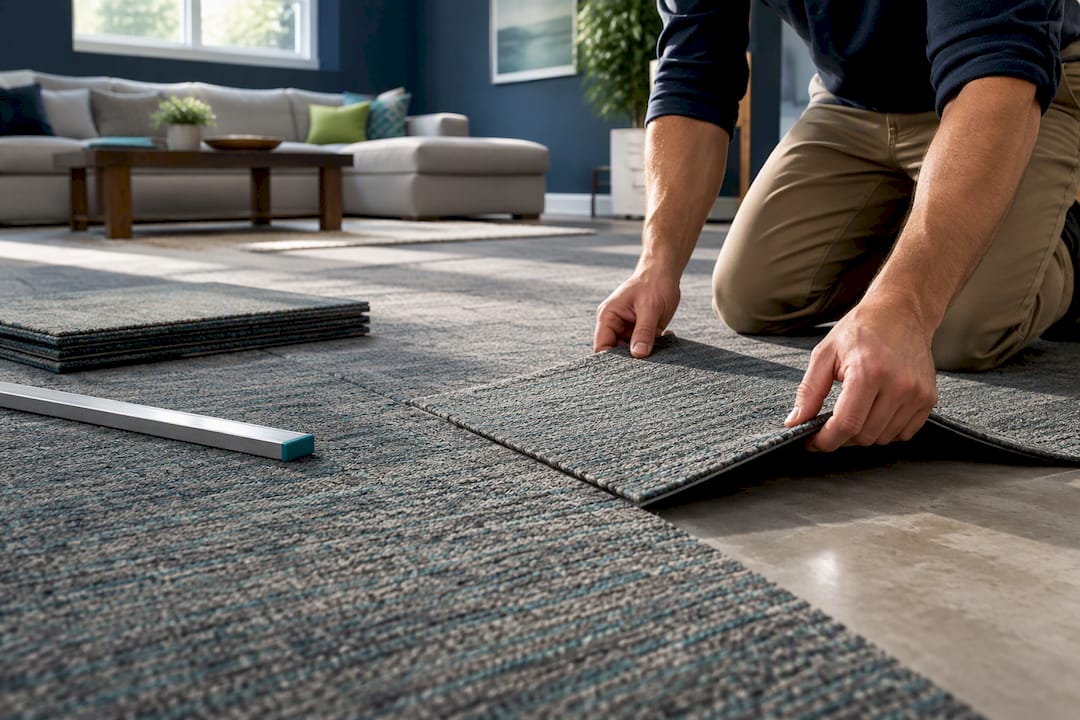
Carpet brings warmth, sound dampening, and comfort that hard flooring cannot match, which is exactly why it remains popular for basement family rooms and playrooms. It is also the material with the least tolerance for moisture problems, so it belongs only in basements that test dry or sit over a properly raised subfloor.
Carpet tiles offer a practical advantage over broadloom carpet: if a section gets wet, you can pull up and replace individual tiles instead of tearing out the entire floor, a recovery option HGTV specifically recommends for basement installations.
- Fiber choice: synthetic fibers like polypropylene or nylon resist mold and mildew far better than natural fibers.
- Backing to avoid: skip jute or other natural-fiber backings below grade, since they absorb and hold moisture.
- Insulation bonus: carpet adds a noticeable sound and thermal buffer that hard surfaces do not provide.
If your basement has ever flooded, or you have not tested the slab, hold off on carpet until you know where you stand.
Epoxy, polyaspartic, and sealed concrete: durable and flood-tolerant options
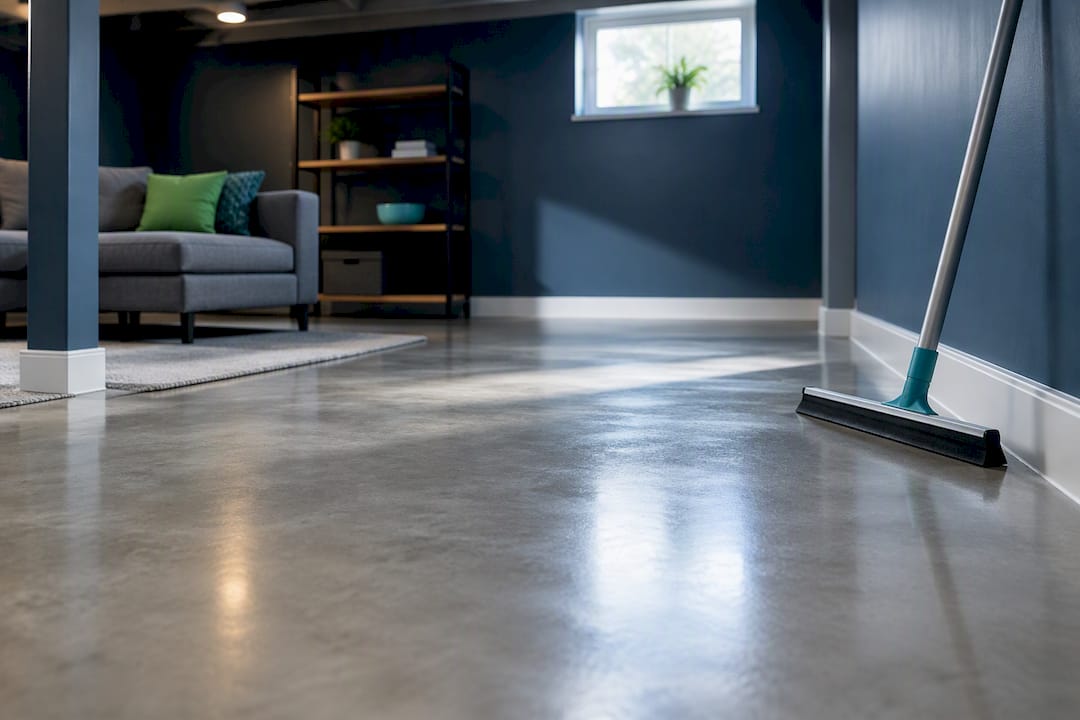
For workshops, gyms, and utility rooms, coating the slab itself instead of covering it is often the smartest move. Epoxy and polyaspartic coatings bond directly to concrete and can hold up on wet or high-alkali slabs, but only when the product is formulated for high pH or the slab has been treated to lower and stabilize alkalinity first, according to BuildingScience’s concrete floor problems guide. Control joints also need vapor-impermeable sealant, or the coating can blister.
When a slab is too wet even for a treated coating, a dimpled plastic membrane creates an airspace that equalizes vapor pressure between the concrete and whatever floor goes on top, allowing a successful installation where direct drying was not an option.
- Use case fit: epoxy and polished concrete suit home gyms, workshops, and utility rooms where impact resistance and easy cleanup matter more than warmth.
- Maintenance: sealed concrete needs periodic resealing, while epoxy is largely wipe-clean and resists most chemicals and stains.
- Cost range: pricing varies widely with slab prep needs, but coatings generally cost less than a full tile or hardwood installation over the same square footage.
Pro Tip: Ask any contractor bidding an epoxy job whether they are testing slab pH before applying the coating, not just moisture.
Rubber and specialized resilient floors: gym, playroom, and work-area solutions
Rubber flooring shows up in basements as interlocking tiles, rolled sheet goods, or dense foam-backed mats, and most versions handle moisture at the surface without issue. It is the category most homeowners overlook, yet it solves specific problems better than anything else on this list.
- Impact and grip: rubber absorbs impact and resists slipping, which is why it dominates home gyms and workshop floors.
- Cleanup: spills, sweat, and dropped tools wipe off easily, with no grout lines or seams to worry about.
- Sound: rubber dampens noise from equipment or foot traffic better than tile, laminate, or LVP.
The tradeoff is aesthetics. Rubber reads as functional rather than finished, so it fits a dedicated gym, kids’ play area, or tool room far better than a media room or guest suite.
How to choose the right basement flooring: a moisture-first framework
Every basement flooring decision should follow the same sequence: test the slab, match the material to the room’s job, then weigh cost against expected lifespan.
- Test the slab first. ASTM F2170 in-situ relative humidity testing is the method professionals rely on to determine whether a slab is dry enough for finish flooring, since it measures moisture inside the concrete rather than just its surface.
- Match material to room function. A media room favors LVP or carpet tiles for comfort, a home gym favors rubber or polished concrete, and a laundry or mechanical room favors tile or epoxy.
- Weigh cost against lifespan. Cheaper materials that fail early because of skipped moisture prep end up costing more than a slightly pricier option installed correctly the first time.
Before hiring anyone, run through a short checklist with your contractor:
- Ask to see the actual RH test results and the manufacturer’s acceptable range for your chosen product.
- Confirm what substrate prep (leveling, moisture barrier, backer board) is included in the quote.
- Ask which adhesive or installation method they plan to use and whether it is approved for below-grade application.
- Get the flooring warranty terms in writing, including what voids them.
Watch for a few red flags. A contractor who skips moisture testing entirely, who promises a material “just works” in any basement, or who cannot explain why they chose a particular adhesive for your slab conditions is worth a second opinion. Our basement finishing best practices guide walks through the full prep and finishing sequence in more detail if you want to go deeper before making a call.
Basement moisture and slab prep: what building science says
Concrete slabs hold built-in moisture from the pour long after they look and feel dry, and that residual moisture is the leading cause of flooring failure when finish materials go down too soon, according to BuildingScience’s BSI-125 report on concrete basement foundations. “Dry to the touch” tells you nothing reliable about what is happening inside the slab.
Building science guidance treats ASTM F2170 in-situ RH testing as the standard method to confirm a slab is ready for flooring, because visual and touch checks consistently miss trapped moisture that causes adhesion failure and mold later.
When a slab tests wet, you have three practical paths: delay installation until it dries, apply a pH-compatible epoxy barrier suited to the slab’s alkalinity, or install a dimpled pressure-equalization membrane that lets flooring go down without waiting on the concrete to fully cure. Subfloor prep and moisture testing matter more to long-term success than which material you pick. Our basement moisture control guide covers weekend fixes worth trying before you commit to any flooring purchase.
A guide to basement subfloor options and how they change your flooring choice
The subfloor sitting between your slab and finish flooring often matters more than the flooring itself. A raised subfloor panel system, typically interlocking plastic or OSB panels with a built-in air gap, lifts flooring off the concrete and lets moisture vapor escape sideways instead of pushing straight up into your floor. This opens the door to materials like carpet and engineered hardwood that would otherwise be risky directly on a slab.
A dimpled membrane serves a similar purpose for wetter slabs, creating an airspace that equalizes vapor pressure before flooring goes down. For dry, tested slabs, some materials, including many LVP and tile products, can go down directly on the concrete with only a thin underlayment or membrane for cushioning and vapor control.
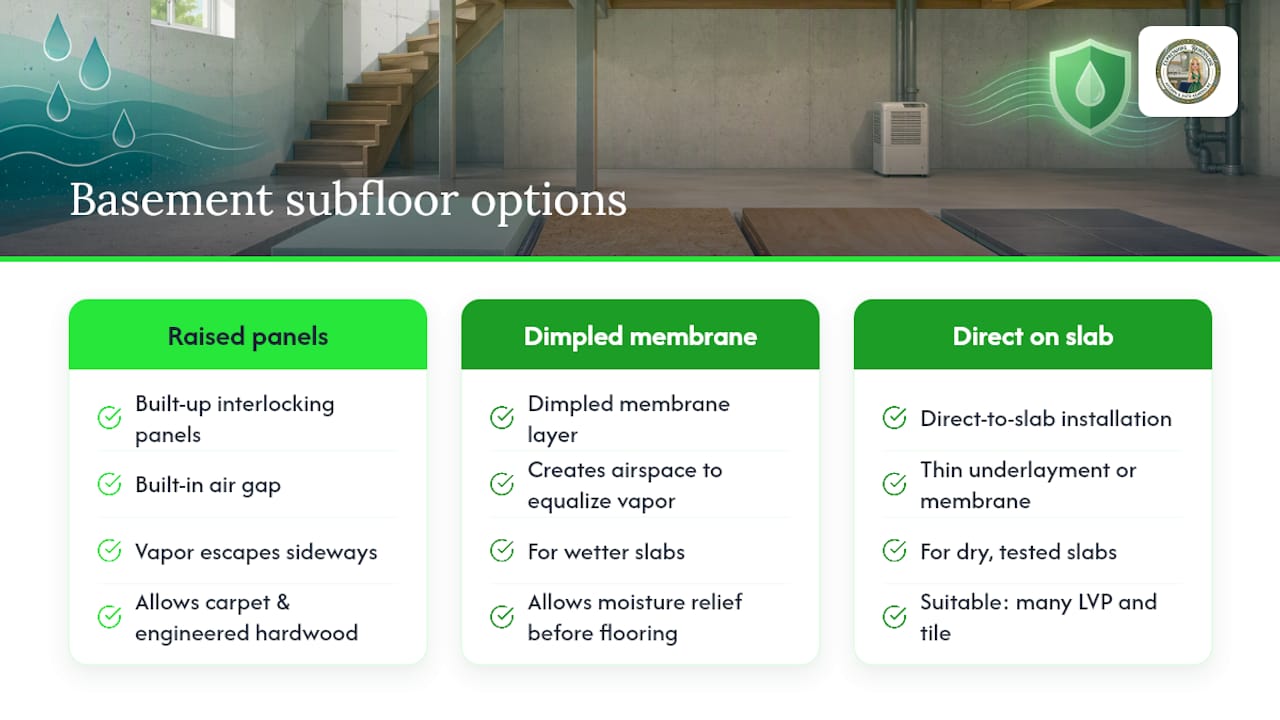
The subfloor decision changes your cost and timeline as much as it changes what materials are on the table. Raised systems add labor and material cost upfront but expand your material options and reduce the odds of a callback. Skipping a subfloor to save money on a slab that has not been properly tested is how homeowners end up replacing flooring twice.
Environmental and health considerations for basement flooring
Basements trap moisture and have less airflow than upper floors, which makes indoor air quality and mold resistance bigger concerns below grade than anywhere else in the house. Flooring adhesives and some laminate and engineered wood cores emit volatile organic compounds (VOCs), and low-VOC or VOC-free labeled products reduce off-gassing in a space that already struggles to ventilate.
Mold resistance is just as important as VOC content. Synthetic carpet fibers and closed-core LVP resist mold growth far better than natural-fiber carpet backing or solid wood, both of which hold moisture and can support mold if the basement ever gets damp. Rubber and tile are inherently mold-resistant at the surface, though grout and any exposed subfloor material still need attention.
If anyone in the household has respiratory sensitivities, prioritize low-VOC adhesives and finishes, and make sure whatever moisture mitigation step you use (membrane, epoxy barrier, or full drying period) is actually completed before flooring traps anything underneath it.
What years of basement remodels have taught us
The most common mistake we see on homeowner-installed basement floors is skipping moisture testing entirely and trusting a visual check instead. That single shortcut causes more callbacks than any material choice. We weigh comfort, durability, and budget against what the slab actually tests at, not against what a homeowner hoped it would be.
Homeowners most often underbudget for moisture mitigation, slab leveling, and warranty-compliant adhesives, the unglamorous prep work that determines whether a floor lasts five years or twenty.
— Kierin
Getting your slab tested and your basement floor done right
Choosing the right material only pays off if the prep underneath it is done correctly, and that is where most basement flooring projects go wrong. Expressions Remodeling handles moisture diagnostics, subfloor prep, and finished flooring installation as part of full basement remodeling projects in the St. Louis area, so the material you choose actually performs the way it is supposed to.
Vinyl flooring installation starts from $2 per square foot, and full basement remodeling starts from $40 per square foot, both listed on our pricing page. If you want a straight answer on whether your slab is ready for the floor you have in mind, reach out through our pricing page to get started.
Sources
The building science guidance in this article draws on BuildingScience’s BSI-125 report on concrete basement foundations and its companion concrete floor problems report, along with HGTV’s basement flooring options guide. Homeowners planning a project in the St. Louis area can find more detail in our moisture-smart basement guide and our page on finishing a basement dry, healthy, and code-compliant.
FAQ
What is best for basement flooring over concrete?
Luxury vinyl plank or tile is generally the best choice directly over concrete because its waterproof core tolerates the moisture concrete slabs naturally hold. Tile and epoxy coatings also work well over concrete, particularly in utility or wet-prone areas, as long as the slab has been tested and prepped correctly first.
What is the most cost-effective flooring option for a basement?
Vinyl flooring is typically the most cost-effective basement option, with installation starting from $2 per square foot according to Expressions Remodeling’s pricing page. It combines a low upfront cost with waterproof performance, which reduces the risk of costly replacement later.
Is it better to have carpet or LVP in a basement?
LVP is the safer default for most basements because it tolerates moisture and spills far better than carpet. Carpet or carpet tiles only make sense once a moisture test confirms the slab is dry or the carpet sits over a raised subfloor system.
Is tile or LVP better for basement floors?
Tile is the stronger choice for wet-prone areas like laundry rooms or mechanical spaces because it resists water at the surface better than almost anything else. LVP is generally the better fit for living areas since it offers more warmth and comfort while still handling moisture well, according to HGTV’s basement flooring guide.
Recommended
- Stop Basement Moisture: 6 Weekend Fixes Homeowners Must Do First
- Basement Finishing Best Practices: Your 2026 Guide
- Moisture Smart, Code Compliant, Built to Last: Transform Your St. Louis Basement
- Finish Your St. Louis Basement the Right Way: Dry, Healthy and Code-Compliant, with Complimentary 3D Design