

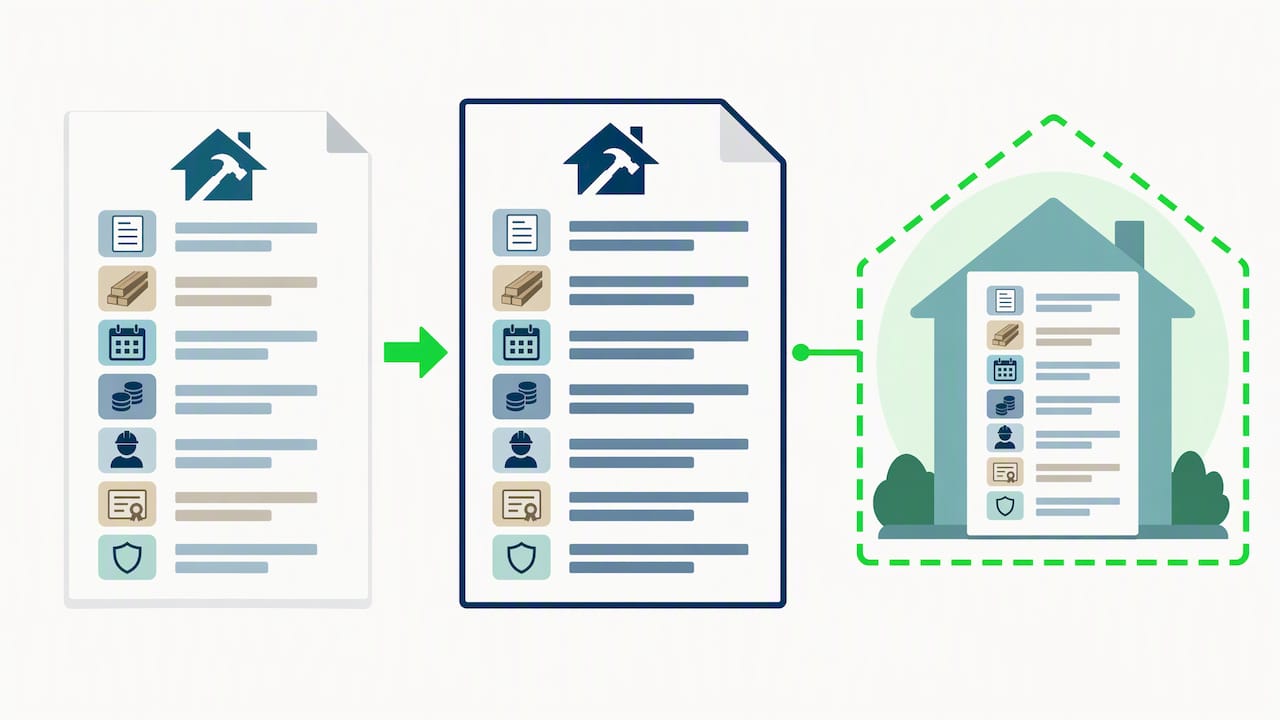
A complete remodeling estimate lists a clear scope of work, itemized materials and labor, allowances for products not yet chosen, a start and completion date, a total price, a payment schedule, change order rules, exclusions, warranties, and the contractor’s contact and license information. It should be itemized rather than a single lump sum, and it should state a contingency amount for unexpected conditions. If any of these pieces are missing, ask for them before you sign anything.
TL;DR:
- An itemized remodeling estimate should include detailed scope, material allowances, total price, contingency funds, and clear change order procedures.
- The scope must specify task boundaries, measurable deliverables, and reference drawings to prevent misunderstandings or disputes.
- Allowances should be explicitly defined with documentation of both the placeholder amount and what it covers, including installation costs.
- Labor costs should be itemized or transparently included, with clear documentation of subcontractor licensing, while permits and schedule milestones should be explicitly assigned.
- Comparing multiple bids requires ensuring scope parity, verifying licensing, permit responsibilities, and scrutinizing contingency and payment terms.
Table of Contents
- Scope of work: how an estimate should break the project down
- Materials, product selections, and allowances
- Labor, subcontractor pricing, and project management fees
- Timeline, milestones, permits, and inspections
- Pricing breakdown, contingency, and how the total is calculated
- Payment terms, deposits, and acceptable holdbacks
- Change orders, contingencies, and documenting scope changes
- Exclusions, site protection, cleanup, and warranties
- How to compare multiple estimates: a practical checklist and questions to ask
- Documentation and homeowner protections (FTC, BBB, EPA lead-safe rules)
- Publisher perspective and Expressions Remodeling proof points
- Author perspective: two practical priorities for homeowners
- How Expressions Remodeling helps: get a detailed in-home estimate
- FAQ
- Sources
- Authoritative links for verification and next steps
Scope of work: how an estimate should break the project down
A scope of work is the backbone of the estimate. It should describe tasks trade by trade or room by room: demolition, framing, electrical rough-in, drywall, finish carpentry, paint. Vague phrases like “update kitchen” or “remodel bathroom” leave too much room for disagreement once work starts.

A specific scope states where each task begins and ends, and it ties work to measurable deliverables such as square footage of tile, linear feet of cabinetry, or fixture counts. It should also reference drawings, plans, or product cut sheets rather than leaving design decisions implied.
A few examples of what specificity looks like in practice:
- Kitchen: “Remove existing upper and lower cabinets, install 18 linear feet of new cabinetry per attached drawing, replace 150 square feet of flooring.”
- Bathroom: “Demo existing tub surround, install 60 inch shower pan and tile to ceiling, relocate plumbing 12 inches per plan.”
- Room addition: “Frame 200 square foot addition on existing foundation, match roofline per architectural drawing, rough in two electrical circuits.”
Ask who is responsible for producing drawings and who has final sign off when the scope changes mid-project. Those two questions prevent a lot of friction later.
Materials, product selections, and allowances
An estimate should separate items the contractor has already specified from items covered by an allowance, a placeholder dollar amount for products you have not chosen yet. Specified items list a brand and model number. Allowances list a dollar figure and a category, such as “countertop allowance: $3,500.”
Common allowance categories include:
- Countertops, cabinets, and hardware
- Plumbing and lighting fixtures
- Flooring and tile
- Appliances
Ask the contractor to clarify exactly what each allowance covers, including installation labor, delivery, and tax, since bids sometimes bury those costs differently.
A low allowance can make one bid look cheaper than another on paper, even though the homeowner ends up paying the difference as a change order once they pick real products. The client resource on how material selection works explains how allowances and final selections are typically documented for homeowners.
Pro Tip: Price out the actual countertop, faucet, or tile you want before signing, then compare that number to the allowance listed in the estimate.
Labor, subcontractor pricing, and project management fees
Labor can appear as itemized trade entries (framing labor, electrical labor, tile labor) or as a single lump sum covering the whole job. Itemized entries make it easier to compare bids and to understand what you are paying for if a trade’s scope changes.
When subcontractors are involved, such as electricians or plumbers, the estimate should state whether their quotes are included in the total or billed separately. Bureau of Labor Statistics occupational data on trades like carpenters helps explain why labor costs vary so much between regions and specialties.
A few things to check for:
- Whether subcontractor pricing is itemized or folded into a lump sum
- Whether the contractor verifies subcontractor licensing and insurance
- Whether project management or overhead fees are shown as a separate line or built into markup
Permit fees and licensing costs should also be visible somewhere in the estimate rather than assumed to be included.
Timeline, milestones, permits, and inspections
The schedule section of an estimate should be as specific as the scope section. At minimum, it needs:
- A projected start date and a projected completion date.
- Milestone dates for major phases, such as demolition complete, rough-in complete, and final inspection.
- A reasonable float for weather, material lead times, or inspection delays.
The estimate should also state who is responsible for pulling permits, since this affects both schedule and liability. Permit review times and inspection scheduling vary by jurisdiction, and delays here are one of the most common reasons projects run long. A partner guide on bathroom renovation phases walks through how milestone scheduling typically works for a mid-size remodel, and a deck building timeline guide shows similar principles for exterior projects.
Ask any contractor you are considering how long permits typically take in your jurisdiction and whether they have pulled permits there before. A contractor unfamiliar with local permit offices can add weeks you did not budget for.
Pricing breakdown, contingency, and how the total is calculated
The total price on an estimate is the sum of several parts: materials, labor, subcontractor costs, permit fees, disposal or dumpster fees, overhead and profit markup, and applicable sales tax. A written estimate should let you see each of these pieces rather than a single number with no explanation behind it.
Contingency is different from an allowance. An allowance covers a product you have not chosen yet; contingency covers conditions nobody could see before opening a wall, such as old wiring, water damage, or structural surprises. Contractors’ planning guidance on budgeting points to site conditions, design changes, and price volatility as the usual drivers behind a contingency line.
To verify the math on a bid:
- Ask for a written cost roll-up showing each category separately
- Confirm whether markup is a flat percentage or built into unit prices
- Confirm whether tax and disposal fees are included in the total or added later
A guide on why renovation costs overrun covers how missing contingency often turns into mid-project change orders.
Payment terms, deposits, and acceptable holdbacks
A reasonable payment schedule starts with a deposit, followed by progress payments tied to completed milestones, and ends with a final payment held back until the work passes inspection and you have accepted it. BBB guidance on contracting with confidence recommends negotiating staggered payments rather than handing over the full amount before work starts, and checking references before signing anything.
A few practices worth following:
- Avoid paying the full contract price upfront, no matter how reasonable the discount sounds
- Confirm the payee name matches the licensed business, not an individual
- Keep receipts for every payment, including the deposit
Pro Tip: Ask for lien waivers from subcontractors as you pay, so you are protected if the general contractor fails to pay them.
Change orders, contingencies, and documenting scope changes
A proper change order is a short written document, not a verbal agreement. At minimum it should include:
- A description of the added or changed work.
- The incremental cost, shown separately from the original contract price.
- Any schedule impact, stated in days or weeks.
- A signature and date from both you and the contractor.
Contingency funds and change orders serve different purposes. Contingency covers unforeseen conditions already budgeted into the contract; a change order covers new work you are requesting, like upgrading a fixture mid-project. Small on-site clarifications should still be noted in writing, even if it is just an email confirming what was discussed, so there is a record if a dispute comes up later.
Exclusions, site protection, cleanup, and warranties
Exclusions matter as much as what is included. Look for language addressing landscaping repair, hidden repairs beyond the original scope, and any permit-driven upgrades the inspector might require once walls are open.
A broom clause, meaning the contractor is responsible for daily cleanup and final debris removal, prevents a surprise cleaning bill at the end of the job.
- Common exclusions: landscaping restoration, hazardous material remediation, structural surprises beyond the stated scope
- Cleanup responsibility: daily debris removal and final haul away
- Warranty coverage: workmanship warranty from the contractor and separate manufacturer warranties on products
Ask who to contact if something fails after the job is done, the contractor or the manufacturer, and get that contact information in writing.
How to compare multiple estimates: a practical checklist and questions to ask
Comparing bids only works when you are comparing the same scope. Before ranking bids by price, check:
- Does each bid cover the same scope of work and the same allowances?
- Are the schedules comparable, including permit time?
- Does each bid list a contingency, and at what level?
- Is the payment schedule staggered in a similar way?
- Does each contractor show proof of license and insurance?
A few questions worth asking every contractor directly: How long have you worked in this area? Who pulls the permits? Do you verify subcontractor licensing before hiring them?
Pro Tip: Get at least three written bids, and if one comes in far below the others, ask what is excluded rather than assuming it is simply a better deal.
Documentation and homeowner protections (FTC, BBB, EPA lead-safe rules)
Several consumer-protection sources spell out what a written estimate should contain. The FTC’s guidance on avoiding home improvement scams says a written estimate should include a clear description of the work, a materials cost breakdown, a start and completion date, and the total price, and that the final contract should list the contractor’s name, address, and license number along with your right to cancel under certain circumstances.
For homes built before 1978, the EPA’s Lead Renovation, Repair and Painting Program requires lead-safe work practices, and homeowners should confirm a contractor’s EPA certification before work begins.
One sourced fact worth remembering: the FTC explicitly recommends getting multiple written estimates before choosing a contractor, since comparing bids line by line is one of the clearest ways to spot a vague or incomplete one.
- Confirm the contractor’s license number and contact information in writing
- Ask about your right to cancel and get it in the contract
- Verify EPA lead-safe certification for pre-1978 homes
Publisher perspective and Expressions Remodeling proof points
Some remodeling contractors document allowances, warranties, and project timelines directly in their written estimates. The free in-home estimate page outlines what homeowners should prepare before a site visit, and the guide to how remodeling contracts work covers payment terms and protections in more detail.
Author perspective: two practical priorities for homeowners
If you remember nothing else, demand an itemized scope and a clear change order process before you sign anything. Beyond that, get three written bids and confirm licensing and permit responsibility directly with each contractor.
— Kierin
How Expressions Remodeling helps: get a detailed in-home estimate
Some remodeling contractors offer free in-home estimates that result in a written, itemized proposal rather than a vague lump sum. After a site visit, customers receive a defined scope, allowance amounts for materials not yet chosen, a realistic timeline, and a summary of workmanship warranties.

- A line-by-line scope specific to your kitchen, bathroom, or basement project
- Clear allowances so you know what is covered and what counts as an upgrade
- A written timeline and warranty summary before work begins
See current pricing for bathroom, kitchen, and basement projects or request your estimate directly.
FAQ
What is the 30% rule in remodeling?
The safer approach is to request an itemized estimate and compare it against your own budget rather than relying on a fixed percentage.
What is the most expensive part of a remodel?
Costs vary heavily by project type and region, but labor, cabinetry, and plumbing or electrical relocation tend to carry the largest line items in kitchen and bathroom remodels. An itemized estimate, broken out by trade and material category, is the clearest way to see where your specific project’s money is going.
What should a contractor’s estimate look like?
According to the FTC, a written estimate should include a clear description of the work, a materials cost breakdown, a start and completion date, and the total price. The signed contract should add the contractor’s name, address, license number, a payment schedule, and your cancellation rights where they apply.
Is $30,000 enough for a kitchen remodel?
It depends on scope, materials, and region, but Expressions Remodeling lists kitchen remodeling starting from $10,000. Getting an itemized estimate for your specific kitchen is the only reliable way to know if your budget fits.
Sources
- How to Avoid a Home Improvement Scam | Consumer Advice (FTC)
- Hiring a Contractor (FTC publication)
- EPA: Lead Renovation, Repair and Painting Program
Authoritative links for verification and next steps
- How to Avoid a Home Improvement Scam | Consumer Advice (FTC)
- Hiring a Contractor (FTC publication)
- EPA: Lead Renovation, Repair and Painting Program
- BBB tips: Contracting with confidence
- BLS: Carpenters (example occupational resource)
- AGC: Project planning guide for owners & project teams