

A licensed and insured remodeling contractor has legal permission to do the work and carries coverage if something goes wrong on your property. That label alone proves nothing until you check it. Before signing anything, get the license number, request Certificates of Insurance for general liability and workers’ compensation, and confirm the surety bond directly with the issuing companies.
TL;DR:
- Verifying a contractor’s license, bond, and insurance requires directly checking with licensing boards, insurance carriers, and surety companies to confirm active coverage and appropriate scope.
- A license confirms legal permission, a bond guarantees financial recourse if the contractor fails, and insurance covers accidents and property damage during the project.
- Requesting and reviewing Certificates of Insurance and bond details prevents gaps in coverage and ensures the contractor meets legal and safety requirements.
- Cross-referencing contractor credentials with permit history and local records helps identify reliable and compliant professionals worth further engagement.
- A detailed, written contract with clear warranty, permit, and payment terms protects homeowners from unforeseen issues and enforces project requirements.
Table of Contents
- What Licensed, Bonded, and Insured Actually Mean
- How to Verify a Contractor’s License, Bond, and Insurance
- Finding and Vetting Contractors Worth Calling Back
- What a Licensed Contractor’s Bid and Timeline Should Look Like
- Your Pre-Signature Hiring Checklist
- How Expressions Remodeling Measures Up to This Checklist
- Verification Isn’t Optional. It’s the Job.
- Ready to Start Your Remodel With a Verified Contractor
- Where to Confirm the Credentials Yourself
- Sources
- FAQ
What Licensed, Bonded, and Insured Actually Mean
These three words get used almost interchangeably in marketing copy, and that’s the problem. Each one protects you from a completely different kind of disaster.
A license means a state or local board has confirmed the contractor meets minimum experience and testing requirements for a specific trade classification. A bond is a financial guarantee, usually purchased through a surety company, that pays out if the contractor fails to complete the job or violates licensing law. Insurance covers accidents and property damage during the project itself, primarily through general liability and workers’ compensation policies.
Here’s the part homeowners miss: a valid license doesn’t confirm active insurance or a bond, because state boards, surety companies, and insurance carriers keep entirely separate records with their own renewal schedules. A contractor’s license can be current while their liability policy lapsed six months ago.
- Licensed = legally permitted to perform the work
- Bonded = financially guaranteed against nonperformance
- Insured = covered for accidents, injuries, and damage during the job
Quick fact: licensing rules and requirements vary sharply by state, so a contractor licensed in one jurisdiction may face different bonding and insurance minimums elsewhere. Skip any one of the three and you’re exposed. No bond means no recourse if the contractor walks off mid-project. No workers’ comp means you could be liable for a worker’s injury on your own property.
How to Verify a Contractor’s License, Bond, and Insurance
Verification takes maybe 20 minutes and it’s the cheapest insurance you’ll buy during your entire renovation; see this guide on contractor background checks to verify before you hire. Work through it in order.
- Get the legal business name and license number. Not the DBA on the truck. The exact name tied to the license record.
- Search your state’s licensing board. Portals like Wisconsin’s license lookup or Arizona’s contractor search show active status, classification, and any disciplinary history. Confirm the classification actually covers your project scope.
- Request separate COIs for general liability and workers’ compensation. Read the effective dates and policy limits, not just the insurer’s name on the letterhead.
- Call the carrier listed on the COI. A Certificate of Insurance can be forged or simply expired, so confirm the policy is active and ask to be named as an additional insured for the duration of the job.
- Get the surety company name and bond number, then call the surety directly to confirm the bond type and face value.
If the license classification doesn’t match your project, if the insurer can’t confirm coverage, or if the contractor hesitates to hand over any of this, that’s your answer. Walk away.
Pro Tip: Ask specifically whether subcontractors are covered under the same general liability policy. Many homeowners assume they are, and that assumption is exactly where coverage gaps show up.
Finding and Vetting Contractors Worth Calling Back
State licensing databases double as a search tool, not just a verification step. Cross-reference candidates against local permit records, which show whether a contractor’s past projects were actually inspected and closed out properly. Referrals from neighbors who finished a similar project, plus trade association directories, round out a solid candidate list.
Once you’ve got names, the interview matters more than the glossy portfolio. A few questions separate professionals from talkers:
- Who pulls the permits, and who’s listed as the responsible contractor on record?
- Is the crew employees or subcontractors, and who’s covered under which policy?
- What’s the realistic timeline with milestone dates, not just a start date?
- What’s the change-order process if something in the walls surprises everyone?
- What warranty applies, and will you get a final lien waiver at project close?
That first question is worth lingering on. Asking who pulls permits and who’s the responsible party on the permit tells you immediately whether a company manages code compliance directly or hands that risk to a subcontractor. Check references and permit history against what the contractor tells you. A contractor who talks a good game but has thin permit history on file is worth a second look.
What a Licensed Contractor’s Bid and Timeline Should Look Like
Homeowners comparing quotes often ask why a contractor’s hourly rate looks so much higher than published trade wage data. It’s not padding. Billed rates run well above wage-line figures because employers layer on payroll taxes, workers’ comp premiums, general liability coverage, overhead, and margin on top of the base wage. A licensed operation carrying all the coverage described above simply costs more than an unlicensed crew cutting corners on that overhead.
Permits and inspections aren’t paperwork theater, either. A permitted, inspected renovation protects your resale value and keeps your homeowner’s insurance intact if a claim ever traces back to work done without proper sign off. Unpermitted work is a common reason claims get denied or sales fall through at inspection.
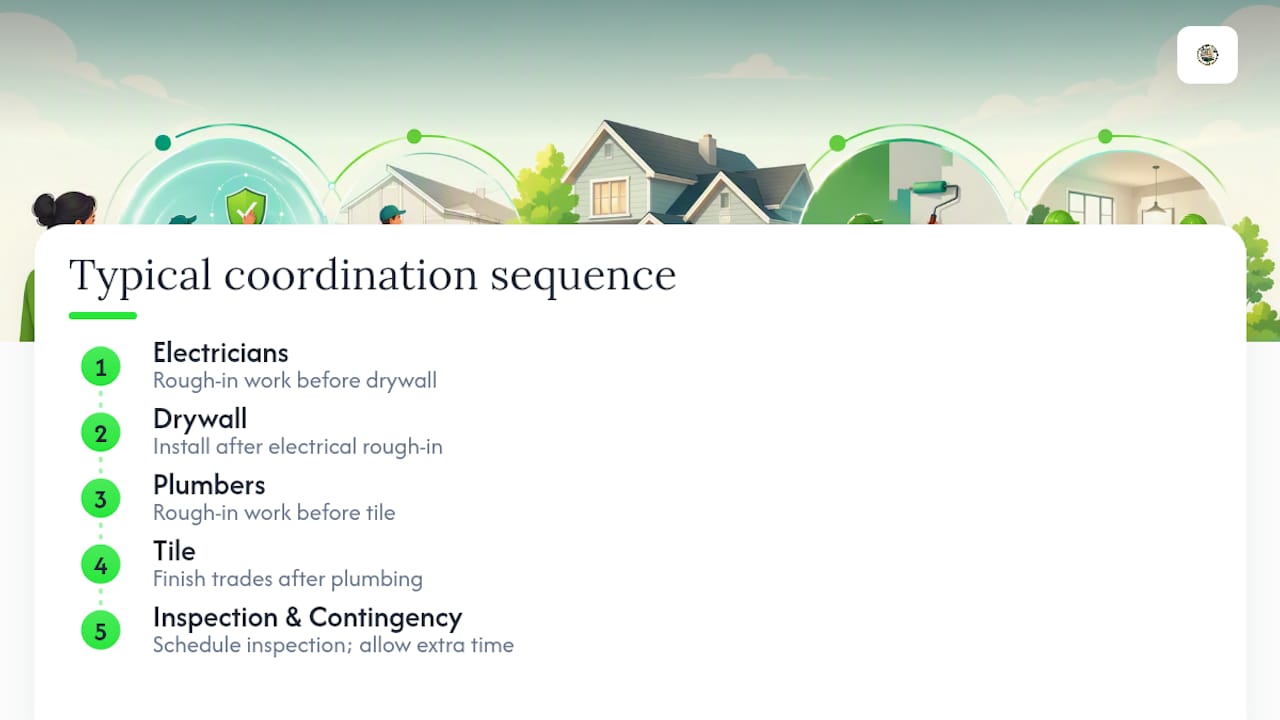
A licensed contractor also manages the parts you never see: sequencing electricians before drywall, plumbers before tile, and building in contingency time for the inspection that gets rescheduled. That coordination, more than any single skill, is what you’re actually paying for.
Your Pre-Signature Hiring Checklist
Before you sign anything, run through this short list. It turns everything above into contract language instead of good intentions.
- Fixed pricing and change-order terms spelled out in writing, not verbal promises.
- Warranty language covering both labor and materials, with a defined term.
- Final lien waiver required at closeout so subcontractors can’t file a claim against your home later.
- Permit responsibility named explicitly, matching what the contractor told you in the interview.
- Payment structure tied to milestones, never a large upfront cash deposit. Retainage on the final payment protects you until punch-list items close out.
A written contract covering these clauses is what actually converts a verified credential into a legal protection you can enforce.
Pro Tip: Keep a written contingency plan for surprises: rot behind old drywall, outdated wiring, a supply delay. Budget 10 to 15 percent above your quote so a discovery mid-project doesn’t turn into a fight over change orders.
How Expressions Remodeling Measures Up to This Checklist
Expressions Remodeling handles kitchen, bathroom, and basement remodeling in St. Louis, along with custom projects like man caves, home offices, and garage renovations, with permits, contracts, and warranty follow-up built into the process. Run this article’s verification steps on Expressions Remodeling the same way you would any contractor: ask for the license number, request COIs, and review a sample contract before committing. The renovation ROI guide is a useful next stop for scoping your project against real return data.
Verification Isn’t Optional. It’s the Job.
Credentials are a starting point, not proof. Calling the insurer and reading the bond number are what actually protect you, and they take less time than picking a paint color. Match your scope to what the neighborhood realistically supports so a well built project still pays you back.
— Kierin
Ready to Start Your Remodel With a Verified Contractor
A reputable remodeling contractor gives homeowners a straightforward alternative to the guesswork of comparing anonymous online bids: a local team you can verify in person, with published pricing instead of vague estimates. Kitchen remodels start from $10,000, a full bathroom remodel runs $16,999, and basement finishing starts at $40 per square foot, all listed on the pricing page rather than buried behind a quote request.

Before you commit to any project, apply the checklist from this article directly to Expressions Remodeling. Ask for the license number, request the COIs, and review a sample contract with the permit and lien waiver language spelled out. For bathroom-specific planning, the bathroom remodel checklist walks through scope decisions before you request a quote. When you’re ready, reach out through the pricing and services page to start the conversation.
Where to Confirm the Credentials Yourself
- Your state’s licensing board portal for active status and disciplinary history.
- The insurer listed on the COI, contacted directly by phone.
- The surety company, to confirm the bond number and face value.
- BLS-based wage data for realistic trade cost context.
Sources
- Licensed, bonded & insured — what each term means and how to verify it (ProFix Directory)
- Licensed, Bonded, and Insured: What Each Term Means | AboveBoardPros
- App
- Roc
- Contractor hourly labor rates by trade (Simplywise)
FAQ
What does it mean when a contractor is licensed and insured?
It means the contractor has state or local permission to perform the work and carries insurance covering accidents or damage during the project, but you still need to verify both directly with the issuing board and the insurance carrier.
What is the 30% rule in remodeling?
It’s a budgeting benchmark suggesting renovation spending should stay proportional to your home’s value rather than a fixed legal rule, and permit costs and municipal fees vary enough that it should guide planning, not dictate it.
How much do remodeling contractors charge per hour?
Rates vary widely by trade and region, and billed rates run well above published wage data because licensed contractors carry payroll burden, insurance, and overhead on top of base labor costs.
What not to tell your contractor?
Avoid revealing your maximum budget upfront or agreeing to verbal changes without written documentation. Every change order and price adjustment belongs in writing, tied to the signed contract terms.
Does Expressions Remodeling handle permits and warranty work?
Yes. Expressions Remodeling builds permit responsibility, contract terms, and warranty follow-up into its kitchen, bathroom, and basement remodeling projects, and homeowners can request specifics before signing.