

TL;DR:
- Most renovations do not fully recoup their costs at resale, especially larger interior projects and pools. Small exterior updates like garage doors and entryways often deliver the highest returns, making them ideal for sellers, while owners planning long-term residence should prioritize personal comfort over resale value. Proper planning, neighborhood comparison, and detailed documentation can maximize benefits and reduce tax liabilities.
Most renovations do not pay back dollar-for-dollar at resale. That is the single most useful thing to know before you spend $40,000 on a kitchen. The projects that come closest to full recoupment are almost always small, exterior-facing, and completed right before listing. Large interior remodels, pools, and room additions typically return less than full cost at resale, and often much less in slower markets.

This guide gives you a practical framework to compare renovation costs vs. value, project by project, so you can decide what to do, when to do it, and how much to spend.
Who should renovate for resale: Sellers doing targeted pre-list refreshes under $15,000, and short-hold investors who can identify projects with clear neighborhood comp support.
Who should renovate for lifestyle: Homeowners planning to stay 7 or more years. At that horizon, personal comfort and utility outweigh resale math. Industry guidance is clear on this: if you are staying long-term, evaluate projects on how much you will use and enjoy them, not on what a buyer might pay.
Immediate next steps:
- Pull 2–3 sold comps in your neighborhood from the last 6–12 months
- Run a quick ROI estimate using a calculator like CalcFi or RECATOOLS
- Get at least two contractor quotes, then add 15% on top for contingency
- Match your project scope to your hold time, not your wish list
Table of Contents
- What does the national cost vs. value data actually show?
- How are Cost vs. Value reports compiled, and what are their limits?
- Should you renovate before selling? A step-by-step decision framework
- Project-by-project guide: what to prioritize and when
- How do you convert national averages into a local estimate?
- How professionals document renovation work to protect your cost basis
- Key Takeaways
- The number that changes everything
- Expressions Remodeling: local expertise for St. Louis homeowners
- Where to find the primary data and tools
What does the national cost vs. value data actually show?
The table below draws on national Cost vs. Value benchmarks and current labor-cost trends. Use it as a directional reference, not a guarantee. Your local market will move these numbers.
| Project | Typical Cost Range | Median Recoup % | Payback Horizon | Best For |
|---|---|---|---|---|
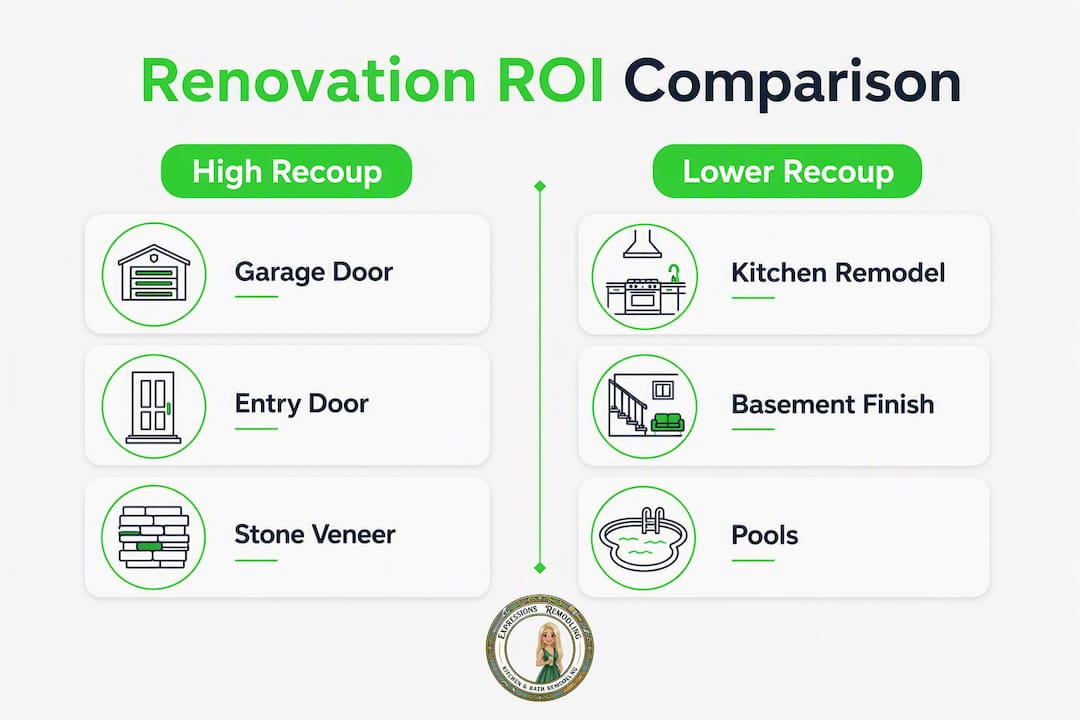
| Garage door replacement | $1,500–$4,500 | ~100%+ | Immediate (pre-list) | Sellers |
| Steel entry door replacement | $2,000–$5,000 | 90–100% | Immediate (pre-list) | Sellers |
| Manufactured stone veneer | $10,000–$20,000 | 90–100% | Immediate (pre-list) | Sellers |
| Minor kitchen refresh | $12,000–$30,000 | 70–85% | 1–3 years | Sellers / short-stay owners |
| Bathroom refresh (cosmetic) | $8,000–$18,000 | 65–80% | 1–3 years | Sellers / short-stay owners |
| Deck addition (wood) | $18,000–$30,000 | 60–75% | 2–5 years | Owners staying 3+ years |
| Siding replacement (fiber cement) | $15,000–$30,000 | 65–78% | 1–3 years | Sellers in colder climates |
| Roof replacement | $12,000–$25,000 | 55–70% | Immediate (deferred maintenance) | Sellers (required, not optional) |
| Full bathroom remodel | $25,000–$55,000 | 55–70% | 3–5 years | Owners staying 3+ years |
| Major kitchen remodel | $50,000–$130,000 | 40–60% | 5+ years | Owners staying 5+ years |
| Basement finish | $30,000–$55,000 | 40–75%* | 3–7 years | Owners; varies sharply by region |
| Window replacement | $15,000–$25,000 | 55–70% | 2–4 years | Owners; energy savings help justify |
| Pool addition | $50,000–$100,000+ | 30–50% | Rarely recoups | Lifestyle only |
*Basement recoup varies the most of any project. Regional buyer expectations drive it: a finished basement can recoup 90% in markets where buyers expect usable lower-level space, and as little as 40% in Sun Belt markets where basements are rare.
Two patterns stand out. First, small exterior and curb-appeal projects consistently top the ROI rankings, with garage door replacement often exceeding 100% recoup nationally. Second, major interior remodels have fallen to historic recoup lows. Labor costs rose 2–4 percentage points as a share of total project cost in 2026, while materials stabilized, which means the same scope costs more to execute without a corresponding jump in appraised value.
How are Cost vs. Value reports compiled, and what are their limits?
The most widely cited benchmarks come from the annual Remodeling/NAR Cost vs. Value report and the JLC (Journal of Light Construction) Cost vs. Value data. Both use a consistent methodology worth understanding before you treat any percentage as a promise.
How the numbers are built:
Cost estimates come from contractor surveys, typically mid-range specifications in a given region. Value uplift estimates come from real estate agent and appraiser surveys asking what a given completed project would add to a home’s sale price in that market. The recoup percentage is simply the estimated value uplift divided by the estimated project cost.
What that methodology cannot tell you:
- It assumes immediate resale after project completion. Hold the home longer and the “newness” premium fades. Projects lose roughly 8–15% of potential resale recoupment per year after installation as buyers begin viewing finishes as dated rather than fresh.
- It uses regional averages, not neighborhood-level data. A $60,000 kitchen in a $250,000 neighborhood will not appraise the same way as the same kitchen in a $600,000 neighborhood.
- Agent and appraiser estimates carry inherent optimism bias. Agents want listings; contractors want work. Neither group has a financial incentive to tell you a project will not pay off.
- The percentages assume mid-range specifications. High-end finishes in a mid-range market rarely recover their premium at appraisal.
What to do with the numbers:
Treat national recoup percentages as a starting filter. If a project type nationally recoups 45%, it is unlikely to recoup 90% in your neighborhood. But if it nationally recoups 85%, local conditions could push it above or below that. Anchor your real estimate to sold comps within 6–12 months in your immediate neighborhood, and get an agent or appraiser to walk the house before you commit to a scope.
Pro Tip: Add 15% to every contractor quote before you run your ROI math. Renovation costs frequently exceed initial estimates by at least 15% in a significant share of projects due to hidden conditions, permit requirements, and code-compliance upgrades in older homes. Budget the overrun in advance, not after the fact.
Should you renovate before selling? A step-by-step decision framework
The question is not whether renovations add value in the abstract. They often do. The question is whether the value added exceeds the cost, given your timeline, budget, and local market. Work through these steps in order.
Step 1: Establish your timeline
- Selling within 12 months: Limit scope to projects under $15,000 that have clear comp support. Pre-list cosmetic fixes such as paint, hardware, landscaping, and a minor kitchen refresh often return near dollar-for-dollar and reduce days on market. Avoid anything requiring permits that could delay your listing.
- Selling in 1–3 years: Mid-range projects with 65%+ national recoup become viable, particularly if your home has a deferred-maintenance issue (roof, HVAC, siding) that will show up on inspection anyway.
- Staying 7+ years: Shift your evaluation entirely to personal ROI. How much will you use the space? Will the project reduce utility bills? Does it solve a real functional problem? Resale recoup at that horizon is secondary.
Step 2: Check your neighborhood comp ceiling
The neighborhood comp ceiling is the single most important guardrail in renovation budgeting. If the highest-priced comparable sale in your immediate neighborhood is $420,000, a $50,000 kitchen will not push your home to $470,000. Appraisers and buyers anchor to neighborhood norms. Over-improving above neighborhood standards is one of the most common and costly mistakes sellers make.
Step 3: Apply the budget guardrails
- Keep any single room renovation to 5–15% of your home’s current market value
- Keep total pre-list renovation spend to no more than 10% of expected sale price
- Never exceed the neighborhood comp ceiling regardless of project quality
- Always carry a 15% contingency on top of contractor quotes
Step 4: Watch for red flags
- Projects requiring permits in markets with slow permitting timelines (adds weeks or months to your listing date)
- Highly personalized or luxury choices (custom tile, specialty cabinetry) that reflect your taste but not buyer preferences
- High regional labor costs that compress recoup percentages below national averages
- Projects where your “upgrade” is actually a lateral move relative to what comps already have
For flippers and investors: Target a minimum 20% net ROI after all costs, including carrying costs, selling costs (typically 6–8% of sale price), and contingency. If the math does not clear that threshold, the project is not worth doing.
For owner-occupants: Accepting a lower recoup percentage is reasonable when the project delivers genuine daily use. A bathroom addition that makes a family’s morning routine workable is worth doing even at 60% resale recoup if you plan to stay five more years. Understanding the difference between financial ROI and personal ROI is what separates good renovation decisions from expensive regrets.

Project-by-project guide: what to prioritize and when
High-recoup exterior projects (best for sellers)
Garage door replacement ($1,500–$4,500): Consistently the strongest recoup of any project nationally, often exceeding 100%. It is fast, inexpensive, and the first thing a buyer sees. Do this for any pre-list situation.
Steel entry door ($2,000–$5,000): Similar logic. Buyers form first impressions at the curb. A fresh, solid entry door signals the home has been maintained. Recoup typically runs 90–100%.
Manufactured stone veneer ($10,000–$20,000): Strong recoup in markets where buyers expect curb appeal. Less effective in neighborhoods where existing homes have minimal exterior detailing.
Exterior paint / siding ($15,000–$30,000 for fiber cement siding): Recoup runs 65–78% nationally. In colder climates where siding condition matters to buyers, this can be a near-necessity before listing.
Kitchen projects: the scope decision matters more than the room
A minor kitchen refresh, meaning new cabinet fronts, hardware, countertops, and possibly appliances, outperforms a full gut renovation in recoup percentage every year. Buyers do not pay dollar-for-dollar on high-end finishes. A $15,000 refresh that makes the kitchen feel clean and current will do more for your sale price than a $70,000 gut remodel in most markets.
Major kitchen remodels ($50,000–$130,000) recoup 40–60% nationally, and that number has been falling as labor costs rise. Do a full remodel only if you plan to stay five or more years and will genuinely use the space. For sellers, affordable kitchen upgrades focused on visual impact rather than structural change are almost always the smarter call.
Pro Tip: Scope down major projects into high-impact, low-cost refreshes for pre-list work. Replacing cabinet doors and hardware, adding a tile backsplash, and installing a new faucet can modernize a kitchen for $8,000–$12,000 and deliver the same buyer impression as a $40,000 partial remodel.
Bathroom projects
A cosmetic bathroom refresh ($8,000–$18,000) covering new fixtures, vanity, lighting, and flooring recoups 65–80% and moves quickly. A full bathroom remodel ($25,000–$55,000) recoups 55–70%, which is acceptable if you are staying three or more years. Simple bathroom upgrades that address dated fixtures and poor lighting tend to deliver the best return relative to cost.
Adding a bathroom where none exists is a different calculation. In homes with only one bathroom, adding a second can be a strong value-add, particularly for family buyers. The lifestyle benefit of a bathroom addition often justifies the cost even when resale recoup is moderate.
Basement finishing
Recoup ranges from 40–75% depending almost entirely on your market. In the Midwest and Northeast, where buyers expect finished lower-level space, a well-executed basement finish can be a strong value-add. In Sun Belt markets, it rarely moves the needle. Check your local comps before committing. Basement finishing makes the most sense when your neighborhood’s comparable sales consistently include finished lower levels.
Projects with negative or near-zero resale ROI
Pools, home theaters, wine cellars, and highly personalized spaces almost never recoup their cost. A pool addition can cost $50,000–$100,000 and return 30–50% at resale, while also adding ongoing maintenance costs that buyers factor into their offers. Solar panels are a partial exception: they reduce utility costs and can be a selling point in energy-conscious markets, but upfront costs are high and buyer perception varies.
How do you convert national averages into a local estimate?
National recoup percentages are a starting point. Here is how to make them useful for your specific home.
- Establish your current home value. Use a recent appraisal, a comparative market analysis from a local agent, or an automated valuation model as a baseline. Do not use Zestimate alone; it can be off by 5–10% in either direction.
- Find 2–3 sold comps. Pull sales from the last 6–12 months within a half-mile of your home, similar in size and condition. These are your ceiling and your floor.
- Apply a regional labor adjustment. Labor costs vary significantly by region. High-cost metros (San Francisco, New York, Boston) can run 30–50% above national averages. Midwest markets like St. Louis typically run at or slightly below national averages, which means your project cost is lower and your recoup percentage can be more favorable.
- Adjust recoup % by neighborhood tier. If your home is already at the top of its neighborhood price range, apply a discount to national recoup estimates. If it is at the bottom, a targeted upgrade may close the gap to comps more efficiently.
- Include carrying and selling costs. Selling costs (agent commissions, closing costs, staging) typically run 6–8% of sale price. If you are carrying a mortgage during a renovation, add those monthly costs to your total project expense before calculating net return.
A quick example: You own a $400,000 home in St. Louis. A minor kitchen refresh costs $25,000. National recoup is 75%, suggesting $18,750 in added value. After a regional adjustment (St. Louis labor is near national average), you estimate $17,500–$19,000 in added value. Subtract selling costs on that increment (roughly $1,200 at 6%), and your net return is approximately $16,300–$17,800 on a $25,000 spend. That is a 65–71% net recoup. Acceptable for a seller listing within 12 months; less compelling if you are two years out and the finishes will have aged.
For the calculation itself, tools like CalcFi’s renovation ROI calculator and RECATOOLS let you input project cost, estimated value uplift, and holding period to model net return. Use them alongside local comp data, not instead of it.
Pro Tip: When reviewing renovation financing options, understanding how carrying costs affect your net ROI is as important as the project cost itself. A home renovation loan adds monthly interest to your total cost basis, which compresses your recoup percentage the longer the project takes.
How professionals document renovation work to protect your cost basis
Proper documentation does two things: it supports your appraisal when you sell, and it can reduce your capital gains tax by increasing your adjusted cost basis. Documented qualified improvements added to your cost basis reduce the taxable gain on sale. On a home that has appreciated significantly, this can be worth thousands of dollars.
Here is the documentation checklist to request from any contractor before work begins:
- Permits: Pulled and closed by the contractor, not skipped to save time or money
- Itemized invoices: Line-item breakdown of materials and labor, not a single lump sum
- Contractor contract: Signed scope of work with specifications, materials listed by product name and model
- Before/after photos: Dated, high-resolution, covering every phase of the project
- Change orders: Any scope changes documented in writing with revised cost
- Lien releases: Signed by the contractor and any subcontractors upon final payment
- Completion report: Summary of work completed, materials used, and warranty terms
- Product specs and serial numbers: For appliances, HVAC units, windows, and roofing materials
A contractor who resists providing any of these items is a contractor worth reconsidering. Reputable remodelers, including Expressions Remodeling, deliver this documentation as a standard part of the project process, alongside quality craftsmanship that holds up under appraisal scrutiny. Good project management practices also ensure that permit timelines, subcontractor coordination, and change orders are handled without delays that could push back your listing date.
This documentation file becomes part of your home’s permanent record. Hand it to your agent when you list, and give a copy to the appraiser. Buyers and their lenders will ask about major work; having the paper trail ready builds confidence and can support a higher appraisal.
Note: This is general information about renovation documentation and cost basis. Consult a qualified tax professional or CPA for guidance specific to your situation and current IRS rules.
Key Takeaways
Most renovations do not pay back dollar-for-dollar at resale; small exterior projects and targeted pre-list refreshes deliver the best recoup, while major interior remodels have fallen to historic lows in 2026.
| Point | Details |
|---|---|
| Curb appeal leads on recoup | Garage door, entry door, and stone veneer consistently return 90–100%+ nationally. |
| Major remodels are for owners, not sellers | Major kitchen and bathroom remodels recoup 40–60%; only do them if you are staying 5+ years. |
| Add 15% contingency to every quote | Renovation costs overrun initial estimates by 15–30% in a significant share of projects. |
| Document every improvement | Permits, invoices, and contracts increase your adjusted cost basis and can reduce capital gains tax owed. |
| Expressions Remodeling | Provides scoped estimates, 3D design visualization, licensed trades, and full project documentation for St. Louis homeowners. |
The number that changes everything
The recoup percentage gets most of the attention in renovation ROI discussions, and it matters. But the figure that actually determines whether a renovation was a good decision is the one almost nobody calculates in advance: total cost including contingency, carrying costs, and selling costs, compared against the actual appraised value increase, not the estimated one.
Most homeowners run the math on the contractor’s quote and the national average recoup percentage and stop there. That is optimistic accounting. The contractor’s quote is a floor, not a ceiling. Cost overruns of 15–30% are common enough to treat as expected, not exceptional. And the national recoup percentage is an average across thousands of homes in dozens of markets, not a prediction for your specific house.
What I see consistently in St. Louis is that the homeowners who come out ahead on renovation ROI are not the ones who spent the most. They are the ones who spent precisely: a garage door here, a kitchen refresh there, a bathroom fixture update that cost $9,000 and made the home feel move-in ready. They listed quickly, priced to the comps, and did not wait for a $60,000 remodel to “pay off” in a market that had already moved on.
The homeowners who struggle are the ones who over-improved for the neighborhood, chose finishes that reflected their taste rather than buyer expectations, or started a major project six months before listing without accounting for permit delays. None of that is a renovation problem. It is a planning problem.
If you are staying in your home for the long term, ignore most of this and renovate for yourself. A basement that becomes your family’s favorite room is worth every dollar regardless of what it does to your appraisal. But if you are selling within three years, treat every renovation dollar as a business decision and run the local math before you commit.
Expressions Remodeling: local expertise for St. Louis homeowners
Getting the scope right before you spend is the hardest part of any renovation decision, and it is where most homeowners either over-commit or under-invest. Expressions Remodeling works with St. Louis homeowners at exactly that stage: scoping projects to match your timeline, your neighborhood’s comp ceiling, and your budget, before a dollar is spent on materials.
Services include kitchen refreshes and full remodels, bathroom upgrades, and basement finishing, alongside 3D design visualization that lets you see the finished result before committing to the scope. Every project includes the permits, invoices, and documentation your accountant and appraiser will want. To get a scoped estimate for your home, visit the pricing and services page or request a consultation directly.
Where to find the primary data and tools
These are the authoritative sources used throughout this guide. Each serves a different purpose.
-
Remodeling / NAR Cost vs. Value Report: The most widely cited annual benchmark for project-level recoup percentages by region. Use it to identify which project types have historically strong or weak recoup in your region. Limitations: assumes mid-range specs and immediate resale; updated annually so check the current year’s edition.
-
JLC Cost vs. Value: The Journal of Light Construction’s companion data, which provides contractor-level cost detail alongside the value estimates. Useful for understanding the cost side of the equation more precisely.
-
CalcFi Renovation ROI Calculator: An interactive tool that lets you input project cost, estimated value uplift, and hold time to model net return. Good for running quick scenarios before committing to a scope.
-
RECATOOLS ROI on Renovation Calculator: Provides project-level ROI estimates with contingency guidance built in. Useful for stress-testing your budget assumptions.
-
Haven Cost Guide: Renovation ROI calculator with neighborhood-tier adjustments. Helpful for understanding how your home’s price position within its neighborhood affects expected recoup.
-
CostToRenovate Renovation ROI: Regional and project-level recoup data with practical guidance on when to prioritize resale vs. lifestyle value.
-
Local MLS / sold comps: Your most accurate source for neighborhood-level value uplift. Ask your agent for a comparative market analysis that includes homes with and without the specific upgrade you are considering.
-
IRS Publication 523 (Selling Your Home): The primary source for understanding which improvements qualify as capital improvements that can be added to your cost basis. Available at IRS.gov; consult a tax professional for application to your situation.