

Yes, smart thermostats are worth it for most homeowners, mainly because automated setbacks and occupancy detection cut HVAC runtime in ways manual programming rarely achieves. ENERGY STAR reports certified models save an average of about 8% on heating and cooling bills, which translates to real dollars for a typical household running central heat and air. That said, results swing depending on your climate, your HVAC equipment, and whether you were already using a programmable thermostat well.
Before you buy, check these three things:
- Your climate — heavier savings tend to show up in cooling-dominated regions.
- Your current thermostat habits — if you already program setbacks religiously, gains shrink.
- How often your home sits empty — occupancy sensing does more work in houses that are frequently vacant.
Key Takeaways
Smart thermostats cut HVAC costs primarily through automation and occupancy detection, with ENERGY STAR-certified models averaging about 8% savings on heating and cooling bills.
| Point | Details |
|---|---|
| Verify certification claims | ENERGY STAR’s 8% average comes from a year of field data, not lab testing or marketing estimates. |
| Expect a savings range, not a fixed number | Field studies show 8–12% HVAC reductions typically, higher in cooling-heavy climates. |
| Check compatibility before buying | Confirm a C-wire, HVAC type, and Wi-Fi coverage to avoid installation surprises. |
| Stack rebates for faster payback | Instant utility rebates and demand-response credits can shorten payback to under a year. |
| Consider a pro for complex systems | Expressions Remodeling checks wiring and HVAC compatibility and installs thermostats as part of broader smart-home or remodeling projects. |
Table of Contents
- How Smart Thermostats Save Energy
- What Do Studies Actually Say About Smart Thermostat Savings?
- What Other Benefits Come With Installing a Smart Thermostat?
- Which Homes Benefit Most From a Smart Thermostat?
- Should You Install It Yourself or Hire a Pro?
- How Do You Estimate Your Own Savings and Payback?
- What Do Installers Wish Homeowners Knew?
- Get Compatibility and Installation Handled by a Local Pro
- Where to Verify These Numbers Yourself
- Frequently Asked Questions
- Sources
How Smart Thermostats Save Energy
The core advantage isn’t the touchscreen. It’s automation replacing human inconsistency. A programmable thermostat only saves money if someone actually programs it and keeps overriding it correctly. Most people don’t. A smart thermostat removes that failure point.
Several mechanisms do the actual work:
- Occupancy sensing (motion detectors, geofencing through your phone) tells the system when nobody’s home and adjusts automatically.
- Learning algorithms track your patterns over days or weeks and build a schedule without you touching a dial.
- Setback scheduling nudges temperatures a few degrees during sleep or absence, which adds up over a heating or cooling season.
- Weather-responsive control anticipates outdoor swings instead of reacting after the house already feels the temperature change.
- Remote sensors placed in specific rooms stop the thermostat from overcooling or overheating based on one unrepresentative spot in the house.
Each of these trims runtime in a different way. Occupancy sensing avoids conditioning empty space. Setbacks reduce the total degree-hours your system works. Weather response prevents the overcorrection that happens when a basic thermostat reacts late.
Pro Tip: Let the device learn undisturbed for about two weeks before judging it. Constant manual overrides during that window confuse the algorithm and can meaningfully cut into your measured savings, according to installer data from Joule.
What Do Studies Actually Say About Smart Thermostat Savings?
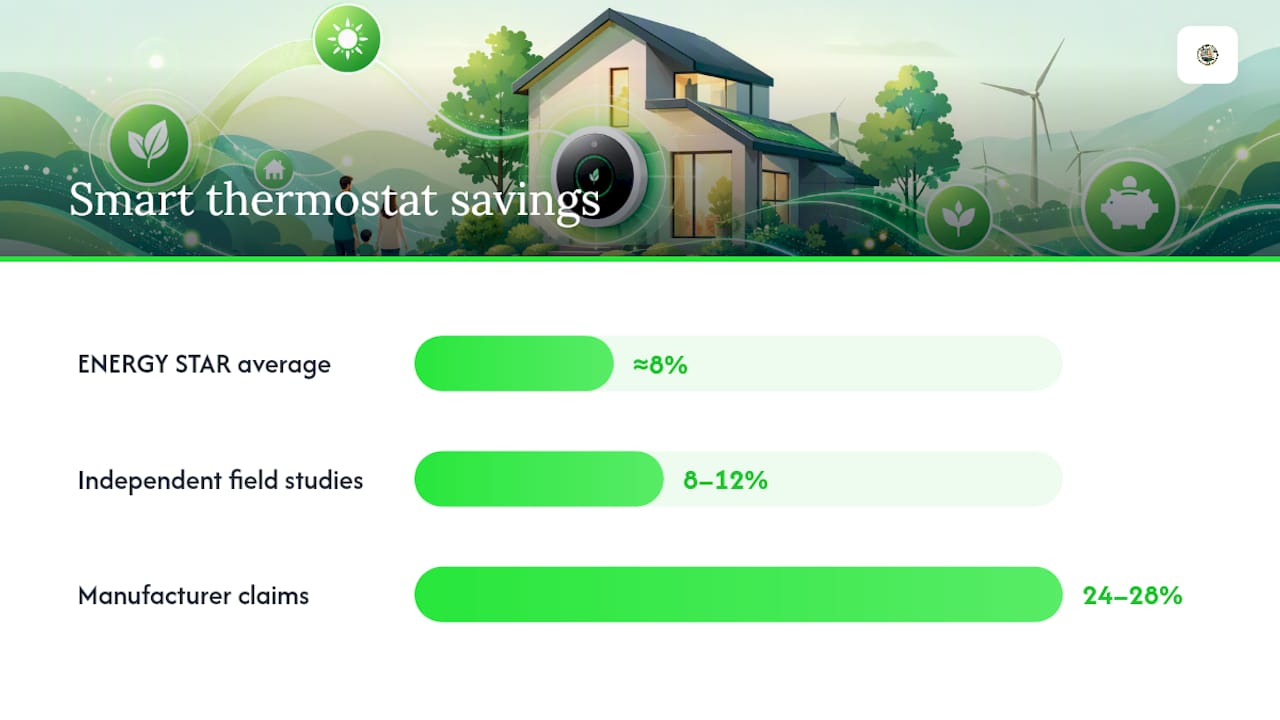
The widely cited figure is ENERGY STAR’s average of about 8% on combined heating and cooling costs. That number isn’t a marketing estimate. It comes from a certification process that requires a full year of field data covering the hardware and the software controlling it together, not lab conditions.
Independent field studies and utility pilots generally land in the 8–12% range for HVAC energy reductions, according to aggregated analysis of real-world usage. DOE and NREL modeling work adds an important caveat here: some manufacturer claims of 24 to 28% savings are optimistic for the average home, and simulation results using tools like ResStock and EnergyPlus often predict more modest gains once algorithm design and local HVAC behavior are factored in.
Consumer Reports echoes this: savings depend heavily on climate, equipment type, and whether you were already running an efficient schedule manually. A household in a mild climate that already used a programmable thermostat well might see marginal gains. A household in a hot, humid region running central air around the clock has more room to save.
Certain features change the math further:
- Room sensors can add another 5–8% by balancing temperature across the house instead of relying on one central reading.
- Heat-pump-aware modes avoid triggering costly auxiliary heat strips, adding a few more percentage points for heat-pump owners.
- Demand-response enrollment doesn’t change your HVAC efficiency directly but adds bill credits on top of energy savings.
What Other Benefits Come With Installing a Smart Thermostat?
Energy savings get the headlines, but comfort and convenience carry real weight too. You get remote app control from anywhere, so you can pre-condition the house before you arrive home instead of walking into a cold or stuffy room. Multi-room sensors fix the classic problem of one part of the house always running hot or cold. Most models also send filter-change reminders and maintenance alerts, which helps catch HVAC problems before they become expensive repairs.
The financial side extends past your utility bill too:
- Instant rebates at checkout or through a utility marketplace, often in the $50 to $125 range.
- Demand-response program credits that can add roughly $25 to $100 per year in exchange for minor, short-term adjustments during peak grid demand.
- Integration with broader smart-home platforms for lighting, security, and voice control.
Pro Tip: Check your utility’s rebate marketplace before buying anywhere else. Many utilities apply the rebate instantly at checkout, which lowers your net installed cost right away instead of making you file for a mail-in rebate later.
Which Homes Benefit Most From a Smart Thermostat?
Not every house sees the same payoff, and knowing where you fall matters more than any national average.
Homes that benefit most tend to share these traits:
- High monthly HVAC spend, especially in extreme summer or winter climates.
- Regular stretches of vacancy, like a two-income household gone nine hours a day.
- Heat-pump systems that can take advantage of optimization modes avoiding auxiliary heat.
- Uneven room temperatures that remote sensors can correct.
Homes that see less benefit include ones with an already well-programmed thermostat, a household that’s occupied nearly all day every day, or a poorly insulated house where thermostat tweaks can’t overcome heat loss through walls and windows.
Run through this quick self-check before buying:
- Do you leave the house empty for eight or more hours on a typical day?
- Does your HVAC bill run noticeably high compared to neighbors with similar square footage?
- Do you have a C-wire at your current thermostat, or wiring that supports one?
- Does one room in your house consistently run hotter or colder than the rest?
Answering yes to two or more usually signals a strong candidate for meaningful savings.
Should You Install It Yourself or Hire a Pro?
Many homeowners can install a smart thermostat themselves. CNET’s installation testing found most DIY installs take 20 to 30 minutes with phone-guided setup. But a few compatibility checks upfront prevent most headaches:
- Confirm you have a C-wire, or a clear path to add one, at your existing thermostat.
- Identify your HVAC system type: standard furnace, central AC, heat pump, or zoned multi-stage equipment.
- Check whether your system uses multi-stage heating or cooling, which not every smart thermostat supports.
- Verify Wi-Fi signal strength reaches your thermostat’s location.
- Decide whether remote room sensors would solve an existing temperature imbalance.
DIY saves on labor cost and can be done same-day, but you take on wiring risk yourself. Professional installation costs more upfront but usually comes with a workmanship warranty and correctly handles unusual wiring setups, multi-stage systems, or zoned HVAC.
Pro Tip: If you’re not sure whether you have a C-wire, shut off the breaker to your HVAC system before opening the thermostat panel to check. If the wiring looks unfamiliar or there’s no clear common wire, call in a professional rather than guessing.
How Do You Estimate Your Own Savings and Payback?
You only need three numbers: your annual HVAC spend, an expected percent reduction, and your net cost after rebates.
Here’s a sample calculation using a household spending $1,800 a year on heating and cooling:
- Conservative estimate (6%): $1,800 x 0.06 = $108 saved per year.
- Median estimate (10%): $1,800 x 0.10 = $180 saved per year.
- Optimistic estimate (15%): $1,800 x 0.15 = $270 saved per year, more realistic in a cooling-heavy climate with room sensors.
If your device costs $200 and a $75 utility rebate brings your net cost to $125, the median scenario pays back in under a year. Add in $25 to $100 from demand-response enrollment and payback shortens further.
If your math lands under two years, buy now. If it lands closer to three or four, weigh it against other efficiency upgrades first. If your home is already well-insulated and well-programmed, a thermostat alone may not move the needle much.
What Do Installers Wish Homeowners Knew?
Installers see the same three problems repeatedly: a missing C-wire, a thermostat mounted somewhere that doesn’t reflect the house’s real temperature, and homeowners who override the schedule so often the learning algorithm never settles.
A few things installers consistently recommend:
- Verify your wiring before you buy, not after.
- Mount the thermostat on an interior wall away from direct sunlight or drafts.
- Resist adjusting it manually for the first couple of weeks.
If your system involves zoned HVAC or multi-stage equipment, a professional installation with a workmanship guarantee is usually the safer call.
Get Compatibility and Installation Handled by a Local Pro
Figuring out C-wire compatibility, HVAC staging, and sensor placement isn’t hard, but it takes a few wrong guesses out of the equation when someone who does this daily handles it. Expressions Remodeling evaluates your existing wiring and HVAC setup, sources ENERGY STAR-eligible models suited to your home, and integrates the installation into any broader smart-home or remodeling project you’re already planning.
Here’s what that service includes:
- A compatibility check covering C-wire presence and HVAC system type.
- Wiring and power adapter handling if a C-wire isn’t already in place.
- Placement and remote-sensor strategy tailored to rooms that run hot or cold.
- Guidance on stacking utility rebates with your installation cost.
If you’re planning a kitchen, basement, or whole-home upgrade and want smart climate control built in from the start rather than bolted on later, request a project evaluation through Expressions Remodeling’s pricing page and get a straight answer on what your home needs.
Where to Verify These Numbers Yourself
For certification standards and field-data methodology, check ENERGY STAR’s own FAQ. For modeling nuance behind why manufacturer claims sometimes overstate real savings, the DOE/NREL benchmarking paper is worth a look. Consumer Reports offers a buyer-focused take, and CNET’s installation guide walks through the hands-on steps.
Frequently Asked Questions
Do smart thermostats really save money, or is it mostly marketing?
They save money for most homes, though the size of the savings depends on your climate and habits. ENERGY STAR’s certified average sits around 8%, based on real field data rather than lab projections.
What’s the biggest reason a smart thermostat installation might not pay off?
A home that’s already well-insulated and running an efficient manual schedule has less room to improve. Frequent manual overrides also chip away at measured savings.
Do I need a C-wire for a smart thermostat?
Most models need one, though adapters and add-on power modules exist for homes without one. If your wiring looks unclear, a professional can add a C-wire safely.
Can financing help cover the cost of a smart thermostat or larger efficiency upgrade?
Yes. Options like green home refinancing can help homeowners fund energy upgrades, especially when bundled into a larger remodeling project.
How long does it take to see payback on a smart thermostat?
Using median savings estimates and typical rebates, many households see payback in under two years, sometimes under one year with strong utility incentives.
Sources
- Are Smart Thermostats Worth It? – Consumer Reports
- Benchmarking Thermostats (DOE / NREL peer review PDF)
- Smart Thermostat Savings 2026: Real Data & ROI Analysis