
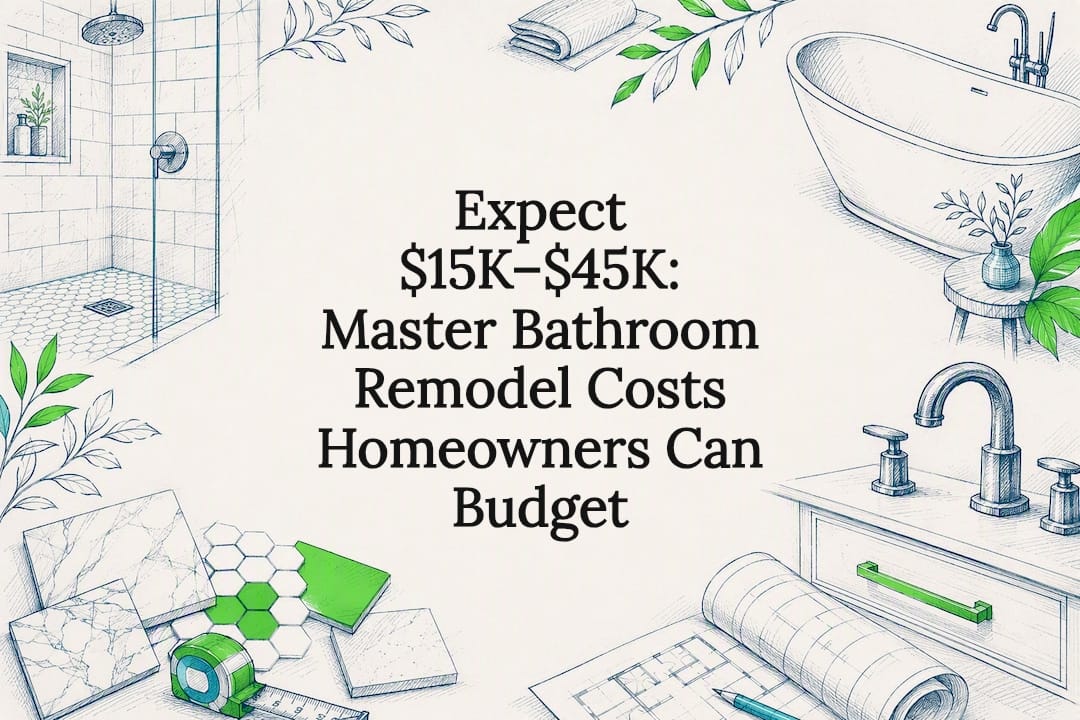
A master bathroom remodel typically runs $15,000 to $45,000, with most homeowners landing between $22,000 and $32,000 for a true midrange job. Budget roughly hundreds of dollars per square foot, depending on finish level. The one rule that keeps a project on track: set your ceiling before you fall in love with tile, then add 15% to 20% on top for surprises.
TL;DR:
- A midrange bathroom remodel typically costs between $22,000 and $32,000, with costs rising significantly if plumbing or layout changes are involved.
- Labor expenses account for 40% to 65% of the budget, with costs increasing if multiple specialized trades are needed for high-end features.
- Moving plumbing fixtures or adding custom tile and heated floors can add thousands of dollars extra, especially if slab access or extensive reconfiguration is required.
- Smaller bathrooms often cost more per square foot due to fixed costs spread over less area, complicating accurate per-square-foot estimates.
- Proper planning, detailed bids, and contingency budgets are essential to avoid unexpected expenses during demolition and construction.
Table of Contents
- How much does a master bathroom remodel cost?
- What does a bathroom remodel cost by category?
- What does a bathroom remodel look like at each budget level?
- How do you estimate cost per square foot?
- What drives the biggest cost jumps in a bathroom remodel?
- How long does a master bathroom remodel take, and what does labor cover?
- What hidden costs show up during demolition?
- How should you budget and finance the remodel?
- How does Expressions Remodeling plan and price a project?
- What do local remodelers wish more homeowners knew?
- Ready to price your own master bathroom remodel?
- Sources
How much does a master bathroom remodel cost?
Most master bathroom projects fall into four distinct tiers, and knowing which one matches your vision saves you from sticker shock at the first contractor walkthrough.
- Budget refresh ($8,000–$15,000): New vanity, fixtures, paint, and a fiberglass tub-to-shower conversion, with plumbing staying exactly where it is.
- Midrange full remodel ($22,000–$32,000): Custom tile shower, new double vanity, updated lighting, and a soaking tub, still keeping the existing layout.
- Upscale remodel ($32,000–$45,000): Frameless glass shower enclosure, natural stone counters, a freestanding tub, and modest layout tweaks like widening a doorway.
- Luxury spa remodel ($45,000–$70,000+): Heated floors, a curbless walk-in shower with multiple heads, custom cabinetry, and often a full plumbing relocation.
These bands echo what national data shows for midrange master remodels running $15,000 to $40,000, with luxury projects exceeding $45,000. A separate analysis puts the realistic midrange sweet spot closer to $22,000 to $32,000, with upscale work pushing past $32,000 once heated floors and custom tile enter the picture.
Region matters more than most homeowners expect. Coastal metros and cities with high labor demand can run 10% to 25% above these national figures, while smaller Midwest markets often land at the low end of each band. Layout changes are the other wildcard: keep your toilet, tub, and shower where they already sit, and you’ll consistently land in the lower half of whichever tier you’re aiming for.
What does a bathroom remodel cost by category?
Every master bathroom remodel breaks down into six cost categories, and understanding how they interact is the difference between a budget that survives contact with reality and one that blows up in week three.
Materials cover tile, countertops, cabinetry, and finishes. This is the category with the widest spread, because a porcelain floor tile and a hand-cut natural stone mosaic can differ by 400% for the same square footage. Fixtures include the tub, shower system, toilet, vanity, faucets, and lighting. Labor covers demolition, plumbing, electrical, tile setting, carpentry, and finish work, and it’s almost always the single largest line item. Permits and inspections are smaller in dollar terms but non-negotiable for plumbing and electrical changes. Disposal covers dumpster rental and hauling for demo debris. Contingency is the buffer every experienced contractor insists on, and the one first-time renovators are most tempted to skip.
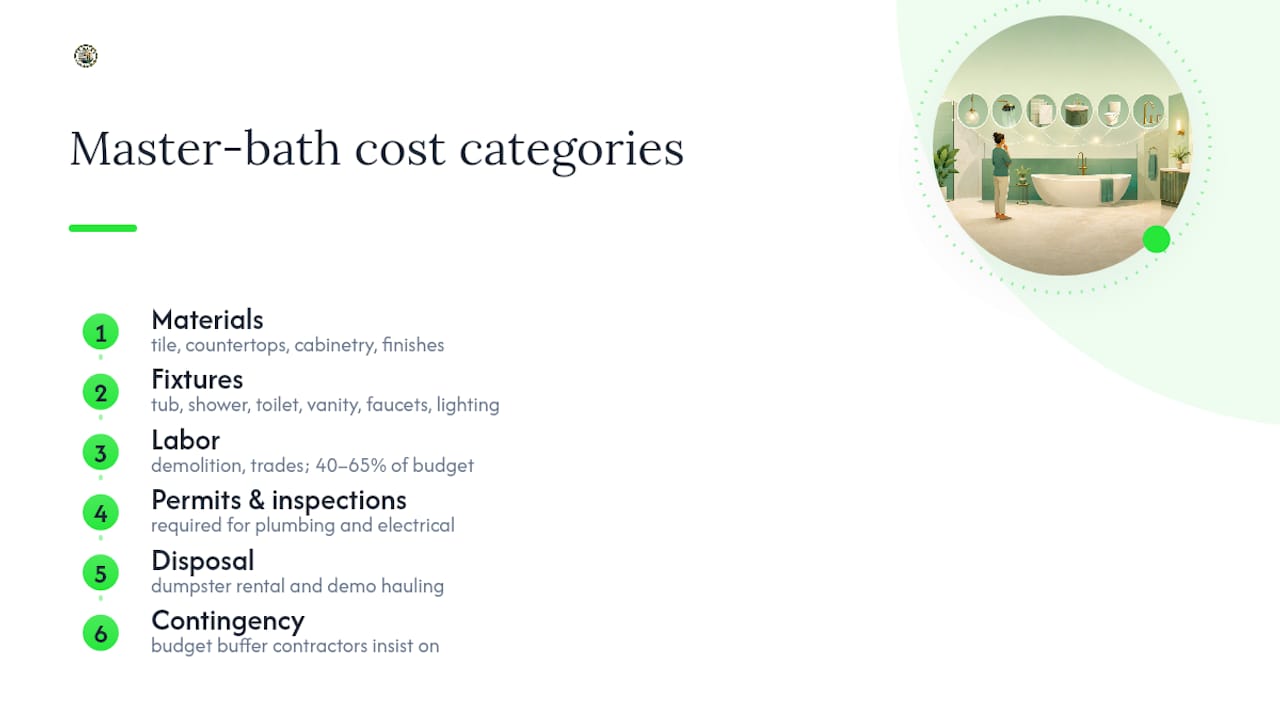
Labor typically eats 40% to 65% of the total budget on custom master-bath projects, and that share has crept upward since 2022 as tile setters and plumbers became harder to book in most metro markets. A separate look at 2026 contractor invoices confirms the pattern: midrange projects clustering near $26,000 to $29,000 carry labor-heavy budgets, often with labor running higher than homeowners initially expect when they price out materials online.
Why does labor swing so much between projects? A midrange remodel with a straightforward shower and standard tile pattern needs a plumber, an electrician, a tile setter, and a carpenter, each billing for a defined number of days. A luxury remodel with a curbless shower, radiant floor heat, and custom millwork adds a waterproofing specialist, a low-voltage technician for smart controls, and often a second carpenter for built-ins. Every added trade means more coordination, more inspection cycles, and more billable hours stacked on the same square footage.
Material grade is where homeowners have the most real control. If you’re deciding where to spend and where to save, put money into the shower system and waterproofing (a leak here is expensive to fix later) and save on decorative elements like cabinet hardware and light fixtures, which are easy to upgrade down the road without opening walls.
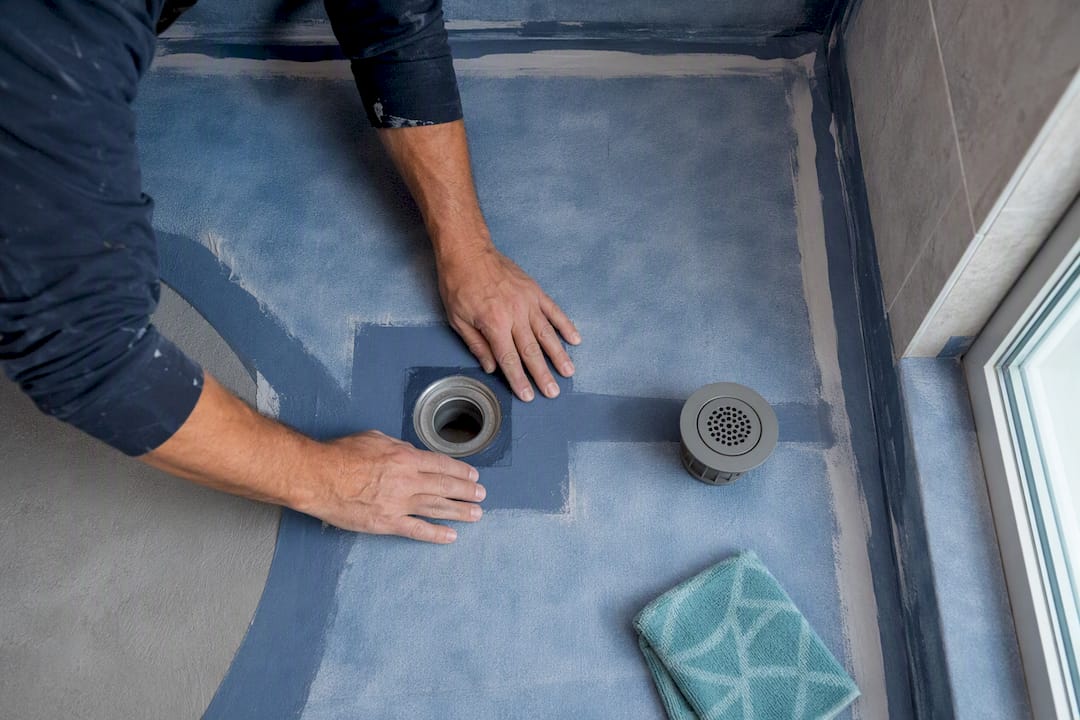
Keeping your plumbing fixtures in their existing locations is one of the most reliable ways to control this section of the budget. Leaving major systems in place saves $5,000 to $10,000 on average compared to relocating a toilet, tub, or shower drain.
What does a bathroom remodel look like at each budget level?
Numbers on a spreadsheet only mean so much until you see what they actually buy. These four scenarios reflect real project shapes, not theoretical averages.
- The refresh (60 sq ft, $12,000–$16,000): Existing layout, new vanity and faucet, updated lighting, fresh paint, and a shower surround replacement. Labor runs 30 to 45 hours across a plumber and a painter/carpenter. Timeline: 1 to 2 weeks. This tier stays cheap only if plumbing rough-in doesn’t move.
- The midrange remodel (80 sq ft, $22,000–$29,000): New tile shower with a glass enclosure, double vanity, soaking tub, updated lighting, and new flooring. Labor runs 120 to 160 hours across plumbing, electrical, tile, and carpentry. Timeline: 3 to 4 weeks. This matches the $26,000 to $29,000 cluster most contractors report for 2026 projects.
- The upscale remodel (100 sq ft, $32,000–$42,000): Frameless glass shower, quartz or stone counters, freestanding tub, expanded footprint by a few feet, and a minor plumbing shift. Labor runs 180 to 220 hours. Timeline: 5 to 6 weeks, largely because moving a drain line adds inspection cycles.
- The luxury spa (120+ sq ft, $45,000–$70,000+): Curbless walk-in shower with dual heads, heated floors, custom cabinetry, smart lighting, and a full layout reconfiguration. Labor runs 250+ hours across six or more trades. Timeline: 7 to 10 weeks.
The jump between scenario two and three isn’t really about square footage. It’s the plumbing move. Any time a toilet, tub, or shower drain relocates even a few feet, you’re paying for slab work or subfloor access, an extra inspection, and schedule risk if the plumber finds something unexpected once the floor opens up.
How do you estimate cost per square foot?
Per-square-foot pricing gives you a fast way to sanity-check a contractor’s bid before you’ve even scheduled a walkthrough.
- Budget finish level: moderate cost per square foot.
- Midrange finish level: higher moderate cost per square foot.
- Upscale finish level: substantial cost per square foot.
- Luxury finish level: premium cost per square foot and above.
To calculate your own estimate, measure length by width in feet to get your square footage, then multiply by the per-square-foot figure that matches your target finish level. An 80 square foot midrange bathroom at $250 per square foot lands around $20,000, before fixtures like a freestanding tub or a large-format shower system that get priced separately.
One counterintuitive detail: smaller bathrooms often cost more per square foot, not less. A tiny 40 square foot powder-style master bath still needs a full plumbing rough-in, a full electrical circuit, and a licensed crew on site for the same number of trade visits as a much larger room, so fixed costs get spread across less area. Smaller footprints routinely run higher per square foot than their larger counterparts for exactly this reason. Odd layouts, like a bathroom tucked under a sloped ceiling or wrapped around existing plumbing stacks, need a custom quote rather than a per-square-foot formula.
What drives the biggest cost jumps in a bathroom remodel?
A handful of decisions account for most of the gap between a $22,000 quote and a $40,000 one.
- Moving plumbing. Relocating a toilet or shower drain adds $1,000 to $5,000 depending on slab access and how far the new location sits from existing stacks.
- Custom tile and stone. Hand-set mosaic, large-format porcelain slabs, or natural stone with complex patterns can add thousands in material and labor over standard tile.
- Heated floors. Radiant heat adds electrical work and a thermostat control, typically $800 to $2,000 depending on square footage.
- Major electrical upgrades. New circuits for heated floors, smart mirrors, or added lighting zones often require a panel assessment, which can surface additional costs if your panel is older.
- Custom cabinetry. Built-to-order vanities and linen towers run well above semi-custom options, especially with specialty finishes.
- Complex shower systems. Multiple shower heads, body sprays, and digital temperature controls add both fixture cost and the plumbing labor to support them.
You can use a bathroom layout redesign guide to figure out which layout changes are worth the added cost versus which ones are mostly cosmetic preference.
Pro Tip: Ask your contractor to price your bid two ways: once with your plumbing fixtures exactly where they are, and once with your dream layout. Seeing the dollar gap side by side makes the trade-off real instead of theoretical.
How long does a master bathroom remodel take, and what does labor cover?
A midrange master bathroom remodel typically runs 3 to 6 weeks from demo to final walkthrough, though that number shifts fast depending on how many trades your scope requires and how easily your home lets them work.
- Week 1: Demolition, disposal, and rough plumbing/electrical inspection.
- Weeks 2 to 3: Framing adjustments if needed, waterproofing, tile setting, and cabinetry installation.
- Week 4: Fixture installation, electrical trim, and finish carpentry.
- Final days: Punch list, final inspection, and cleanup.
Plumbers, electricians, tile setters, carpenters, and painters each bill separately, and most bids blend those hourly rates into a single trade-labor line. Site access matters more than homeowners expect. A second-floor master bath in an older home with narrow stairways adds hours just for material handling, and a home with a single working bathroom during the remodel sometimes needs a temporary setup, which can extend the schedule if it isn’t planned for upfront. Sequencing errors, like ordering custom tile before final measurements are locked, are the single most common reason a 4-week project turns into 6.
What hidden costs show up during demolition?
Almost every remodel that opens walls or floors finds something the original bid didn’t account for. The most common discoveries: water damage behind an old shower pan, outdated wiring that doesn’t meet current code, subfloor rot from a slow leak, or asbestos-containing materials in homes built before the 1980s. Each of these can add anywhere from a few hundred dollars for minor subfloor repair to several thousand for full mold remediation or code-mandated rewiring.
This is exactly why a 15% contingency is the standard recommendation, rising to 20% for homes older than 30 years or any project where the walls haven’t been opened in decades.
- Water damage or mold behind old fixtures: $500 to $5,000, and homeowners dealing with a serious find should understand the remediation process before signing off on repairs.
- Outdated or unsafe wiring: $500 to $3,000 depending on scope.
- Subfloor rot or structural repair: $800 to $4,000.
- Asbestos abatement in older homes: $1,500 to $6,000 if materials test positive.
Get change orders in writing before work continues, with a dollar figure and a reason attached. A verbal “we found something, it’ll cost a bit more” is how a $28,000 project turns into $38,000 without anyone quite noticing when it happened.
How should you budget and finance the remodel?
A realistic budget starts with scope, not price. Write down exactly what’s changing, layout, fixtures, finish level, before you request a single bid, and use a step-by-step remodel checklist to make sure nothing gets missed between the design conversation and the signed contract.
- Lock your scope and finish level before requesting bids, not after.
- Get at least three itemized bids so you can compare line items, not just bottom-line totals.
- Add 15% to 20% contingency on top of your target budget, not inside it.
- Build in a timeline buffer of one to two extra weeks for inspections and material lead times.
- Confirm financing is approved before demo starts, not mid-project.
Financing options include a home equity line of credit, a cash-out refinance, a personal loan, or a contractor-arranged payment plan. A HELOC typically offers the lowest rate but ties the loan to your home as collateral. A personal loan closes faster but usually carries a higher rate. Whichever route you choose, financing the full amount including your contingency, rather than financing the base bid and hoping you don’t need the buffer, is what keeps a project from stalling halfway through.
On resale, a mid-range remodel that keeps the existing layout typically recovers a solid share of its cost, while high-end finishes tend to show a lower percentage ROI even though the space itself may be more enjoyable to live in. If you’re renovating primarily for resale value rather than your own daily use, a renovation targeted at maximizing property value in your specific market segment usually outperforms chasing every luxury feature on the list. The practical takeaway: spend to the level your neighborhood supports, not to the level of the nicest bathroom you’ve seen on social media.
How does Expressions Remodeling plan and price a project?
Every accurate estimate starts with a measured takeoff, not a guess from a photo or a phone call. Expressions Remodeling walks each master bathroom in person, documents the existing plumbing and electrical layout, and builds a 3D design so homeowners can see the finished space before a single wall comes down. That visualization step catches layout problems early, before they become change orders during demo.
From there, every bid comes itemized by category: materials, labor, fixtures, permits, and contingency, broken out line by line rather than bundled into a single number. Homeowners reviewing a bid from Expressions Remodeling can see exactly what a walk-in shower conversion costs versus what the vanity and lighting package costs, which makes it far easier to trim scope intelligently if the total lands above budget.
Communication follows the same transparency principle. Clients get a defined point of contact throughout the project, scheduled updates at each phase, and advance notice before any change order gets approved, never a surprise on the final invoice. That local, hands-on approach to St. Louis area remodels, from smaller layout tweaks to full luxury spa conversions, is what turns an online cost range into a bid you can actually trust.
What do local remodelers wish more homeowners knew?
Most cost overruns trace back to five avoidable habits, not bad luck. First, homeowners often price their project off national averages instead of getting a bid based on their specific home’s plumbing and electrical condition. Second, they skip the contingency line entirely, treating 15% to 20% as padding rather than a near-certainty on any project involving demo. Third, they compare bids by bottom-line total instead of by line item, which hides where one contractor is cutting corners on materials or labor hours.
Fourth, and this one surprises people: the cheapest bid is rarely the cheapest bathroom. A bid that’s dramatically lower than two others usually means thinner allowances for tile, fixtures, or labor hours, and the gap gets billed back as change orders once work starts. Fifth, layout changes get underestimated because they look simple on paper and expensive only once the floor is open.
Red flags in an itemized estimate: vague material allowances with no brand or grade specified, a labor line that’s suspiciously low relative to the scope, and no contingency line at all. If you see any of these, ask for clarification before signing.
Get three itemized bids and a professional measured takeoff before you commit to a number in your head. That single step catches more budget problems than any spreadsheet ever will.
— Kierin
Ready to price your own master bathroom remodel?
Getting an accurate number for your own bathroom means moving past online ranges and into an itemized bid based on your actual home. Expressions Remodeling gives St. Louis area homeowners a free planning consult that includes a measured takeoff and a 3D design visualization, so you can see your new layout before committing to a budget.
The first consult covers your scope, walks through material and fixture options at different price points, and ends with an itemized bid broken down by category, not a single lump number you have to take on faith. If you’re weighing a full remodel against smaller upgrades first, Expressions Remodeling’s bathroom remodeling services page covers both paths, and the modern sanctuary bathroom project page shows completed work at the upscale and luxury end of the spectrum. Request your free consult and 3D design today, and walk into contractor conversations with a real number instead of a guess.
Sources
- Master Bathroom Remodel Cost Guide for U.S. Buyers 2026
- Master Bathroom Remodel Cost 2026: Complete Guide