Most interior stair remodels vary in cost, with a typical project settling near the mid-range depending on scope. A simple refinish on a 13-step run can cost under $2,000, while a full custom rebuild with new oak treads and balustrade often runs $8,700 to $15,100 or more. Where you land depends almost entirely on scope: touch up what’s there, overlay it, or tear it out and start over.
TL;DR:
- The total cost largely depends on scope, with refinishing costing around $1,500 to $2,400 and full replacements exceeding $8,700 to $15,100.
- Material choices, such as pine at $50 per step or exotic woods at $250, significantly affect overall costs, especially for high-end options like railings.
- Major cost drivers include structural issues found during inspection, rise-and-run compliance, and complex custom designs like curved or open-stringer stairs.
- Permits may be required for structural or code changes, adding time and expense, especially when fixing rot or altering stair dimensions.
- A typical project timeline ranges from three days for refinishing up to eight weeks for complex custom builds, with planning and permitting often taking longer than installation.
Table of Contents
- Stair Remodel Cost Ranges You’ll Actually See
- Cost by Project Scope: Refinish, Overlay, Replace, or Build New
- Material Costs by Species, Railing Type, and Finish
- Labor and Contractor Pricing: What You’re Actually Paying For
- Special-Case Stairs: Spiral, Curved, Exterior, and Attic
- How to Estimate Your Stair Remodel Cost
- Cutting Costs Without Cutting Corners
- Is a Stair Remodel Worth the Investment?
- What a Licensed Remodeler Checks Before Quoting Your Stairs
- Does Stair Width or Height Change the Price?
- How Long Does a Stair Remodel Actually Take?
- Budgeting for Stair Safety and Accessibility Upgrades
- Practical Priorities When Budgeting for Stairs
- Get a Transparent Stair Remodel Quote from Expressions Remodeling
- Sources
Stair Remodel Cost Ranges You’ll Actually See
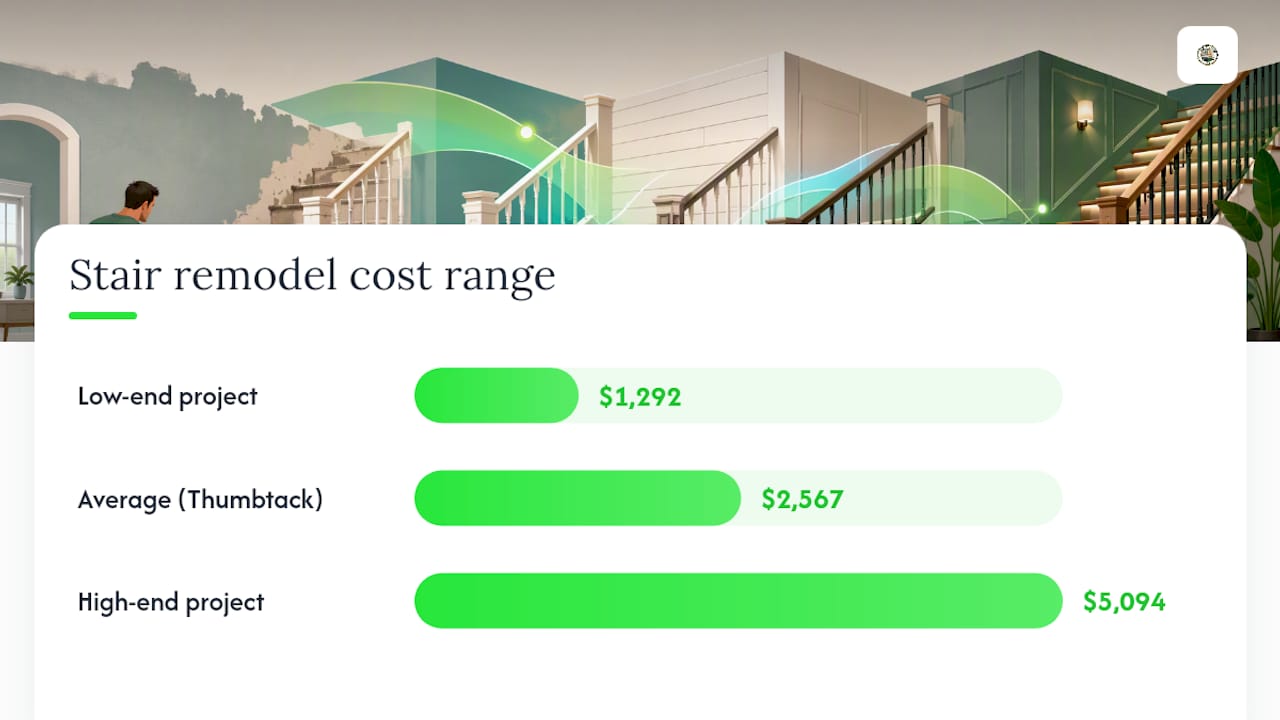
The national numbers give you a starting point, not a promise. Thumbtack’s data puts the average stair remodel cost around $2,567, with jobs on the low end near $1,292 and bigger projects climbing to $5,094. That spread exists because “stair remodel” covers everything from sanding and restaining existing treads to ripping out a rotted staircase and building new.
Per-step pricing is where the real budgeting happens, since almost every contractor quote breaks down to a rate multiplied by step count. HomeCostCalc’s modeling shows a typical project around $4,357 total, or roughly $311 per step, though material choice swings that number hard in either direction.
A few concrete examples help anchor expectations:
- Refinish only, 13 steps: $1,500 to $2,400 for sanding, staining, and sealing existing wood.
- Red Oak retro overlay, 12 treads and 13 risers: $1,250 to $3,300 installed, with materials alone running $600 to $900.
- New oak straight run with balustrade: $8,700 to $15,100 for full replacement.
- Custom curved or open-stringer staircase: frequently exceeds $20,000 once shop fabrication and fitting time are factored in.
The gap between the cheapest and most expensive options on this list isn’t really about the stairs themselves. It’s about how much of the existing structure you keep.
Cost by Project Scope: Refinish, Overlay, Replace, or Build New
Four scopes cover almost every stair project, and picking the right one starts with an honest look at what’s underneath your current treads.
- Refinish. If the stringers and treads are structurally sound and you just want a fresh look, sanding, staining, and resealing costs $1,500 to $2,400 for a 13-step run and usually wraps in one to three days. This works only when there’s no rot, no squeaking from loose joints, and no code violations to fix.
- Retro (overlay) treads. This is the sweet spot for most homeowners: new tread and riser caps go directly over the existing structure. For a 12 tread, 13 riser Red Oak job, expect $600 to $900 in materials and $650 to $1,800 in labor, landing the total around $1,250 to $3,300. Timelines typically run three to five days.
- Full replacement. Here the old stairs come out entirely and new stringers, treads, risers, and railings go in. A straight oak run with balustrade lands around $8,700 to $15,100, and the job usually takes one to two weeks including custom fabrication lead time.
- Custom new build. Curved runs, open-stringer designs, or stairs built for an addition fall here, often exceeding $20,000 with multi-week lead times for shop work alone.
What pushes a project from overlay to full replacement almost always comes down to what an inspection finds: sagging stringers, wood rot at the base, or a rise-and-run configuration that no longer meets current building code. Any of those turns a cosmetic job into a structural one.
Material Costs by Species, Railing Type, and Finish
Wood species is the single biggest lever on your material bill, and the range is wider than most homeowners expect. Paint-grade pine runs around $50 per step, red oak sits in the middle near $130 per step, and premium exotics like Brazilian cherry or walnut can hit $250 per step or higher.
Railings add their own swing in price:
- Wood railings are the budget baseline and blend easily with stained treads.
- Iron or powder-coated metal balusters cost more per unit but add a distinct look and hold up well over decades.
- Cable railing systems run higher still, largely due to tensioning hardware and installation precision.
- Glass panel railings sit at the top of the range, often reserved for modern or open-concept staircases.
Individual balusters typically cost $5 to $25 in materials with $15 to $40 for installed labor each, so a full foyer balustrade swap can add $1,000 to $4,500 to a project on its own. Newel posts, riser trim, and stringer skirt boards are smaller line items but worth asking your contractor to itemize separately, since they get bundled into vague quotes more often than they should.
Labor and Contractor Pricing: What You’re Actually Paying For
Contractors typically use per-step, hourly crew rates, or bundled scope pricing models for stair projects. Knowing which model you’re being quoted matters because it changes how you compare bids.
Hourly crew rates commonly work out to roughly $135 per hour for a three-person crew, based on an individual rate near $45 per hour per carpenter. Per-step pricing tends to run $100 to $200 per step for retro overlay installs and climbs to $150 to $300 per step for full replacement, where structural framing and custom fitting eat more time.
Labor typically includes:
- Demolition and haul-away of the old structure
- Stringer inspection and any needed reinforcement
- Tread, riser, and railing installation
- Sanding, staining, or painting to match
- Site protection for adjacent flooring and walls
Pro Tip: Ask every contractor whether disposal fees, dust containment, and final touch-up sanding are included in the quoted price. These three line items are the most common source of “surprise” charges on final invoices, and they’re easy to nail down before signing.
Special-Case Stairs: Spiral, Curved, Exterior, and Attic
Not every staircase fits the standard per-step math, and a few configurations reliably push costs higher.
- Prefab spiral kits start around $3,000 installed, making them one of the more affordable ways to add a secondary staircase to a loft or deck.
- Custom spiral or curved staircases commonly start well above $20,000 once you factor in shop-fabricated stringers, precise on-site fitting, and extended lead times.
- Open-stringer designs, where the side profile of each step is exposed rather than boxed in, multiply labor hours because every cut has to be finish-quality on both faces.
- Exterior stairs carry different cost drivers entirely: pressure-treated or composite materials, code-required tread depth and riser height for outdoor use, and drainage considerations that indoor stairs never face.
- Attic pull-down stairs are their own budget category, usually priced closer to a unit installation than a full remodel, but framing modifications for a larger opening can add cost quickly.
Curved and open-stringer work isn’t priced higher just because it looks fancier. It genuinely takes longer to build, and skilled finish carpenters who do this work well are in shorter supply than general contractors.
How to Estimate Your Stair Remodel Cost
A rough but usable formula gets you within range before you ever call a contractor:
- Count your steps. Most residential runs have 12 to 14 steps; measure yours precisely.
- Multiply per-step material cost by step count, using pine (~$50), oak (~$130), or premium species (~$250) as your tier.
- Add per-step labor based on scope: $100 to $200 for retro overlay, $150 to $300 for full replacement.
- Add railing and newel costs separately, since these are rarely included in per-step tread pricing.
- Add demolition and permit fees, then build in a 10% to 20% contingency for surprises like hidden rot or outdated wiring behind walls.
Permits matter more than most homeowners assume. Structural changes, altered rise-and-run dimensions, or new baluster spacing to meet current code can all trigger a permit requirement that a simple refinish never would. Always confirm with your local building department before assuming a project is cosmetic. For general project sequencing, Trussell’s Transformations offers a useful walkthrough of how contractor coordination typically unfolds on multi-trade renovations.
Cutting Costs Without Cutting Corners
Retro overlay treads are the highest-value savings move available when your existing stringers are sound, since you skip the labor and material cost of full demolition entirely. Choosing prefinished treads instead of on-site staining also shaves both time and mess.
Where DIY makes sense: painting risers, installing prefabricated baluster kits, or refinishing treads yourself if you’re comfortable with a sander. Where it doesn’t: anything touching stringer integrity, handrail anchoring into wall studs, or rise-and-run changes tied to code. A poorly anchored handrail is a liability issue, not a style choice.
Paying a pro for a one-time structural check before you start is cheap insurance against a much bigger bill later.*
Is a Stair Remodel Worth the Investment?
Entryway staircases carry outsized weight in first impressions, and refreshed treads or railings tend to support curb appeal more than they add hard resale value dollar-for-dollar. Highly custom work, like curved open-stringer builds, rarely returns its full cost at resale, so treat those as a lifestyle investment rather than a financial one.
Safety and code compliance are the exception. Money spent fixing loose balusters, uneven risers, or a wobbly handrail isn’t optional ROI. It’s liability reduction, and it matters even if you never sell the house. When budget is tight, prioritize durable finishes over trendy ones. Learn more about how entryway updates influence home presentation if resale is part of your timeline.
What a Licensed Remodeler Checks Before Quoting Your Stairs
A proper inspection focuses on stringer integrity, rise-and-run consistency, hidden rot near the base, and how securely railings anchor into framing. These checks are what separate an accurate quote from a guess.
Real project outcomes tend to cluster: straightforward overlay jobs typically wrap in three to five days, while full replacements with custom railings often take one to two weeks once fabrication lead times are included. The projects that run long almost always trace back to something the initial inspection uncovered, not scope creep from the homeowner.
Does Stair Width or Height Change the Price?
Wider staircases cost more, and the relationship is close to linear once you cross standard dimensions. A typical residential stair runs about 36 inches wide, and every additional few inches means more tread material, longer stringers, and wider railings on both sides if applicable.
Ceiling height and total rise matter just as much. A staircase connecting standard 8-foot ceilings needs fewer steps than one serving a 10 or 12-foot great room, and more steps means the per-step math from earlier in this guide simply multiplies further.
Riser height also plays into code compliance. Most jurisdictions cap riser height around 7.75 inches and require consistent measurements step to step. If your existing stairs violate that spacing, correcting it during a remodel often means adjusting the entire stringer, which nudges a simple refinish into full-replacement territory. Always measure your actual rise and run before assuming a quote will match a “standard” 12-step estimate.
How Long Does a Stair Remodel Actually Take?
Planning eats more calendar time than installation for most projects. Expect one to two weeks for material selection, contractor scheduling, and permit approval (when required) before any work begins. This is where custom species or railing materials matter most, since exotic wood and fabricated metal or glass railings often carry longer lead times than standard oak or pine.
Once work starts, a refinish typically takes one to three days. Retro overlay installs run three to five days. Full replacements with new stringers, treads, and railings usually take one to two weeks on-site, not counting the fabrication lead time for custom balustrades, which can add another two to four weeks before installation even begins.
Curved or custom open-stringer builds are the outlier. Between shop fabrication and precise on-site fitting, these projects commonly stretch to four to eight weeks from signed contract to finished stairs. If you’re planning around a move-in date or a home sale, build in that extended timeline early rather than discovering it mid-project.
Budgeting for Stair Safety and Accessibility Upgrades
Safety features are often the smallest line items with the biggest practical impact. A basic child safety gate at the top or bottom of a staircase typically costs $30 to $100 for the hardware, plus a small labor charge if it requires permanent wall mounting rather than a pressure-fit model.
Non-slip treads or adhesive strips run modestly, usually $5 to $15 per step for materials, and are one of the easiest additions to bundle into a refinish or overlay project without adding meaningful time. Stair lighting, whether recessed riser lights or a simple motion-sensor fixture at the top and bottom, adds more depending on whether new wiring is needed, since running electrical to a staircase mid-remodel is far cheaper than retrofitting it later.
Accessibility modifications carry a wider range. A handrail added to a previously open side of a staircase, done correctly with proper wall-stud anchoring, is a modest add-on labor cost. Widening a staircase or adding a stairlift for mobility needs is a different category of investment entirely and should be scoped separately from a cosmetic or structural remodel. Whatever safety features you’re considering, the same rule from earlier applies: any modification touching handrail anchoring or structural attachment points deserves professional installation, not a DIY attempt.
Practical Priorities When Budgeting for Stairs
Safety and structural soundness come before finish selection, every time. A beautiful walnut tread on a stringer with hidden rot is a liability wearing a nice coat of stain. Prioritize durable finishes that hold up to daily traffic over trend-driven choices that look great for a year and dull fast.
Expressions Remodeling builds transparent, itemized quotes and offers 3D previews so you see the finished staircase before a single tread comes out.
— Kierin
Get a Transparent Stair Remodel Quote from Expressions Remodeling
Expressions Remodeling gives St. Louis homeowners something most stair quotes skip: a real itemized breakdown before work starts, not a vague lump-sum number you have to trust blindly. Our carpentry team handles everything from custom railing fabrication to structural stringer repair, and we manage permit applications directly so you’re not tracking down code requirements on your own.

Every estimate includes a walkthrough of what we find during inspection, honest talk about whether your project needs a refinish, overlay, or full replacement, and a 3D preview so you can see railing and tread choices before committing to materials. If you’re weighing a stair remodel alongside other projects, our material selection guide is worth a look too. Ready to see real numbers for your own staircase? Request your quote through our pricing page and get a project timeline back within days, not weeks.
Sources
- 2026 Average Staircase Remodel Cost (with Price Factors)
- Staircase Cost Calculator (2026) | Refinish, New, Spiral
- Stair Remodeling Cost | Red Oak & Brazilian Cherry
- Staircase Remodel Cost Calculator (2026) — Free Online Estimate | HomeCostCalc