


Hire a handyman for small, one-off repairs and odd jobs. Hire a contractor when the work is larger, involves several trades, needs a permit, or touches structure, wiring, or pipes behind walls. The line is rarely about the title. It comes down to project size, complexity, and how much a mistake would cost you.
This guide shows where that line sits, how to check who you are hiring in St. Louis, and what to ask before anyone starts work.
TL;DR
- A handyman typically takes on small, varied, one-off residential tasks. A contractor typically handles larger or specialized work, including planning, subcontractors, permits, and code compliance.
- Call a professional contractor when an error could carry serious safety or financial consequences: load-bearing walls, foundations, complex electrical, sewer, or major plumbing.
- In the City of St. Louis, structural changes and major alterations need a building permit, and plumbing, mechanical, and electrical work can need their own.
- Before you sign, get at least three written estimates, ask for a certificate of insurance, and verify the coverage with the insurer.
- If your project spans more than one trade, one accountable contractor is usually simpler than managing several people yourself.
Table of Contents
- What a handyman does
- What a contractor does
- Side-by-side: how they differ
- Where the line falls: project by project
- Why a remodel is almost always a contractor job
- Permits in St. Louis: what triggers them
- How to vet whoever you hire
- A quick decision guide
- Our perspective
- When you are ready for a full remodel
- FAQ
- Sources
What a handyman does
A handyman is the person you call for the to-do list: a sticky door, a loose railing, a patched section of drywall, a mounted TV, a replaced faucet. The work is usually small, varied, and finished in a visit or two. Industry guidance describes handyman work as small, one-off residential projects across many kinds of tasks.
That breadth is the value. One person can knock out six small items in an afternoon, and you do not need to schedule six trades. Nationwide describes a handyman as suited to flexible, basic work.

The tradeoff is depth. A handyman is generally a generalist, not a specialist in any single trade, and the more a task depends on trade-specific skill, code knowledge, or inspection, the less a generalist fits.
What a contractor does
Contractor is a broader word than it sounds. There are two common types:
- General contractors oversee the whole project and coordinate the specialists who do the work.
- Specialty contractors focus on one trade, such as plumbing or roofing.
California’s Contractors State License Board, for example, explains that general contractors coordinate specialty subcontractors while specialty contractors perform a defined trade. Rules differ by state, but the roles are similar across the country.
When a contractor runs a project, the responsibilities are wider than the physical work. They commonly include project planning, budgeting, coordinating subcontractors, obtaining permits where required, and meeting building-code requirements. The exact duties and licensing rules vary by state and locality, so treat any national checklist as a starting point.
If you own an older house and the work involves period details, a specialty approach matters even more. This roundup of contractors that specialize in old homes shows how differently restoration work is scoped from routine remodeling.
We cover the categories in more depth in our guide to types of home renovation contractors.
Side-by-side: how they differ
| Factor | Handyman | Contractor |
|---|---|---|
| Typical work | Small repairs, odd jobs, minor installs | Remodels, additions, structural work, multi-trade projects |
| Duration | Hours to a couple of days | Weeks to months |
| Permits | Usually not involved | Often pulled and managed by the contractor where required |
| Trades | One generalist | Coordinates subcontractors or performs a specialty trade |
| Planning | Little formal planning | Scope, budget, schedule, and code compliance |
| Contract | Often a quick quote or verbal agreement | Written contract with scope and payment terms |
| Best for | Punch lists and maintenance | Anything where a mistake is costly or inspected |
The table is a pattern, not a law. Some handymen are highly skilled, and some small contractors take on modest jobs. Judge the specific person against the specific job.
Where the line falls: project by project
A useful test is to ask what happens if the work is done wrong. Forbes Home advises calling a professional when a project could have significant safety or financial consequences, and notes that complex electrical, sewer, foundation, load-bearing, and structural work is typically best left to professionals. The Washington Post draws a similar boundary around structure, electrical systems, plumbing, sewer lines, architectural plans, and permits.
Usually fine for a handyman
- Patching and painting small areas
- Hanging shelves, mirrors, and TVs
- Swapping a faucet, showerhead, or light fixture on an existing connection
- Replacing a door, cabinet hardware, or weatherstripping
- Caulking, minor trim work, and small drywall repairs
Better for a contractor or licensed trade
- Removing or moving walls, especially anything that could be load-bearing
- Foundation, sewer line, or major plumbing work
- New circuits, panel changes, or other complex electrical work
- Kitchen, bathroom, or basement remodels that combine several trades
- Anything that requires drawings or a building permit
Wiring and pipes behind walls sit squarely on the contractor side. Amica Insurance says that when work involves wiring, pipes behind walls, structural changes, or safety risks, a professional is usually the safer choice. For an example of why trade-specific licensing matters, read why a licensed HVAC contractor matters, which applies the same logic to heating and cooling.
Is a plumber a contractor?
Often, yes, but it depends on the work and local licensing. A plumber doing a specialty trade is typically a specialty contractor, and general contractors may hire plumbers as subcontractors. Licensing requirements vary by location and type of work, so ask any plumber, electrician, or HVAC technician what license they hold and who issued it.
Why a remodel is almost always a contractor job
A kitchen, bathroom, or basement remodel is where the handyman-versus-contractor question comes up most. Each involves demolition, plumbing, electrical, framing, surfaces, and finishes, in a sequence where one trade’s work must be finished and inspected before the next starts.
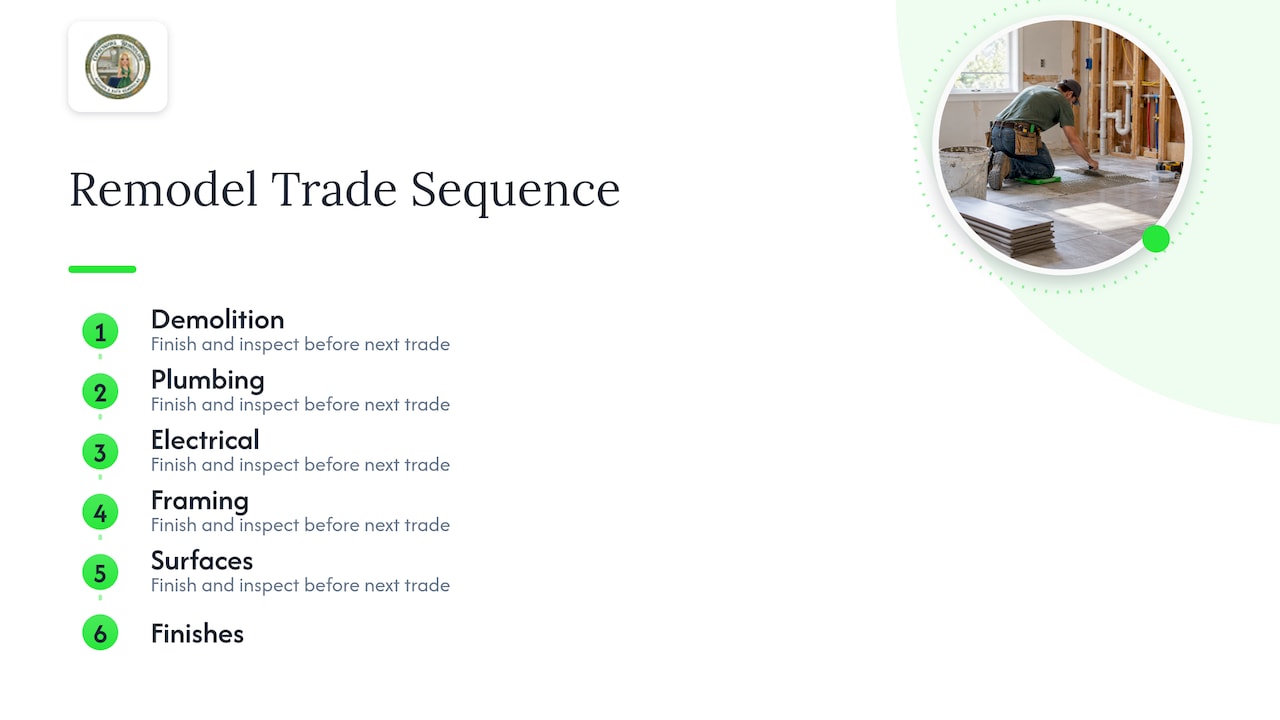
A handyman can do pieces of that. But someone has to own the schedule, the permits, and the handoffs between trades. If that someone is you, you are acting as your own general contractor, with the risk that comes with it.
Basements add their own wrinkles: moisture, egress, and code. Our St. Louis basement code, permits, and egress guide walks through what changes when you finish below grade. For a bigger picture of how remodel pricing and bids work locally, see our St. Louis remodel cost and bid checklist.
Permits in St. Louis: what triggers them
Permits are one of the clearest dividing lines. According to the City of St. Louis, a building permit is required for structural changes, major alterations, and new construction, and separate plumbing, mechanical, and electrical permits are also required when applicable.
In practice, a small repair rarely triggers any of that. A remodel often triggers several. Ask any person you are considering: “Who pulls the permits, and will they be in your name or mine?” A contractor who regularly works in your municipality should answer that without hesitation.
Homeowners doing their own permitted electrical work have a separate hurdle. The city says that homeowners performing permitted electrical work on their own homes must pass a test given by the Building Division to show sufficient knowledge of the Electrical Code. That is a good reminder that electrical work is not casual, even when it is your own house.
Rules differ across St. Louis County and its municipalities, so confirm requirements with your local building department before work begins.
How to vet whoever you hire
The same checks apply to a handyman and to a contractor. The larger the job, the more they matter.
1. Check the registry and licensing
The City of St. Louis has launched a Contractor Registry to help residents verify the license and insurance status of professional contractors, and residents are encouraged to check it before hiring. Licensing for specific trades varies by location, so ask what license applies to the work and confirm it with the issuing authority. Our walkthrough on how to verify a licensed, insured remodeler in 20 minutes gives a practical order of operations.
2. Ask for proof of insurance, then verify it
A verbal “yes, I’m insured” is not proof. Local government guidance says you should ask contractors for proof of valid insurance, such as general liability and workers’ compensation, and confirm that the coverage is active by contacting the insurance carrier directly. Ask for a certificate of insurance, and have the insurer confirm it is still in effect.
Why it matters: if someone is injured on your property or damage occurs during the work and there is no coverage, the cost can land on you. A bargain price from an uninsured worker is not always a bargain.
One nuance from the City of St. Louis: construction businesses with no employees that are not an LLC may be eligible for an affidavit of exemption from workers’ compensation insurance. A solo operator may therefore legitimately lack a workers’ comp policy. Ask which situation applies and whether general liability coverage is in place.
3. Get three written estimates
The same guidance recommends getting written estimates from at least three contractors, then comparing the work and costs. Compare the scope line by line, not only the total. A low number often leaves out something the others included: demolition, disposal, permits, or finish materials.
4. Get the scope in writing
For anything beyond a repair, you want a written contract that spells out the work, materials, schedule, payment milestones, and how changes are handled. Our guide to how remodeling contracts work explains what each part should say.
5. Questions worth asking
- What license or registration do you hold, and who issued it?
- Can you send a certificate of insurance I can verify with your carrier?
- Who pulls the permits, and who schedules inspections?
- Which parts will you do yourself, and which go to subcontractors?
- What does the payment schedule look like, and what happens if scope changes?
- Can I see similar projects you have completed locally?
A quick decision guide
Use this sequence when you are unsure:
- Does the work touch structure, a foundation, a sewer line, or the main electrical system? Hire a contractor or the relevant licensed trade.
- Does it need a permit or drawings? Hire a contractor who handles permits locally.
- Does it involve more than one trade, in sequence? A general contractor will save you coordination headaches.
- Is it a small, self-contained repair on existing fixtures? A handyman is a sensible, economical choice.
- Unsure? Ask a contractor to look at the job. A good one will tell you honestly if it is small enough for a handyman.
Our perspective
Most of the homeowners who call us are standing in the middle of this question. They have a dated kitchen, a bathroom that has outlived its tile, or an unfinished basement, and they are wondering whether a handyman and a few subs could pull it off.
Our answer is that it depends on what you want at the end. If you want a few cosmetic fixes, a handyman may be all you need. If you want a space designed around how your family lives, with plumbing, electrical, framing, and finishes coordinated and the permits handled, that is contractor work, and the real value is having one team accountable from the first sketch to the final walkthrough.
That is why we pair craftsmanship with design. We use 3D visualization so you can see the space before demolition starts, and we guide the project end to end. The most expensive remodel is the one you have to redo, so our advice is to match the person to the risk: small tasks to a handyman, projects with consequences to a team that is licensed, insured, and used to inspections. And if you are not sure which you need, ask us. We will tell you honestly, even when the answer is a handyman.
— Kierin
When you are ready for a full remodel
If your project is a kitchen, bathroom, or basement, Expressions Remodeling handles design, coordination, and construction as one St. Louis team. Our published starting points are $10,000 for a kitchen remodel, $16,999 for a full bathroom remodel, and from $40 per sq. ft. for a full basement remodel, with details on our pricing page.

We also take on garage and storage room renovations, floor replacement, home offices, and man caves. Tell us what you are picturing on our home page, and we will walk you through the scope, the permits, and the budget.
FAQ
When should I hire a contractor instead of a handyman?
Hire a contractor when the work is large, spans several trades, needs a permit, or could cause serious safety or financial harm if done wrong. Structural, load-bearing, foundation, sewer, and complex electrical work are the classic examples. For a remodel of a whole room, a contractor is the more reliable choice.
Is a handyman licensed?
It depends on where you live and what the work is. Licensing rules vary by state and locality, and a license held for one kind of work does not automatically cover another. Ask what license applies to your job and verify it with the issuing authority. In the City of St. Louis, you can also check the city’s Contractor Registry.
Is a plumber considered a contractor?
Often yes, as a specialty contractor focused on one trade. General contractors also hire plumbers as subcontractors. Licensing requirements vary by location and by the type of work, so ask the plumber what license they hold.
Do I need a permit if I hire a handyman?
The permit depends on the work, not on who does it. In the City of St. Louis, structural changes and major alterations need a building permit, and plumbing, mechanical, or electrical work can require its own. If a handyman suggests skipping a permit for work that needs one, treat that as a warning sign.
What should I ask before hiring either one?
Ask for their license or registration, a certificate of insurance you can verify with the carrier, a written estimate, and who will handle permits. Get at least three estimates for larger projects and compare scope, not just price.
Sources
- Handyman vs Contractor: What’s the Difference?
- What Kind of Contractor Do You Need? (CSLB)
- Nationwide: Handyman vs. General Contractor
- Forbes Home: When To Call In Professional Contractors
- Washington Post: Home improvement projects you can DIY and ones to leave to pros
- Amica Insurance: DIY vs. Professional House Repairs
- Insureon: General Contractor vs. Handyman
- City of St. Louis: When a Residential Building Permit is Needed
- City of St. Louis: Apply for an Electrical Permit
- City of St. Louis: Affidavit of Exemption for Workers’ Compensation Insurance
- City of St. Louis: Contractor Registry announcement
- Webster Groves: Hiring a Contractor