
Heated bathroom floors are worth it for most people who are already tearing out the tile, and rarely worth it as a stand-alone project. Professionally installed, national averages run $600 to $4,600, with most homeowners paying $1,600 to $1,800. The comfort is real. The catch is that the system goes under the tile, so the right moment to add it is during a remodel, not after.
Below you will find what drives the price, what the system costs to run, which floors work, the safety rules that matter in a wet room, and the permit requirements in St. Louis and St. Louis County.
TL;DR
- Expect roughly $8 to $20 per square foot, installed, for an electric system, before the new finish flooring. A typical small bathroom lands between about $600 and $4,600 nationally.
- Electric cable or mat systems are the standard for bathroom retrofits. Water-based (hydronic) systems usually make sense only in big new builds or whole-house remodels.
- Add it while the floor is already open. Retrofitting an existing home costs 50% to 80% more than building new because of demolition and floor replacement.
- In St. Louis and St. Louis County, radiant heating is mechanical and electrical work that needs a licensed contractor and permits. This is not a DIY job.
- Treat it as a comfort upgrade, not a heat source, and put it on a programmable thermostat.
Table of Contents
- What a heated bathroom floor actually is
- What heated bathroom floors cost in 2026
- What it costs to run
- Are heated bathroom floors worth it?
- Which flooring works over heated floors
- Safety rules that matter in a wet room
- Permits and licensing in St. Louis and St. Louis County
- Adding heated floors during a bathroom remodel
- Our perspective
- Planning a bathroom remodel in St. Louis?
- FAQ
- Sources
What a heated bathroom floor actually is
Most bathroom systems are electric. A network of cables, usually woven into a thin mat, sits under the tile and warms the floor from below. A thermostat with a floor sensor controls it. The tile and thin-set bury the cables, so nothing is visible once the room is finished.
There are three common forms:
- Loose cable on fixing strips or in an uncoupling membrane. It suits odd shapes and rooms with many obstacles.
- Pre-spaced mats, where cable is already attached to mesh. They go down fast in square or rectangular rooms.
- Hydronic tubing, which circulates warm water. It costs $10 to $25 per square foot in materials alone, and it is typically reserved for large new construction or major remodels.
For a single bathroom in an existing house, electric is almost always the practical answer.
What heated bathroom floors cost in 2026
Published national figures agree closely. Angi puts the professional range at $600 to $4,600, calculated at $8 to $20 per square foot for materials and labor. That figure leaves out the new finish flooring. HomeAdvisor reports the same range and a $1,800 average, and a cost calculator from CostToRenovate gives $800 to $3,500 with a $1,600 average.
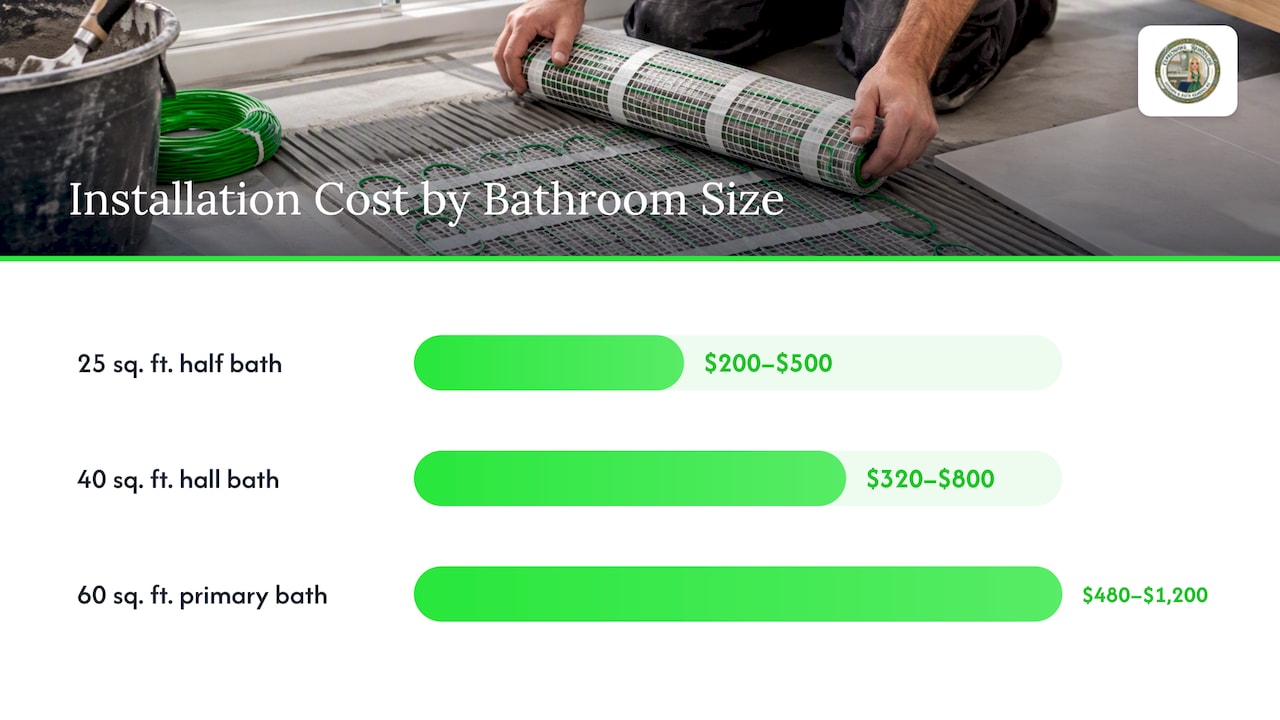
Here is how that plays out on common bathroom sizes, using the $8 to $20 per square foot range as simple arithmetic:
| Heated area | Low end ($8/sq. ft.) | High end ($20/sq. ft.) |
|---|---|---|
| 25 sq. ft. (half bath) | $200 | $500 |
| 40 sq. ft. (hall bath) | $320 | $800 |
| 60 sq. ft. (primary bath) | $480 | $1,200 |
The small-room totals come out lower than the national minimum because contractors usually have a minimum job charge, and because thermostat, electrical hookup and prep work do not shrink with the room. That is why the published floor of $600 is a better planning number than the raw multiplication.
What pushes the price up
- Retrofit conditions. Installing in an existing home costs 50% to 80% more than in new construction, because the old floor has to come out first.
- Thermostat choice. A basic dial is cheap. A Wi-Fi programmable unit costs more and saves money on running costs.
- Electrical work. The system needs its own protected circuit, which may mean work at the panel.
- Heated area. You do not have to heat wall to wall. Skipping the spot under the vanity and tub saves money and avoids cable placement problems.
- Finish flooring. Tile, labor and waterproofing are separate from the heating line item. HomeGuide’s all-in figure with new flooring is $12 to $55 per square foot.
A Missouri reality check
Those figures are national. Pricing in the St. Louis area depends on your electrical panel, your subfloor and the finish you choose. We always suggest getting the heating priced as a line item inside the full bathroom scope, so you can see what it adds and decide with real numbers. Our published bathroom remodel pricing lists a full bathroom remodel at $16,999 per project, and our St. Louis bathroom remodel cost breakdown explains what moves a project up or down.
What it costs to run
Electric floor heat is not free to operate, but a bathroom is small. One guide estimates that a 35 sq. ft. heated area draws about $0.15 to $0.35 per hour of operation at the national average electricity rate. Run that for two hours on weekday mornings and you are looking at a few dollars a month in most cases. Your actual rate and the system’s wattage will move that number.
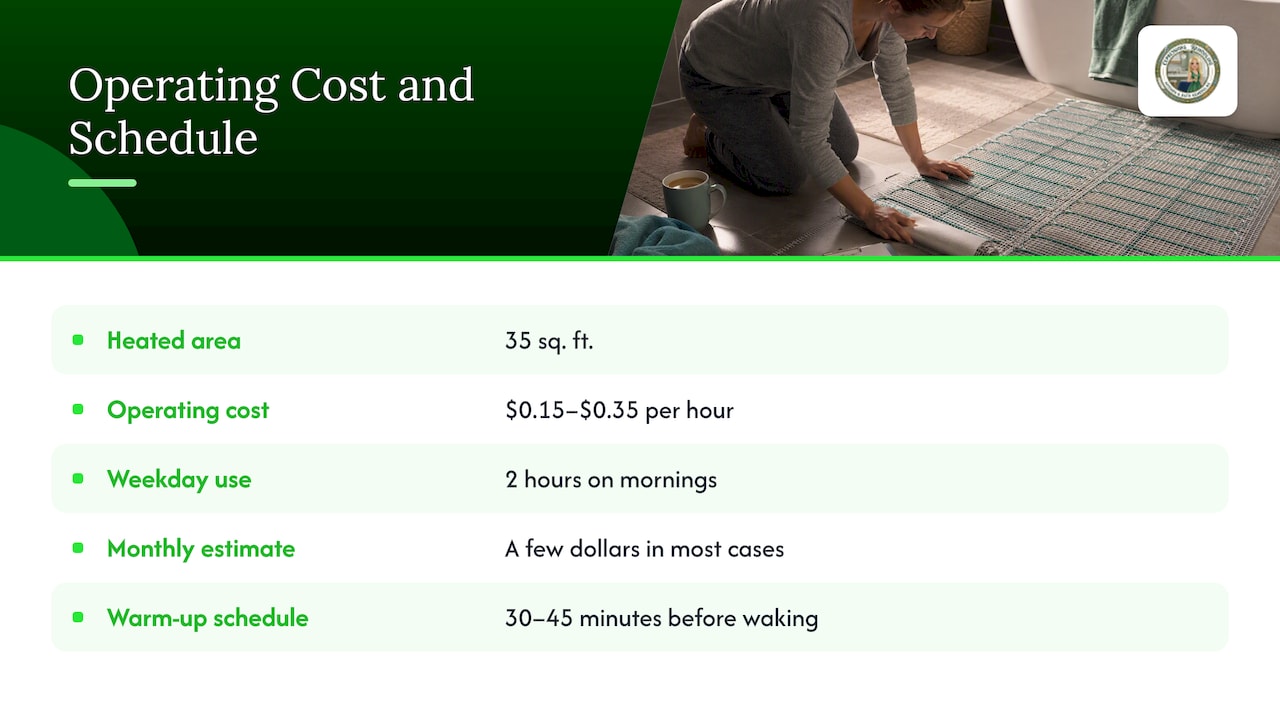
The habit that makes the difference is the thermostat. Richard Trethewey of This Old House recommends a smart thermostat with a timer to avoid unnecessary energy use and high bills, and describes the system as a luxury upgrade rather than a primary heat source for the room. A schedule that warms the floor 30 to 45 minutes before you get up, then shuts off, captures the benefit without the waste.
Are heated bathroom floors worth it?
They are worth it when:
- You are already replacing the floor, so the demolition cost is shared.
- Your bathroom sits over a basement, a crawl space or a slab, where tile feels cold in winter.
- You plan to stay in the home long enough to enjoy it, or you are targeting a higher-end buyer.
- You want a bathroom that feels finished in the morning, not just looks finished.
They are a weaker buy when:
- The floor is fine and you would be tearing it out only for the heat.
- You expect the system to replace a heater. It will take the chill off the surface, but it is designed as supplemental comfort.
- You plan to install a floating vinyl or laminate floor that has a low temperature tolerance (more on that below).
The honest downsides
Homeowners on forums raise fair objections. The main ones are cost relative to the benefit, the long warm-up time on a cold slab, and the fact that a failure under tile is expensive to repair. Each one has an answer. Warm-up is solved by a timer. Repair risk is why testing matters before and after the tile goes down, as covered below. Cost is the only one you have to weigh yourself.
Which flooring works over heated floors
Ceramic and porcelain tile are the gold standard because they conduct heat well and tolerate it. Natural stone behaves similarly. Those are also the materials most people want in a bathroom anyway.
Vinyl and laminate need care. Some products have lower maximum temperature limits that can damage the floor if the system is configured incorrectly. Always confirm that your chosen floor is rated for use over radiant heat and that the thermostat limit is set below the manufacturer’s maximum.
If you are still deciding between the two, our guide to porcelain tile or vinyl for St. Louis bathrooms walks through durability, moisture and feel underfoot. For heated floors specifically, tile is the safer default.
Safety rules that matter in a wet room
Electricity and water share a small room, so the rules are strict. This section describes what the sources say. It is not a guide to doing it yourself.
- Never cut the heating cable or mat to fit. Cutting changes the resistance, which can cause overheating and create shock and fire hazards. Layouts are planned around the toilet flange, vanity and tub instead.
- No overlapping and no crowding. Cables must not cross themselves or sit closer than 1.5 to 2 inches apart, and they need at least a 4-inch gap from walls, tubs and shower curbs.
- GFCI protection. The National Electrical Code calls for radiant heat circuits in bathrooms to be protected by a dedicated GFCI.
- Waterproofing above the cables in wet areas. In showers, a membrane over the heating cables keeps them dry.
- Test before and after the mortar. Continuity testing both before and after the thin-set goes down catches damage while it can still be fixed. Once the floor is set, faults are very hard to repair.
That last point is the strongest argument against DIY. Professionals strongly advise against treating radiant installation as a DIY project in bathrooms, and an improper install can void the manufacturer warranty. If you have a cold-floor problem and a limited budget, hire a licensed contractor for the heating and save money elsewhere.
Permits and licensing in St. Louis and St. Louis County
This is where local rules change the answer.
In St. Louis County, mechanical work on residential property, including installing a radiant heating system, must be done by a licensed contractor, and a mechanical permit is required for new radiant installations. The same page treats replacing a radiant heating unit as a mechanical repair that needs a permit, with only ordinary maintenance exempt.
In the City of St. Louis, electrical permits are issued to licensed electrical contractors, and the city’s page notes that homeowners cannot apply for certain permit types themselves. Requirements differ between the city, the county and individual municipalities, so confirm with your local building department before work starts.
In practice: ask any contractor who quotes heated floors who pulls the permits, who is licensed for the electrical and mechanical pieces, and who schedules the inspection. A vague answer is a reason to keep looking.
Adding heated floors during a bathroom remodel
The order of work is what makes this a remodel upgrade. Roughly:
- Plan the layout. Decide where the toilet, vanity, tub or shower will sit, and map the heated zone around them.
- Prep the subfloor. It needs to be flat, clean and sound.
- Install the membrane or mat, and test. Continuity is checked before anything covers it.
- Wire the thermostat and GFCI-protected circuit. This is licensed electrical work.
- Set the tile, then test again.
- Inspect and commission. Follow the manufacturer’s curing time before the first warm-up.
If you are working through the whole bathroom, our bathroom remodel checklist shows where heating decisions fit among plumbing, tile and fixtures. Our piece on design-build for bathroom remodels explains why one team handling design and construction avoids the finger-pointing that happens when trades work in the wrong order.
Our perspective
We remodel bathrooms in St. Louis, and the question we hear most about heated floors is not whether they feel good. It is whether the money is better spent elsewhere. Our answer is to decide it early, on paper, before demolition.
Heated floors are a design decision, because they touch the tile choice, the thermostat location, the electrical plan and the budget at once. That is why we like to put the idea into a 3D design before anyone picks up a hammer. You can see the layout, compare finishes and price the heating as its own line, so there are no surprises mid-project.
Our advice is simple. If the floor is coming up anyway and you have a cold bathroom, price it. If the floor is staying, spend the money on something you will notice every day, like storage, lighting or ventilation. And whatever you do, do not skip the licensed installer, the permit or the pre-tile testing. A heated floor that fails under new tile is the most expensive kind of cold floor.
— Kierin
Planning a bathroom remodel in St. Louis?
If you are comparing options, bring the heated floor question to us during planning. Our bathroom remodeling service covers the full project from design through finish, and our pricing page lists a full bathroom remodel at $16,999 per project and vinyl flooring from $2 per sq. ft. For a feel of what is possible, see our simple bathroom upgrades that make a big difference.
FAQ
How much does it cost for heated bathroom floors?
Nationally, professional installation runs about $600 to $4,600, and most homeowners pay between $1,600 and $1,800, according to Angi. That works out to $8 to $20 per square foot before the finish flooring. Retrofits cost more than new construction, so get the heating priced inside your bathroom scope.
Are heated floors in bathrooms safe?
Yes, when a licensed professional installs them correctly. The key requirements are a dedicated GFCI-protected circuit, cables that are never cut or overlapped, waterproofing over the cable in wet areas, and continuity tests before and after tiling. Skipping any of those is where the danger comes from, which is why the work should not be DIY.
What are the disadvantages of heated floors?
The main ones are upfront cost, a warm-up delay of a half hour or more, added running cost if left on all day, and difficult repairs once the floor is tiled. Some vinyl and laminate floors also have temperature limits. A timer thermostat and a tile floor address most of these.
Do heated floors increase the electric bill much?
Not in a single bathroom if you use a schedule. One estimate puts a typical bathroom floor at $0.15 to $0.35 per hour to run. Your local rate and the system’s wattage change that, so check the product’s specifications.
Do I need a permit for heated floors in St. Louis?
Usually yes. St. Louis County requires a mechanical permit and a licensed contractor for new radiant heating installations. Check with your city or municipality, since rules vary by location.
Sources
- Angi: How Much Does It Cost to Install a Heated Bathroom Floor?
- HomeGuide: How Much Does a Heated Bathroom Floor Cost?
- HomeAdvisor: Heated Bathroom Floor Cost
- CostToRenovate: Heated Bathroom Floor Cost Calculator
- Bathify: Heated Bathroom Floors guide
- This Old House: Electric Radiant Heating
- This Old House: How To Install Electric Radiant Heating
- Green Building Advisor: Tips for Installing Electric Radiant Floors
- Family Handyman: How to Install In-Floor Radiant Heat
- St. Louis County: Mechanical Work, Residential
- City of St. Louis: Apply for an Electrical Permit