

Return on investment (ROI) remodeling is the percentage of your renovation cost recovered through increased home resale value. Spend $10,000 on a project, add $8,000 in home value, and your ROI is 80%. That single number helps you decide which projects are worth doing before you sell and which ones are purely for personal enjoyment. Datasets like Zonda’s annual Cost vs. Value report and the National Association of REALTORS® Remodeling Impact study track these figures across 119 U.S. markets, giving homeowners real data to plan smarter renovations.
What is return on investment remodeling and how is it calculated?
ROI remodeling measures the percentage of renovation cost recouped through resale value gains. The formula is straightforward: divide the value added to your home by the total project cost, then multiply by 100. A $20,000 kitchen update that adds $16,000 in resale value returns 80% ROI.
The numbers behind published ROI figures come from a specific process. Cost vs. Value data combines builder cost estimates with resale value perceptions from real estate professionals across 119 U.S. markets. That methodology means the figures reflect what buyers actually pay more for, not just what contractors charge.
Two metrics matter when you read any ROI report. The percentage tells you efficiency. The absolute dollar gain tells you scale. A project with 60% ROI on a $50,000 remodel returns $30,000. A project with 90% ROI on a $5,000 update returns $4,500. Comparing dollars recouped alongside the percentage gives you the full picture of what each project actually adds.

Pro Tip: Always check the most recent Cost vs. Value report for your specific metro area. National averages can differ significantly from St. Louis or any other local market.
The three main data sources homeowners should consult are Zonda’s Cost vs. Value report, the NAR Remodeling Impact study, and Opendoor’s annual home improvement analysis. Each uses slightly different methodology, so cross-referencing all three gives you the most reliable picture.
- Find the total project cost including labor and materials.
- Estimate the resale value added using local Cost vs. Value data.
- Divide value added by project cost.
- Multiply by 100 to get your ROI percentage.
- Compare the absolute dollar gain across competing project options.
Which remodeling projects offer the best ROI?
Exterior replacements consistently outperform interior remodels on ROI percentage. Garage door replacement recoups about 267.7% and steel entry door replacement recoups about 216.4% of costs nationally, according to Zonda’s 2025 Cost vs. Value dataset. Those numbers reflect a simple truth: buyers form opinions about a home before they walk through the front door.
The NAR Remodeling Impact study confirms the same pattern. Garage door replacements return 194% and steel door replacements return 188% according to NAR figures. The slight variation between datasets reflects different survey methods, but both point to the same conclusion: exterior curb appeal projects are the most efficient use of remodeling dollars when resale is the goal.
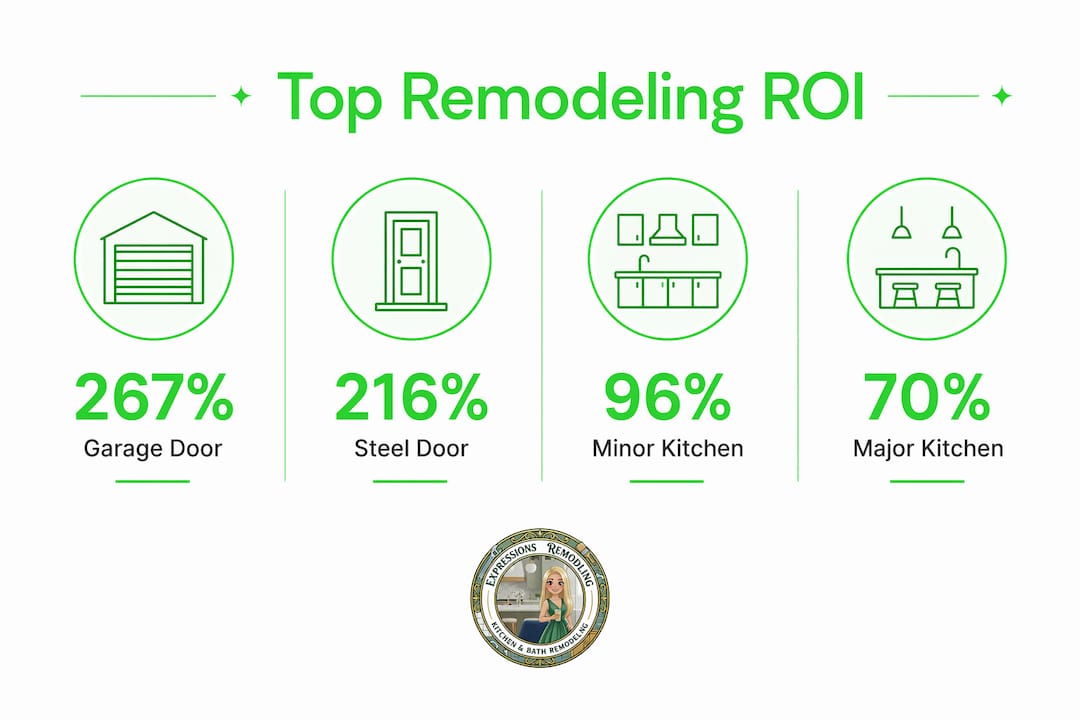
Interior projects tell a more nuanced story. Minor kitchen remodels yield roughly 96% ROI while major upscale kitchen remodels return only about 38%. That gap is one of the most important data points in home renovation planning. Spending more does not mean recovering more.
| Project | Estimated ROI |
|---|---|
| Garage door replacement | ~267% |
| Steel entry door replacement | ~216% |
| Minor kitchen remodel | ~96% |
| Bathroom remodel (midrange) | ~74% |
| Major kitchen remodel (upscale) | ~38% |
Why do exterior projects dominate? Curb appeal projects tend to yield better ROI because buyer first impressions and broad appeal strongly influence resale value. An interior remodel reflects personal taste. A clean, updated exterior appeals to every buyer who drives past.
Key takeaways from the project comparison data:
- Standardized replacements (doors, siding) beat custom interior upgrades on ROI percentage.
- Minor kitchen updates beat major kitchen overhauls on cost recoup.
- Bathroom remodels sit in the middle range and add meaningful value without the risk of over-customization.
- Upscale finishes rarely recover their cost at resale.
What factors affect remodeling ROI?
Project scale is the single biggest variable in remodeling investment returns. Minor updates to existing kitchens and bathrooms consistently outperform full gut renovations on ROI percentage. The reason is simple: a $5,000 refresh competes against a $60,000 overhaul, and buyers rarely pay $60,000 more for a kitchen than they would for a refreshed one.
Local market conditions matter just as much as project type. ROI figures are directional benchmarks, not guarantees. Actual returns vary with homeownership duration and local real estate conditions. A homeowner in a hot St. Louis suburb may recoup far more on a bathroom remodel than the national average suggests.
How long you own the home also shapes the math. Short-term sellers face the most risk on expensive interior remodels because they have less time for the market to absorb the added value. Homeowners who plan to stay 10 or more years can justify projects with lower resale ROI because they also get years of personal use from the upgrade.
Pro Tip: Before committing to any major remodel, pull the Cost vs. Value data for your specific city. National averages are a starting point, not a final answer.
Keep remodeling projects to about 30% or less of your home’s current value to maintain positive ROI potential. A $400,000 home can support roughly $120,000 in total renovation spending before you risk over-improving for the neighborhood. Exceeding that threshold makes it harder to recoup costs regardless of project quality.
Additional factors that shift your actual ROI:
- Finish quality: Higher-end specs increase cost faster than they increase resale value.
- Scope changes: Mid-project additions are a leading cause of budget overruns that crush ROI.
- Buyer demand alignment: Projects that match what buyers in your area want return more than personal preference projects.
- Timing: Renovating in a slow market means buyers have more negotiating power, which can reduce the value you capture.
How can homeowners maximize remodeling ROI in practice?
The most reliable strategy for strong remodeling investment returns is choosing projects with broad buyer appeal over highly personal ones. Standardized projects like door replacements and minor kitchen updates consistently outperform custom or upscale interior remodels on cost recoup. A neutral, well-executed kitchen refresh attracts more buyers than a bold, custom design.
Budget discipline is the second pillar of strong ROI. Tying your total renovation budget to 30% of current home value keeps you from over-improving. For a $300,000 home in St. Louis, that means keeping total remodeling spend under $90,000 across all projects. Spreading that budget across high-ROI projects like exterior updates, a minor kitchen refresh, and a bathroom update produces better returns than pouring it all into one showpiece room.
Consulting updated reports before you plan is non-negotiable. ROI predictions shift annually with market costs and trends, making current Cost vs. Value data the most reliable planning tool available. A project that returned 80% three years ago may return 60% today because material costs have risen faster than resale values.
Practical steps to maximize your home renovation payback period:
- Pull the current Zonda Cost vs. Value report for your metro area.
- List projects by ROI percentage and absolute dollar gain side by side.
- Prioritize exterior projects and minor interior updates first.
- Set a firm budget at or below 30% of your home’s current value.
- Get multiple contractor bids to control the cost side of the ROI equation.
- Avoid scope changes once work begins.
Learning how to plan a home remodel that balances style, function, and long-term value is the foundation of any high-ROI renovation strategy. The homeowners who get the best returns are the ones who plan before they spend, not after.
For kitchen projects specifically, planning a kitchen remodel without overspending is a skill that separates high-ROI renovators from homeowners who end up disappointed at resale.
Key Takeaways
Exterior replacements and minor interior updates deliver the highest remodeling ROI, while upscale custom projects consistently return the lowest percentage of cost at resale.
| Point | Details |
|---|---|
| ROI formula | Divide value added by project cost, multiply by 100 to get your ROI percentage. |
| Top ROI projects | Garage door and steel entry door replacements lead all categories at over 200% ROI. |
| Minor beats major | Minor kitchen remodels return roughly 96% ROI; major upscale remodels return only about 38%. |
| 30% budget rule | Keep total renovation spending at or below 30% of your home’s current value. |
| Use local data | National ROI averages are directional benchmarks; always check figures for your specific market. |
What the ROI numbers actually tell you
I’ve spent years watching homeowners make the same mistake: they treat ROI percentages as a promise instead of a benchmark. The data from Zonda and NAR is genuinely useful, but it describes averages across thousands of projects. Your specific project, contractor, and neighborhood will produce a different number.
The insight that changed how I think about renovation ROI is this: the percentage and the dollar gain are two different conversations. A garage door replacement at 267% ROI sounds extraordinary, but the absolute dollar gain is modest because the project cost is low. A well-executed bathroom remodel at 74% ROI on a $25,000 project adds $18,500 in value. That is real money. Chasing the highest percentage without looking at the dollar gain leads to a portfolio of cheap swaps that look great on paper but don’t move the needle on your home’s price.
The other thing I’d push back on is the idea that low resale ROI means a project is a bad decision. If you plan to stay in your home for 15 years, a $60,000 kitchen remodel that only returns 38% at resale still gave you 15 years of cooking in a space you love. That has value. The mistake is spending $60,000 on a kitchen two years before you sell and expecting to get it back.
My honest advice: use ROI data to eliminate the worst projects, not to pick the single best one. Avoid anything that requires heavy customization if resale is within five years. Prioritize exteriors and minor updates. Then spend the rest on the room you actually live in.
— Kierin
Expressions Remodeling can help you get the most from your renovation budget
Knowing which projects deliver the best returns is only half the equation. Executing them at the right cost is the other half. Expressions Remodeling works with St. Louis homeowners to plan and build renovations that hit both targets.
Expressions Remodeling offers complimentary 3D design and free estimates on kitchen and bathroom projects, so you can see exactly what you’re getting before you commit a dollar. Their team specializes in affordable kitchen upgrades that deliver strong resale value without the cost of a full gut renovation. For bathroom projects, their bathroom remodeling upgrades focus on the changes that buyers actually notice and pay for. If you’re in St. Louis and want a renovation plan built around real ROI data, Expressions Remodeling is the place to start.
FAQ
What does remodeling ROI mean?
Remodeling ROI is the percentage of your renovation cost recovered through increased home resale value. Spend $10,000 and add $8,000 in home value, and your ROI is 80%.
Which home renovation has the highest ROI?
Garage door replacement leads all projects at roughly 267% ROI nationally, followed by steel entry door replacement at about 216%, according to Zonda’s 2025 Cost vs. Value report.
Is a minor or major kitchen remodel a better investment?
A minor kitchen remodel returns roughly 96% of its cost at resale, while a major upscale kitchen remodel returns only about 38%. Minor updates almost always win on ROI percentage.
How do I calculate ROI on a home renovation?
Divide the resale value added by the total project cost, then multiply by 100. Use local Cost vs. Value data from Zonda or NAR to estimate the value added before you start.
How much should I spend on a remodel to protect my ROI?
Keep total renovation spending at or below 30% of your home’s current value. Spending beyond that threshold makes it harder to recoup costs regardless of which projects you choose.
Recommended
- How to Plan a Home Remodel That Balances Style, Function, and Long-Term Value – Expressions Remodeling
- How to Plan a Home Remodel That Balances Style, Function, and Budget – Expressions Remodeling
- Renovation Project Management: A Homeowner’s Guide
- How to Balance Style, Function, and Budget in a Successful Home Remodel – Expressions Remodeling