

Mid-range remodel ROI is the percentage of your project cost you recover in added resale value when you sell. According to Journal of Light Construction Cost vs. Value data, a minor mid-range kitchen remodel returns roughly 113% of its cost at resale, while a mid-range bathroom remodel returns about 80% nationally. Those numbers sound clean, but they are national averages built from thousands of projects across wildly different markets. Your actual return depends on your neighborhood, your project scope, and when you sell.
Two quick headline ranges to anchor your expectations:
- Mid-range kitchen (minor scope): recoups close to or typically at a high national percentage of its cost
- Mid-range bathroom (full remodel): generally recoups a solid but lower proportion of cost nationally, with some markets performing better
Resale ROI is not the whole story. Lifestyle ROI — the daily comfort, function, and enjoyment you get from a better kitchen or bathroom — and risk-reduction value (fewer buyer repair credits, faster closings) are real financial benefits that never show up in a recoup percentage. Keep all three in mind as you read.
Table of Contents
- What “ROI” really means in home remodeling
- What “mid-range” actually means in scope and finishes
- Typical ROI ranges and the dollar math behind them
- Why ROI numbers vary and the neighborhood ceiling risk
- How to interpret mid-range remodel ROI for your specific situation
- Checklist: mid-range upgrades that reliably improve resale value
- How to maximize ROI through budgeting and scope control
- Typical timelines and cost drivers for mid-range projects
- A mid-range project from Expressions Remodeling: how ROI played out
- How mid-range ROI compares to other remodeling tiers
- Key Takeaways
- A local remodeler’s perspective on mid-range ROI
- Expressions Remodeling can help you plan a mid-range project with confidence
- Primary sources and further reading
What “ROI” really means in home remodeling
The phrase “return on investment” gets used three different ways in remodeling conversations, and conflating them leads to bad decisions. Understanding remodel ROI means knowing which version applies to your situation.
- Resale ROI: The version Cost vs. Value reports measure. It expresses how many cents of resale value you recover per dollar spent. A 80% recoup means an $26,000 bathroom remodel adds roughly $20,800 in sale price. This is the number most articles lead with.
- Lifestyle ROI: The daily quality-of-life return. A functional, beautiful kitchen you use for eight years before selling has real value that never appears in an appraisal. For long-term owners, this often justifies the spend even when resale recoup is modest.
- Risk-reduction ROI: A dated bathroom or kitchen gives buyers ammunition. They ask for repair credits, price reductions, or walk away. A mid-range refresh removes that leverage and can shorten days on market, which has a dollar value even if it is hard to quantify precisely.
Pro Tip: If you are not selling within three to five years, weight lifestyle ROI more heavily than the recoup percentage. The resale number matters most when a sale is imminent.

What “mid-range” actually means in scope and finishes
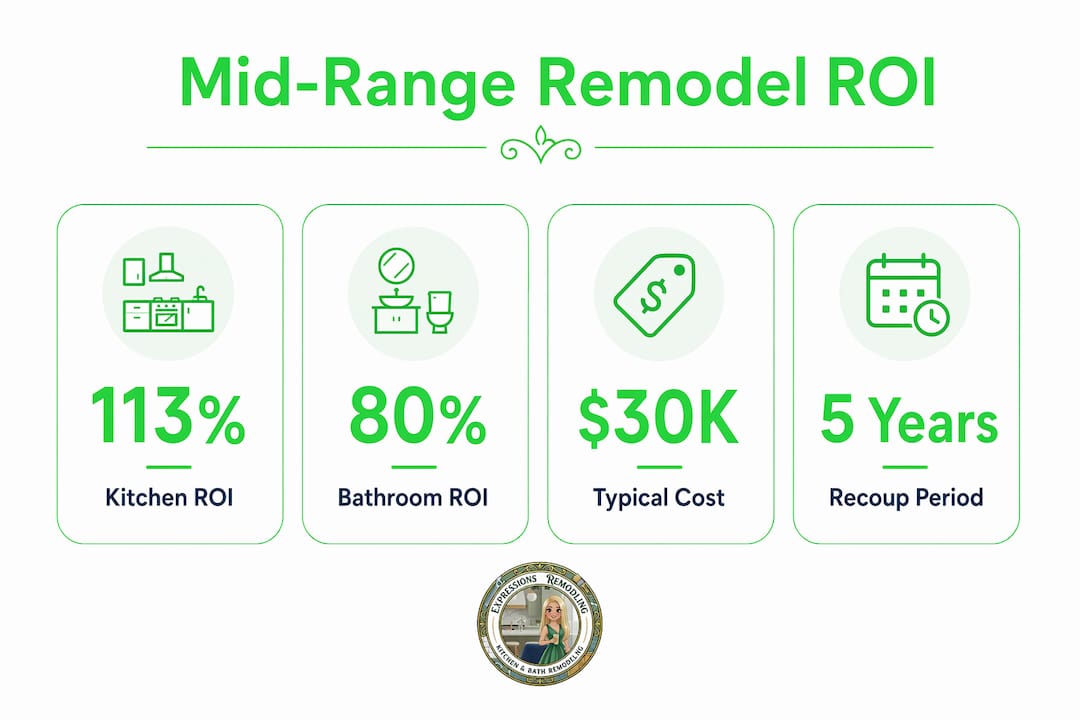
“Mid-range” is not just a price band. In Cost vs. Value methodology, midrange scope is defined by what you do NOT do: no walls moved, no plumbing or electrical relocated, no custom cabinetry, no luxury finishes. The moment you cross those lines, the project reclassifies into a higher tier and the recoup percentage typically drops because costs rise faster than resale value.
Kitchen mid-range examples:
- Cabinet refacing or replacement with stock or semi-custom cabinets
- Mid-tier appliances (not professional-grade)
- Laminate, butcher block, or entry-level quartz countertops
- New hardware, faucet, and lighting within the existing layout
Bathroom mid-range examples:
- New vanity, mirror, and lighting
- Tile surround replacement on the same plumbing footprint
- Standard fixtures and a new toilet
- Refreshed grout, caulk, and accessories
| Project Type | National Cost Range | Typical Recoup % |
|---|---|---|
| Minor kitchen remodel (midrange) | — | 96%–113% |
| Major kitchen remodel (midrange) | $45,000–$80,000 | Lower than minor scope |
| Full bathroom remodel (midrange) | — | 80% |
| Surface bathroom refresh | — | Varies by condition |
Regional labor and material costs shift these numbers by 15%–40% from the national average. A mid-range bathroom in St. Louis costs less than the same project in San Francisco, and the recoup percentage reflects local comparable sales, not a national formula.

Typical ROI ranges and the dollar math behind them
The JLC Cost vs. Value data gives the clearest national benchmarks. A minor mid-range kitchen remodel typically costs in the high tens of thousands and often returns resale value slightly exceeding cost. A mid-range bathroom remodel generally costs somewhat less and returns a lower but solid portion of its cost on resale.
HomeCostLab’s 2026 summary places the minor kitchen remodel near the top of all projects at approximately 96% ROI in their ranking table. The difference between 96% and 113% comes down to methodology and the data year each source draws from. Both figures confirm the same directional truth: minor mid-range kitchen refreshes are among the highest-returning projects you can do.
Worked example — kitchen:
A $30,000 minor mid-range kitchen remodel (new cabinet fronts, mid-tier counters, updated appliances and lighting) returns roughly $30,000–$34,000 in added resale value at the national average. Net cost after recoup: near zero to slightly positive.
Worked example — bathroom:
A $24,000 mid-range bathroom remodel (new vanity, tile surround, fixtures, same layout) returns roughly $19,200 at 80% recoup. Net out-of-pocket after recoup: about $4,800, plus the lifestyle and risk-reduction value during the time you own the home.
Zillow’s analysis confirms the bathroom national average near 80%, with Pacific region projects reaching roughly 91% and New England near 90.5%. If you are in a high-demand coastal market, your bathroom remodel is likely to perform above the national figure.
Why ROI numbers vary and the neighborhood ceiling risk
National averages are starting points, not guarantees. Several factors push your actual return above or below the published range.
- Local market demand: A hot seller’s market compresses buyer negotiating power, which means a turnkey kitchen commands a premium. A slow market narrows that gap.
- Neighborhood ceiling: The realistic top sale price for comparable homes on your block. Over-improving past neighborhood norms rarely increases sale price proportionally. A $60,000 kitchen in a neighborhood where top comps sell at $280,000 will not push your home to $340,000.
- Project scope creep: Adding a wall relocation or custom cabinetry mid-project moves you out of mid-range territory and into a tier where costs rise faster than returns.
- Timing and market cycle: Projects completed in a rising market capture more value than identical projects in a cooling one.
- Material and labor inflation: Regional labor trends change the cost side of the equation without changing the resale value side.
Pro Tip: Before approving any scope expansion, pull recent comparable sales in your immediate neighborhood. The ceiling those comps set is the single most important number in your ROI calculation.
How to interpret mid-range remodel ROI for your specific situation
National recoup percentages are averages. What matters is how they apply to your timeline and goals. Here is a simple decision framework:
- Selling within 12 months: Prioritize resale ROI. Choose neutral, turnkey finishes that appeal to the broadest buyer pool. Avoid personal style choices that narrow appeal. Focus on the items buyers notice first: counters, cabinet faces, fixtures, and lighting.
- Selling in one to five years: Balance resale and lifestyle ROI. You will enjoy the upgrade for a few years, so spending slightly more on durable materials or a finish you love makes sense, as long as you stay within mid-range scope.
- Staying long-term: Prioritize lifestyle ROI and durability. The recoup percentage matters less when you have 10-plus years before a sale. Choose materials and layouts that serve your daily life.
Scenario A (seller): A homeowner planning to list in eight months spends $28,000 on a minor kitchen refresh. At 113% recoup, the project adds roughly $31,600 in resale value, covering its cost and then some. The right call here is neutral finishes and a fast timeline.
Scenario B (stayer): A homeowner staying for 10 years spends $30,000 on a bathroom remodel with finishes they love. Even at 80% recoup, they recover $24,000 at sale while enjoying a better bathroom for a decade. The lifestyle ROI justifies the $6,000 gap.
Pro Tip: Talk to a local real estate agent before finalizing scope. They know which finishes buyers in your specific neighborhood expect and which upgrades are already priced into comparable sales.
Checklist: mid-range upgrades that reliably improve resale value
These are the items that consistently show up in high-ROI renovation data and buyer preference surveys. Each one earns its cost through broad appeal and visible impact.
Kitchen:
- Cabinet refacing or replacement with neutral-finish stock cabinets — buyers see cabinets first
- Quartz or granite countertops in white, gray, or warm neutral tones — perceived value is high relative to cost
- Updated hardware (pulls and knobs) — low cost, immediate visual refresh
- New faucet and under-mount sink — signals a cared-for kitchen without structural work
- Mid-tier appliances in a consistent finish — stainless remains the safest resale choice
- Recessed or pendant lighting — improves perceived size and modernity
Bathroom:
- New vanity with integrated sink — one of the highest-impact single purchases
- Tile surround replacement or re-grouting — dated tile is a buyer objection; fresh tile removes it
- Updated fixtures (faucet, showerhead, towel bars) — low cost, high perceived quality
- New toilet — buyers notice; a clean, efficient model signals move-in readiness
- Improved lighting and a new mirror — makes small bathrooms feel larger
Avoid when selling: Highly personal tile patterns, bold color choices, or luxury finishes that price above neighborhood norms. A $15,000 steam shower in a $250,000 neighborhood does not return its cost.
How to maximize ROI through budgeting and scope control
Good financial returns on a remodel come from discipline as much as design. Here is how to protect your return from the most common cost traps.
- Set a firm scope in writing before you sign anything. Scope creep is the primary driver of budget overruns. Every addition mid-project costs more than it would have at the start.
- Get three bids from local contractors. Not to find the cheapest option, but to understand the real price range and catch outliers. A bid that is 40% below the others usually signals something missing from the scope.
- Lock material selections early. Cabinet lead times of six to ten weeks are common. Delays push your project timeline and can affect a sale window.
- Budget a 10%–20% contingency. Hidden water damage, outdated wiring behind walls, and permit surprises are common. A contingency keeps them from derailing the project.
- Prioritize visible items. Buyers form impressions in the first 60 seconds. Counters, cabinet faces, and fixtures matter more than what is behind the walls.
- Vet your contractor’s portfolio for mid-range projects specifically. A contractor who specializes in luxury custom work may not be the right fit for a cost-conscious mid-range refresh. Ask to see comparable projects.
A design consultation before finalizing material selections can prevent costly mid-project changes and improve the functional layout of the finished space.
Pro Tip: Reserve $2,000–$4,000 for staging, touch-ups, and cosmetic fixes right before listing. Fresh paint, clean grout, and good staging photos often increase net proceeds more than a deeper upgrade would.
Typical timelines and cost drivers for mid-range projects
Planning around a sale date or a life event requires realistic timeline expectations. Mid-range projects move faster than full gut renovations, but they are not quick.
- Mid-range bathroom remodel: 3–6 weeks for construction, plus 2–4 weeks for material lead times if ordering a vanity or custom tile
- Minor mid-range kitchen remodel: 4–6 weeks for construction; cabinet delivery can add 6–10 weeks if ordering new boxes rather than refacing
- Mid-range kitchen with new cabinets: 6–10 weeks total from order to completion in most markets
Primary cost drivers in order of impact: labor, cabinets, countertops, plumbing and electrical (even minor work), permits, and finish materials. Regional labor inflation has pushed costs up in most U.S. metros over the past two years, so national cost bands from older reports may understate current local pricing by 10%–20%.
Pro Tip: Build cabinet and appliance lead times into your schedule before you set a listing date. A six-week cabinet delay in a project planned around a spring listing can push you into a slower summer market.
A mid-range project from Expressions Remodeling: how ROI played out
Expressions Remodeling completed a mid-range kitchen refresh for a St. Louis homeowner preparing to list within 12 months. The project stayed within a strict mid-range scope: cabinet refacing with a neutral white finish, new quartz countertops, updated hardware, a new faucet and sink, and recessed lighting. No walls moved. No appliances replaced. Total project cost landed in the $28,000–$32,000 range.
Key decisions that preserved ROI:
- Refacing rather than replacing cabinets saved roughly $8,000–$12,000 versus new boxes while delivering the same visual result
- Neutral quartz countertops in a light gray tone appealed to the broadest buyer pool in the neighborhood’s price range
- Contingency covered a small section of subflooring that needed repair once old flooring was removed
The neighborhood ceiling informed every scope decision. Comparable homes in the area were selling in the $310,000–$340,000 range. The team advised against upgrading appliances to professional-grade, which would have added $6,000–$8,000 without moving the sale price in that comp band.
The most valuable thing a local contractor brings to a mid-range project is knowing where the neighborhood ceiling sits before the first dollar is spent. Scope decisions made without that context are where homeowners leave money on the table.
Expressions Remodeling offers a no-pressure local consult for St. Louis homeowners who want to validate scope and budget before committing to a project.
How mid-range ROI compares to other remodeling tiers
Mid-range projects consistently outperform upscale remodels on percentage recouped, and the reason is straightforward: cost rises faster than resale value as scope increases. Major upscale kitchen remodels can cost $80,000–$150,000 and return roughly 40%–51% at resale. A minor mid-range kitchen at $28,000–$45,000 returns 96%–113%. The buyer pays for what they can see and what meets their expectations for the neighborhood, not for the premium materials hidden inside the walls.
Basic or cosmetic-only refreshes (paint, hardware, minor fixture swaps under $10,000) can deliver high percentage returns but add less absolute dollar value because the base is so small. They are useful for risk reduction and days-on-market improvement but rarely move an appraisal significantly.
The sweet spot for most homeowners is mid-range: enough visible improvement to meet buyer expectations and command a competitive price, without the cost escalation that drags upscale projects into sub-50% recoup territory. Resale-focused remodeling works best when scope matches the neighborhood, not the homeowner’s wish list.
Key Takeaways
Mid-range remodel ROI consistently outperforms upscale tiers because cost stays controlled while visible value meets buyer expectations.
| Point | Details |
|---|---|
| Mid-range kitchen leads all projects | A minor mid-range kitchen remodel returns 113% nationally per JLC Cost vs. Value data. |
| Bathroom recoup is solid but lower | Mid-range bathroom remodels return roughly 80% nationally, with regional peaks near 91%. |
| Neighborhood ceiling controls upside | Over-improving past comparable sales rarely increases sale price proportionally. |
| Timeline planning prevents lost value | Cabinet lead times of 6–10 weeks must be built into any schedule tied to a listing date. |
| Expressions Remodeling | Offers St. Louis homeowners a local consult to validate scope, budget, and neighborhood ceiling before committing. |
A local remodeler’s perspective on mid-range ROI
What the national data does not capture is how much local buyer expectations shape the return. In St. Louis, buyers in the $280,000–$380,000 price range expect a kitchen and bathroom that look clean, functional, and move-in ready. They are not expecting custom cabinetry or imported tile. They are expecting nothing to be broken, dated, or embarrassing. That is exactly the gap mid-range remodeling fills.
The projects that deliver the best returns here are the ones where the homeowner resisted the urge to upgrade everything. Refaced cabinets with new hardware and a fresh quartz counter photograph beautifully and satisfy buyers completely. Adding a $12,000 appliance package on top of that rarely moves the needle on sale price in most St. Louis neighborhoods.
Permits and inspector expectations matter too. St. Louis County requires permits for electrical and plumbing work even in mid-range scopes, and inspectors do flag unpermitted work during buyer inspections. Budget for permits upfront and factor in the two-to-three-week approval window. Unexpected costs most commonly come from water damage behind tile and outdated electrical panels that need upgrading to pass inspection.
Expressions Remodeling can help you plan a mid-range project with confidence
Knowing the national averages is useful. Knowing what those numbers mean for your specific home, neighborhood, and timeline is what actually drives a good decision.
Expressions Remodeling works with St. Louis homeowners through a site visit, 3D design visualization, and a detailed budget estimate before any contract is signed. That process lets you see the finished project, validate the scope against your neighborhood ceiling, and confirm the numbers make sense for your goals. Whether you are planning a kitchen upgrade before listing or a bathroom remodel you will enjoy for years, the consult gives you a clear picture of cost, timeline, and realistic return. Request your consult at Expressions Remodeling’s pricing and design page to get started.
Primary sources and further reading
The figures and recommendations in this article draw from the following sources. Each covers a different dimension of the ROI picture.
- Journal of Light Construction — Cost vs. Value 2025: The primary dataset for project-level recoup percentages. Use it for national benchmarks on specific project types.
- HomeCostLab 2026 Cost vs. Value Summary: Ranks projects by ROI and explains midrange scope methodology. Useful for comparing project tiers.
- Zillow — ROI for a Bathroom Remodel: Covers regional variation in bathroom ROI and explains why Pacific and New England markets outperform the national average.
- Zillow — Kitchen Remodel ROI: Explains why strategic mid-range updates outperform expensive customized remodels on percentage recoup.
- RemodelFinder — Bathroom Remodel Cost 2026: Provides national cost bands, regional multipliers, and ROI commentary for mid-range bathroom projects.
- Hammerio — Kitchen Remodel Cost and Design: Covers how professional design consultation improves functional ROI and layout efficiency.
How to use these sources: Start with JLC and HomeCostLab for national benchmarks, then check Zillow for regional context, then verify local comparable sales with a real estate agent. National averages are a floor and ceiling estimate, not a prediction for your specific home.