

A renovation budget is a structured financial plan that defines how much you will spend, on what, and in what order across every phase of your home improvement project. Without one, most projects run over cost before the drywall goes up. The good news: setting a renovation budget follows a clear, repeatable process. This homeowner guide covers the cost structures, step-by-step planning methods, and tracking habits that keep projects on track. Whether you are planning a kitchen overhaul, a bathroom refresh, or a full basement finish, the same core principles apply.
What key factors influence renovation costs and budget planning?
Renovation costs fall into two categories: hard costs and soft costs. Hard costs cover materials and labor. Soft costs cover permits, design fees, inspections, and temporary housing if needed. Understanding both categories prevents the most common budget shock: assuming the quote from a contractor covers everything.

Labor alone runs about 65% of a typical renovation budget. That figure surprises most homeowners who focus on material costs when shopping. Hard costs as a whole represent 70–80% of the total budget, leaving soft costs at 20–30%.
Room-specific spending limits protect your home’s resale value. Industry guidelines cap total renovation spending at 30% of your home’s current market value. Within that ceiling, the recommended allocations by room are:
- Kitchens and finished basements: 10–15% of home value
- Primary bathrooms: up to 10% of home value
- Half-baths: up to 5% of home value
- Other rooms: 1–3% of home value
These percentages exist to prevent over-improving. A $50,000 kitchen in a $200,000 home rarely returns full value at resale.
Contingency funds are not optional. Newer homes need a 10–15% contingency buffer on top of the project total. Older homes require 20–30% because hidden problems like asbestos, knob-and-tube wiring, and rot are common discoveries once walls open. Skipping the contingency is the single fastest way to stall a project mid-build.
Pro Tip: Get your home appraised before finalizing your renovation budget. Knowing your current market value lets you apply the 30% cap accurately and avoid over-investing in a neighborhood where values have a ceiling.
How to set your renovation budget step by step
A structured approach to renovation cost planning removes guesswork and protects your finances. Follow these steps before signing any contract.
-
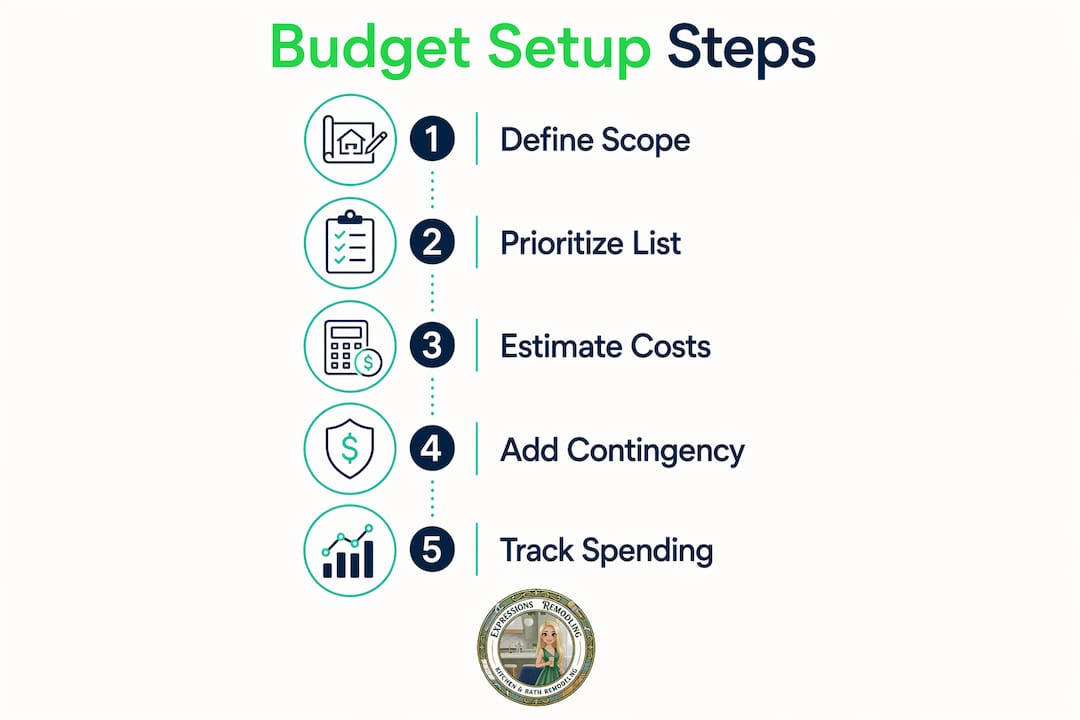
Define your goals and rank them. Separate your renovation needs into three tiers: structural (foundation, roof, plumbing, electrical), functional (layout changes, storage, accessibility), and cosmetic (finishes, fixtures, paint). Fund structural work first. Cosmetic upgrades come last.
-
Research local costs with multiple bids. Get at least three written quotes from licensed contractors in your area. Bids vary widely, and the lowest number is rarely the full picture. Ask each contractor to break out labor, materials, permits, and disposal separately so you can compare line by line.
-
Build your budget from scope, not price per square foot. Realistic budgets start with scope, finish level, and contingency. Price per square foot is a rough screening tool, not a planning number. A mid-range kitchen finish costs very differently than a high-end one, even in the same square footage.
-
Allocate budget proportions by category. Once you have contractor bids, assign percentages to each project category: structure, systems (HVAC, plumbing, electrical), finishes, fixtures, and soft costs. This allocation map shows you immediately where the money goes and where you can adjust.
-
Set your contingency and savings target. Add 10–20% to your total project estimate as a contingency line. Then set a savings goal with a target date. If you plan to finance part of the project, confirm your loan terms before committing to a contractor start date.
-
Understand payment timing. Structured budgets track payment timing against project milestones. Never pay more than 10–15% upfront. Tie each payment to a completed phase: framing, rough-in, drywall, finish work. Retain 5–10% of the contract value until final inspection and all lien waivers are signed.
A good resource for balancing style and budget during the planning phase can help you prioritize without sacrificing the look you want.
Pro Tip: Create a “wish list” and a “must-have list” before your first contractor meeting. Contractors can then price both scenarios, giving you a clear picture of what each upgrade actually costs.
How to track and manage your renovation budget throughout the project
Budget control does not end when you sign the contract. Active tracking throughout the build is what separates projects that finish on budget from those that spiral.
The most effective tracking method is a live spreadsheet with three columns for every line item: estimated cost, actual invoice, and variance. Update it as change orders occur so you always know your real remaining balance. Spreadsheet tools like Google Sheets or Microsoft Excel work well for this. The key is updating the file every time a new invoice arrives, not at the end of the month.
Change orders are the primary budget killer. Every change to the original scope, no matter how small, must be written, priced, and approved before work begins. Small untracked changes exhaust budgets through what financial experts call “death by a thousand cuts.” A $200 upgrade here and a $350 fixture swap there add up to thousands before you realize the contingency is gone.
Follow the correct project sequence to avoid expensive rework. The proven order is: design freeze, permits, build phases, inspections, and closeout. Performing tasks out of sequence significantly increases costs because work gets undone and redone. Freeze your design choices completely before demolition starts.
Key budget management habits to build into every project:
- Review invoices against the original bid line by line before paying.
- Log every verbal agreement in writing within 24 hours.
- Track upgrade decisions in a separate “upgrades log” to see cumulative impact.
- Set a personal spending freeze rule: no new upgrades once the contingency drops below 5%.
- Retain 5–10% of the contract value until final inspection and lien waivers are complete.
Pro Tip: Schedule a weekly 15-minute budget review with your contractor during active construction. Catching a $500 variance early is far easier than reconciling a $5,000 gap at project closeout.
Common budgeting mistakes homeowners make and how to avoid them
Most renovation budgets fail for predictable reasons. Knowing them in advance puts you ahead of the majority of homeowners who learn these lessons the hard way.
-
Starting with a price target instead of a scope. Setting a dollar figure before defining what the project includes leads to scope cuts mid-build. Define the full scope first, then price it. If the number is too high, reduce scope deliberately rather than hoping costs will come in lower.
-
Ignoring soft costs. Permits, design fees, structural engineering reports, waste disposal, and temporary storage are real costs. They are not included in most contractor quotes. Budget 20–30% of your total for soft costs and supporting expenses.
-
Spending on cosmetics before structure. Homeowners frequently overspend on cosmetic upgrades while skipping structural and efficiency improvements that add more long-term value. New cabinet hardware does not matter if the subfloor beneath the kitchen is rotting.
-
Skipping the contingency fund. A contingency is not a sign of poor planning. It is the financial tool that keeps a project moving when the unexpected happens. Without it, a single surprise, like discovering mold behind a wall, can halt the entire project.
-
Underestimating older home risks. Homes built before 1980 carry a higher probability of hidden problems. Budget accordingly with a 20–30% contingency and prioritize invisible investments like updated wiring and insulation before visible finishes.
“Realistic budgets start with scope, finish level, and contingency. Relying on price per square foot alone sets homeowners up to underestimate costs from the start.”
— Mike Mroz, remodeling industry expert
Reviewing common basement renovation mistakes offers a concrete example of how these errors play out in one of the most budget-sensitive spaces in any home.
Key Takeaways
A renovation budget built on scope, contingency, and milestone-based payments is the most reliable way to finish a project on time and within your financial limits.
| Point | Details |
|---|---|
| Cap total spending at 30% of home value | Exceeding this threshold reduces your return at resale, regardless of finish quality. |
| Labor drives most of your budget | Labor alone accounts for about 65% of hard costs, so get itemized bids before committing. |
| Contingency is non-negotiable | Set aside 10–20% for newer homes and 20–30% for older homes to cover hidden surprises. |
| Track every change order in writing | Untracked changes are the leading cause of budget overruns on otherwise well-planned projects. |
| Fund structure before cosmetics | Structural and efficiency upgrades deliver more long-term value than cosmetic finishes. |
What I’ve learned about renovation budgets after years in the field
The homeowners who finish renovations without financial stress share one habit: they make all their decisions before demolition starts. Not most decisions. All of them. Finishes, fixtures, layout, appliances. Once the walls are open, every change costs two to three times what it would have cost on paper.
The second thing I have seen consistently is that homeowners underestimate how much they will want to upgrade once the project is underway. You pick a mid-range tile, then you see the premium version installed in the showroom and the math starts to feel flexible. It is not. Set a substitution rule before you start: any upgrade must be offset by a cut elsewhere in the budget. That rule alone has saved more projects than any spreadsheet.
Working with a contractor who gives you full cost transparency from day one changes the entire experience. When you can see how the remodeling process works at each phase, you make better decisions and spend less time second-guessing. The budget becomes a tool you use, not a number you dread.
My honest opinion: most homeowners treat the contingency as money they hope not to spend. Treat it as money you plan to spend. If you do not use it, you finish under budget. That mindset shift removes the anxiety that derails projects when the first surprise appears.
— Kierin
Expressions Remodeling can help you plan and build with confidence
Budgeting for a renovation is one thing. Executing it with a team that respects your numbers is another. Expressions Remodeling works with St. Louis homeowners on kitchens, bathrooms, and basements with full cost transparency from the first consultation. Every project starts with a clear scope, a detailed estimate, and a complimentary 3D design so you can see exactly what you are paying for before any work begins.
Whether you are planning affordable kitchen upgrades or a full bathroom remodel, Expressions Remodeling builds projects that match your vision and your budget. Explore the full range of remodeling services and request a consultation to get started with a team that treats your budget as seriously as you do.
FAQ
What is a safe renovation budget as a percentage of home value?
Industry guidelines cap total renovation spending at 30% of your home’s current market value. Kitchens and finished basements typically receive 10–15%, while primary bathrooms receive up to 10%.
How much contingency should I add to my renovation budget?
Add 10–20% for newer homes and 20–30% for older homes built before 1980. Hidden issues like outdated wiring, asbestos, and structural rot are common discoveries once renovation work begins.
What is the biggest mistake homeowners make when budgeting for renovations?
Starting with a price target instead of a defined scope is the most common error. Budgets built around scope, finish level, and contingency are far more accurate than those built around a dollar figure alone.
How do I prevent renovation costs from going over budget?
Document every change order in writing and require approval before work begins. Track estimated costs against actual invoices in a live spreadsheet and update it every time a new invoice arrives.
Should I pay for structural upgrades before cosmetic ones?
Structural integrity and energy efficiency upgrades deliver more long-term value and should always be funded before cosmetic finishes. Spending on visible upgrades while ignoring hidden systems is one of the most common and costly renovation errors.