
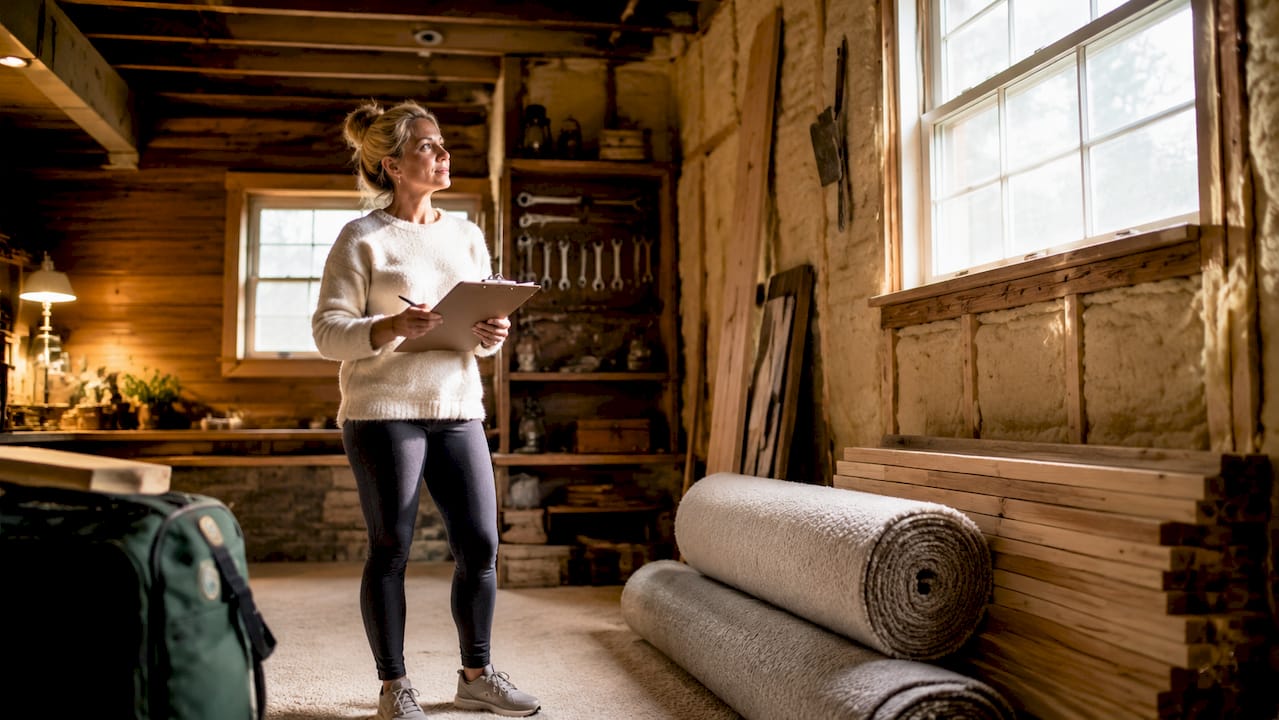
Finishing your basement increases home equity by converting raw, unused space into livable square footage that appraisers count and buyers want. The 2025 Cost vs. Value Report shows that basement finishing recoups about 71% of its cost at resale, adding roughly $35,000 in value on a $50,000 project. That return comes from a simple principle: more functional square footage means a higher appraised value and a broader pool of buyers. Features like legal bedrooms, full bathrooms, and proper egress windows push that number even higher. Understanding why basement finishing increases equity gives you a real advantage when planning your renovation budget.
Why basement finishing increases equity: the core mechanics
Finished basements add value in two distinct ways. The first is square footage. The second is functionality. Both matter to appraisers and buyers, but they work differently.
Appraisers count finished basement square footage separately from above-grade living space. Below-grade finished space typically appraises at a 30–50% discount per square foot compared to above-grade rooms. That discount sounds discouraging, but it does not erase the value. A 1,000-square-foot finished basement still adds meaningful dollars to your appraisal, especially when it includes amenities that appraisers treat as separate line items.

Walk-out basements receive a smaller discount of 10–30% because they feel more like above-grade space. Natural light, exterior access, and full-height ceilings all reduce the appraisal penalty. If your basement has a walk-out configuration, your equity gain from finishing it will be proportionally larger.
Legal bedrooms and bathrooms are the biggest individual value drivers. Appraisers treat these as separate amenities that push comparable sales upward, not just as extra square footage. A finished basement with a bedroom and a full bath gives your home an additional bedroom count, which directly affects which comparable sales an appraiser uses to value your property.
- Egress windows make a basement bedroom legal under most building codes. Without one, the room cannot be listed as a bedroom.
- Full bathrooms add the most dollar-for-dollar value of any single basement feature.
- Open layouts with good lighting attract the widest buyer pool and reduce time on market.
- Separate exterior access increases rental potential and buyer appeal simultaneously.
Pro Tip: If your basement already has a walk-out door or large windows, prioritize finishing it first. You will recover a larger share of your renovation cost than a fully below-grade basement would return.
How much does it cost, and what is the actual ROI?
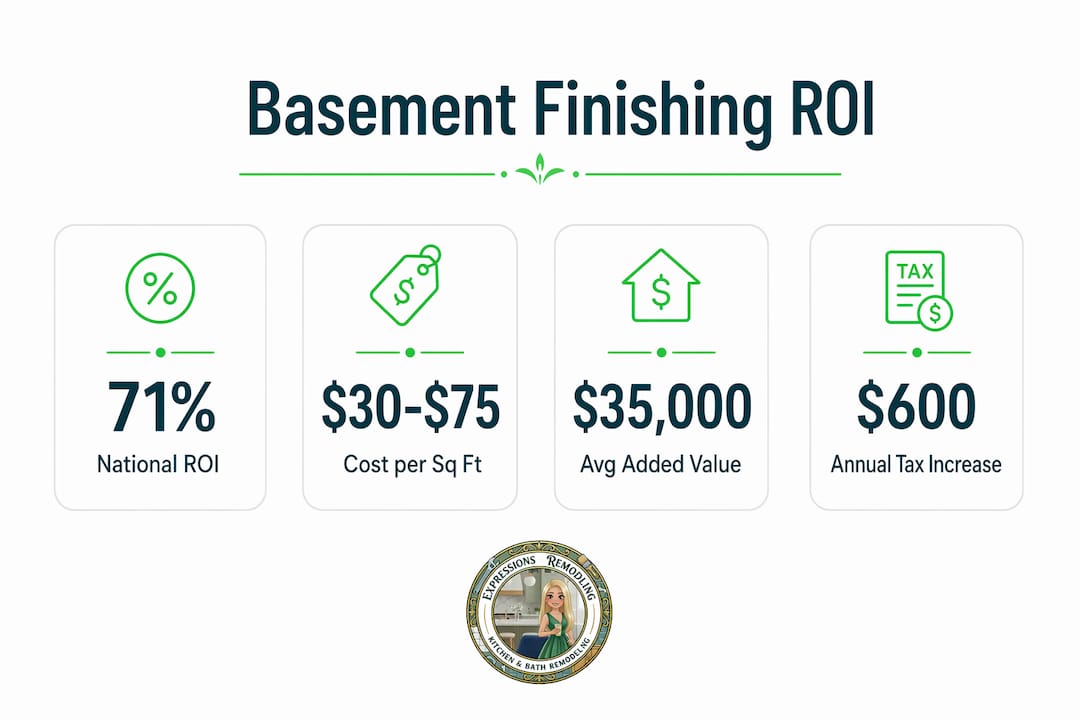
Cost is the most practical starting point for any homeowner. Finishing a basement costs $30–$75 per square foot nationally, with a typical mid-range project running $35,000–$55,000. Compare that to above-grade additions, which run $150–$400 per square foot. The cost gap is significant. You get more livable space per dollar spent by finishing a basement than by building an addition.
The national average return on investment sits around 71%, but that number varies by market. Some markets return as little as 50% while others return up to 86%. The variation comes down to buyer expectations.
| Market condition | Typical ROI range | Key driver |
|---|---|---|
| Finished basements are common locally | 75–86% | Buyers expect it; unfinished is a disadvantage |
| Mixed market with some finished basements | 65–75% | Neutral expectation; quality of finish matters most |
| Finished basements are rare locally | 50–65% | Buyers may not value the feature as highly |
| Walk-out or daylight basement | Higher end of range | Smaller appraisal discount boosts net value |
In markets where finished basements are the norm, leaving yours unfinished actively hurts your sale price. Buyers compare your home to finished competitors and discount their offers accordingly. Finishing becomes a defensive move as much as a value-add.
Property taxes are a real consideration. A $53,000 remodel that adds $40,000 in assessed value produces roughly $600 per year in additional property taxes. That is a manageable cost relative to the equity gained, but you should factor it into your long-term math.
Pro Tip: Get a pre-renovation appraisal if you are unsure how much your local market values finished basement space. A licensed appraiser can tell you the expected value increase before you spend a dollar on construction.
What renovation features maximize your equity gain?
Not every basement upgrade delivers equal returns. The features that maximize equity share one trait: they serve the broadest possible buyer pool.
Adding a code-compliant bedroom with an egress window and a full bathroom delivers the highest ROI of any basement upgrade. Basement bathroom projects typically cost $15,000–$25,000 and command 20–30% higher sales premiums on the finished space. That is a strong return for a single feature.
Moisture management is the most critical non-negotiable. Failure to address dampness before finishing causes mold and structural damage, which negates every dollar you spent and triggers buyer objections during inspection. Professional waterproofing and drainage are not optional upgrades. They are the foundation of a basement finish that holds its value.
Here is the priority order for features that protect and grow your equity:
- Moisture control and waterproofing. Address this before framing a single wall.
- Egress windows. Required for legal bedrooms and important for emergency exit compliance.
- Full bathroom rough-in. Even a rough-in adds value if a full bath is not in the budget now.
- Proper HVAC extension. Appraisers discount space that lacks adequate heating and cooling.
- Closet in any bedroom. Most codes require a closet for a room to qualify as a bedroom.
Permits are not optional either. Building permits are legally required for finished basements to count in official living space appraisals. Unpermitted work risks appraisal exclusion and buyer financing issues. A buyer’s lender may refuse to finance a home with unpermitted improvements, which can kill a sale entirely.
Neutral, functional designs with good lighting and open layouts attract the broadest buyer pool and deliver better ROI than niche uses like home theaters or gyms. Over-customization narrows your buyer pool. A finished basement that works as a family room, a guest suite, or a home office appeals to far more buyers than a dedicated sports bar or recording studio.
Pro Tip: Keep your basement palette neutral: gray or beige LVP flooring, white or light gray walls, and recessed lighting. These choices cost no more than bold alternatives and appeal to nearly every buyer.
How does basement finishing fit into your overall renovation strategy?
Basement finishing ranks in the mid-tier of renovation projects by ROI. Kitchen remodels and exterior improvements like new garage doors or siding often return a higher percentage of cost. But basement finishing offers something those projects do not: it creates entirely new livable square footage rather than upgrading existing space.
That distinction matters when you are thinking about resale. Buyers compare homes partly on price per square foot. A finished basement increases your total square footage, which can make your home look competitively priced even at a higher asking price.
“A finished basement does not just add value to your home. It changes the category of buyer who will consider it. Families who need a guest room, a playroom, or a home office suddenly see your home as a match. That expanded buyer pool is what drives faster sales and stronger offers.”
Staging your finished basement matters as much as the renovation itself. A well-lit, furnished basement photograph in your listing signals livable space, not storage. Buyers who tour a finished basement in person are far more likely to make strong offers than those who see an unfinished space and mentally calculate what it would cost them to finish it.
Financing the renovation through a home equity line of credit or a cash-out refinance is a common approach. The key is to finish the project before listing, not during. Buyers discount homes with active construction, and lenders may not appraise mid-project work at full value. You can explore budget-friendly finishing approaches that keep costs controlled without sacrificing the features that drive equity.
The tax implication is worth repeating: the annual property tax increase from a finished basement is typically modest relative to the equity gain. A $600 annual tax increase on $40,000 in added value represents a strong trade-off for most homeowners.
Key Takeaways
Finishing a basement increases equity because it adds livable square footage, legal bedrooms, and bathrooms that appraisers and buyers value directly, typically returning about 71% of renovation costs at resale.
| Point | Details |
|---|---|
| ROI averages 71% nationally | A $50,000 project adds roughly $35,000 in resale value based on 2025 Cost vs. Value data. |
| Permits are non-negotiable | Unpermitted basement work is excluded from appraisals and can block buyer financing. |
| Bathrooms and bedrooms lead ROI | Adding a code-compliant bedroom and full bath commands 20–30% higher sales premiums. |
| Moisture control comes first | Skipping waterproofing risks mold and structural damage that wipes out all added value. |
| Market conditions shape your return | In areas where finished basements are standard, leaving yours unfinished lowers your sale price. |
What I have learned after watching dozens of basement projects play out
After seeing many basement renovations from planning through resale, one pattern stands out clearly. Homeowners who treat the basement as a financial asset from day one make better decisions than those who treat it as a personal project.
The biggest mistake I see is skipping permits to save time or money. That decision costs far more at resale than the permit fees ever would have. Appraisers cannot count unpermitted space, and buyers’ agents flag it immediately. The second most common mistake is over-personalizing. A $30,000 home theater is a great room for the current owner and a liability for the next buyer.
The homeowners who get the best return finish their basements with neutral materials, proper permits, moisture control, and at least one bathroom. They do it at least 12 months before they plan to sell, so the improvement shows up in their property record and in their listing photos. Timing matters more than most people realize.
Documentation is the final piece most homeowners overlook. Keep every permit, every inspection report, and every contractor invoice. When your appraiser or buyer’s agent asks for proof that the work was done correctly, you want a complete paper trail. That documentation is what converts a finished basement from a renovation into a verified equity asset.
— Kierin
Expressions Remodeling can help you finish your basement the right way
Finishing a basement the right way requires more than drywall and flooring. It requires code compliance, moisture management, and design choices that hold their value at resale.
Expressions Remodeling works with St. Louis homeowners to plan and execute basement finishing projects that meet building codes, pass inspections, and deliver real equity gains. Every project includes a complimentary 3D design consultation so you can see the finished space before construction begins. The team focuses on functional, neutral designs that appeal to the broadest buyer pool, not just the current homeowner’s preferences. If you are ready to turn your unfinished basement into a documented, appraised asset, contact Expressions Remodeling to schedule your free consultation.
FAQ
How much equity does finishing a basement add?
Finishing a basement adds roughly $35,000 in resale value on a $50,000 project, based on the 2025 Cost vs. Value Report. The national average return is about 71% of the renovation cost.
Does a finished basement count as living space?
A finished basement counts as living space for appraisal purposes only when it has proper permits and passes required inspections. Appraisers list it separately from above-grade square footage and apply a per-square-foot discount.
What basement features increase home value the most?
A code-compliant bedroom with an egress window and a full bathroom deliver the highest ROI of any basement features. These additions can command 20–30% higher sales premiums on the finished space.
Do I need a permit to finish my basement?
Yes. Building permits are legally required for finished basement space to be included in your home’s official appraisal. Unpermitted work is excluded from appraisals and can create financing problems for buyers.
Does finishing a basement increase property taxes?
Finishing a basement typically raises your property tax assessment, but the increase is usually modest. A $53,000 remodel that adds $40,000 in assessed value produces approximately $600 per year in additional taxes, which is a manageable cost relative to the equity gained.
Recommended
- Maximize Your Home’s Value with Budget-Friendly Basement Finishing – Expressions Remodeling
- Elevate Your Home: Affordable Basement Finishing Tips – Expressions Remodeling
- Basement Finishing Ideas That Turn Underused Space Into the Best Room in the House – Expressions Remodeling
- Basement Finishing Best Practices: Your 2026 Guide